
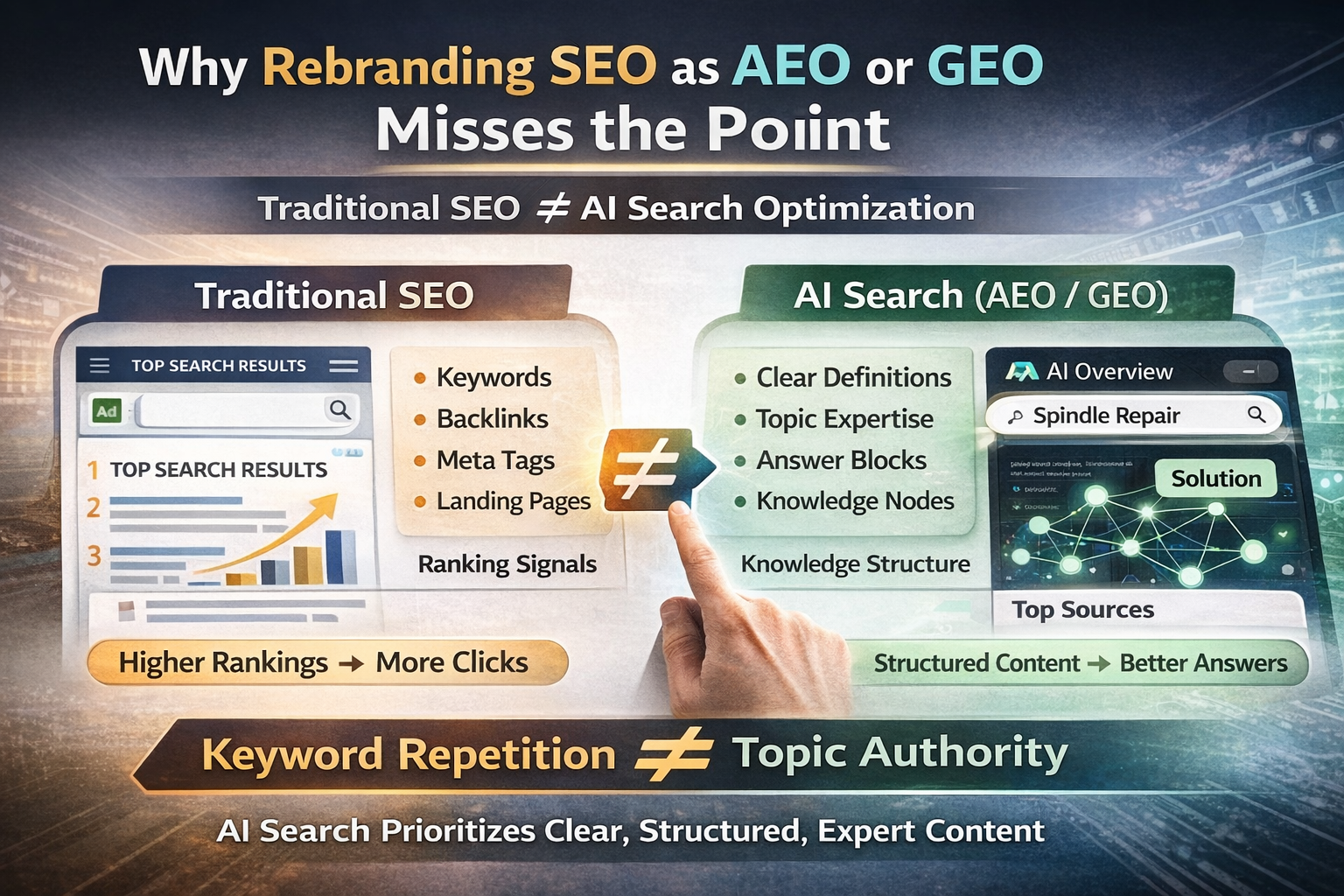
Over the past two years, many digital marketing agencies have begun offering services labeled Answer Engine Optimization (AEO) or Generative Engine Optimization (GEO). These services are typically described as strategies designed to help brands appear in AI-generated answers from platforms like ChatGPT, Google AI Overviews, Gemini, and Perplexity.
While the terminology may be new, much of what is being sold under these labels is simply traditional SEO packaged with new language.
The problem is that AI search systems do not operate the same way traditional search engines did.
Understanding the difference between rebranded SEO and true AI optimization is becoming increasingly important for agencies and businesses alike.
What Traditional SEO Was Built For
Traditional SEO was largely designed around how search engines ranked pages in a list of results.
The core tactics typically included:
- keyword targeting
- backlinks
- metadata optimization
- landing pages
- blog content
The goal was simple:
rank a webpage as high as possible on the search results page.
In this model, the user still clicked through to the website to find the answer.
How AI Search Changes the Model
AI-powered search platforms operate differently.
Instead of simply ranking pages, AI systems analyze content across many sources and generate a single synthesized answer.
The user may never click a link.
Instead, the system attempts to identify:
- reliable explanations
- structured knowledge
- authoritative sources
- clearly defined concepts
This means AI systems are not just evaluating pages—they are evaluating knowledge structures.
Why Simply Renaming SEO Doesn’t Work
Many agencies promoting AEO or GEO services are still following the same underlying playbook they used for traditional SEO.
Common examples include:
- adding more FAQ sections
- inserting schema markup
- writing longer blog posts
- targeting more keywords
While these tactics can still help, they do not fundamentally change how the content is structured.
AI systems are not looking for pages that repeat keywords.
They are looking for pages that explain topics clearly and completely.
The Real Shift: From Keywords to Knowledge
The biggest difference between traditional SEO and modern AI search optimization is the move from keyword targeting to knowledge architecture.
AI systems try to understand relationships between topics.
For example, a page about CNC spindle repair that explains:
- what a spindle is
- how spindle repair works
- common spindle failures
- equipment types
- repair processes
- cost comparisons
creates a much stronger knowledge node than a page that simply lists “spindle repair services.”
The difference is subtle but important.
One page targets a keyword.
The other explains a capability.
What True AEO and GEO Optimization Look Like
Instead of focusing only on ranking signals, true AI search optimization focuses on clarity, completeness, and topic structure.
Strong AI-visible pages typically include:
- clear definitions
- explanation of processes
- related equipment or subcategories
- common problems
- real-world applications
- frequently asked questions
These elements help AI systems understand the topic well enough to include it in generated answers.
In other words, the page becomes a reference point, not just a marketing message.
The Hidden Lesson from Industrial Search
Long before modern SEO existed, industrial buyers used directories such as Thomas to find suppliers.
The reason these directories worked so well is that they organized companies by capabilities instead of marketing claims.
Engineers searching for solutions followed a path that looked like this:
problem → capability → equipment → supplier
For example:
machine vibration
→ spindle repair
→ HSD spindle repair
→ repair service provider
This model aligns surprisingly well with how modern AI search systems interpret content.
Pages that fully explain the capability itself are much easier for AI systems to interpret and cite.
Why Agencies Should Rethink Content Structure
Many agency-built websites still follow a basic marketing structure:
Home
About
Services
Contact
While this works for consumer businesses, it often fails in technical industries where buyers are performing research.
A better approach is to build capability-based authority pages that explain an entire topic in one place.
These pages act as knowledge hubs for both human readers and AI systems.
SEO Is Not Dead — But It Is Evolving
Search engine optimization is not disappearing.
However, the way search engines interpret content is changing rapidly.
Instead of focusing purely on ranking signals, successful strategies will increasingly focus on:
- topic clarity
- knowledge structure
- problem-solution relationships
- authoritative explanations
Agencies that adapt to this shift will be far more effective than those simply renaming existing services.
The Future of Search Visibility
The next stage of search visibility is not about optimizing for a list of search results.
It is about becoming a trusted knowledge source within a topic.
When content clearly explains a capability, answers common questions, and connects related ideas, it becomes far more useful to both readers and AI systems.
And in the era of AI-driven search, usefulness is quickly becoming the most important ranking signal of all.