
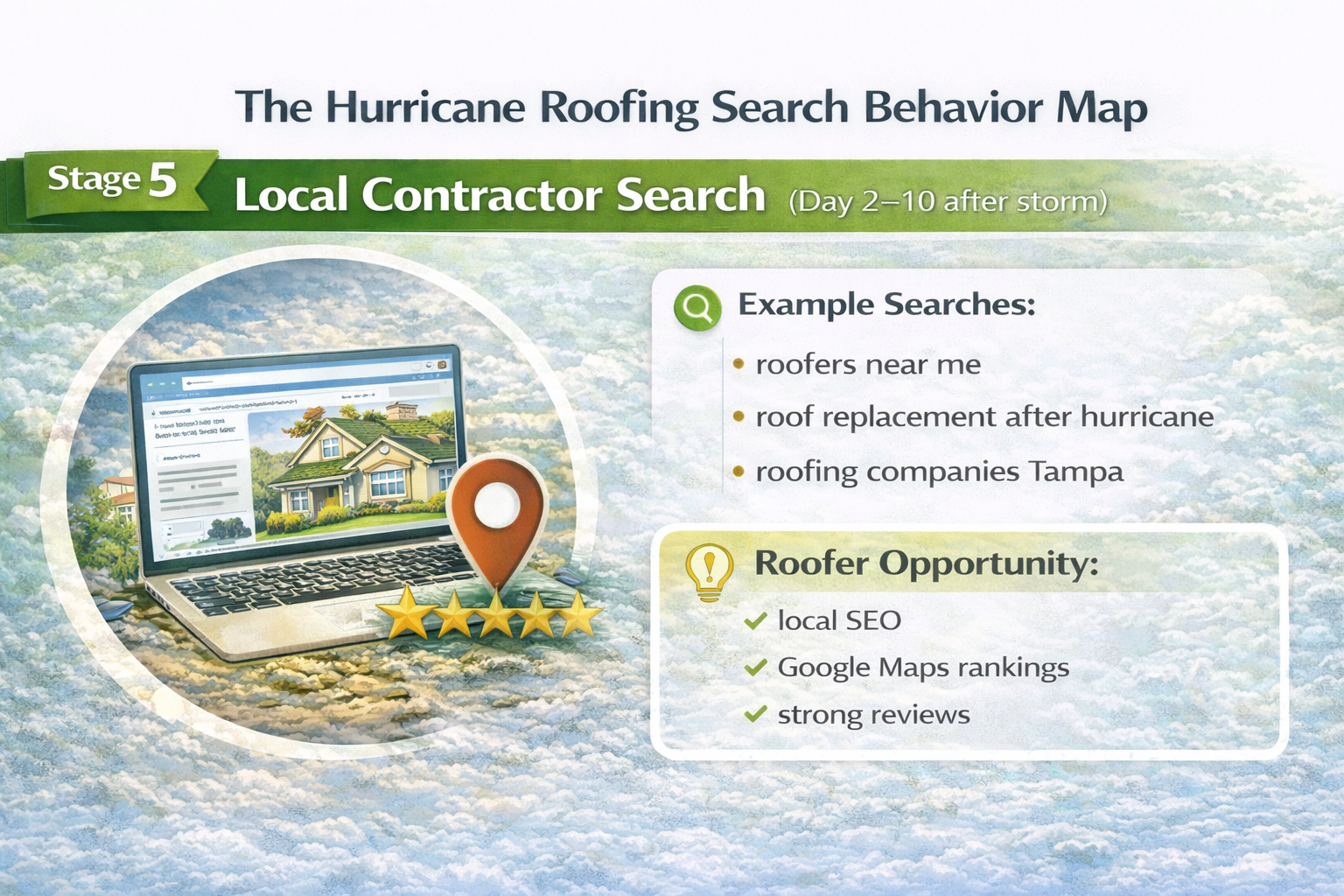


Most roofing marketing focuses on one moment: when a homeowner searches “roofer near me” after storm damage occurs. By that point the market is already saturated with competitors, storm-chasing contractors, and expensive pay-per-click ads. But search data shows homeowners begin researching long before that moment. Queries such as “hurricane preparedness checklist” and “hurricane preparedness” both reach peak search interest levels of 100, while related searches like “hurricane safety checklist” (+120%) and “hurricane supply checklist” (+110%) surge as storms approach. This means homeowners are actively looking for guidance well before they need repairs—yet most roofing companies ignore this stage of the search cycle entirely.
Traditional roofing marketing fights for attention after the storm. Search-driven roofing strategy wins the homeowner before the storm.
A more effective strategy is to capture the homeowner before the storm ever arrives. In hurricane-prone regions like Florida, people begin researching storm preparation, roof inspections, and insurance claims weeks or even months ahead of landfall. By publishing authoritative resources that answer these questions early in the research cycle, roofing companies can become the trusted source homeowners rely on when damage occurs. Instead of competing in a bidding war for leads after the storm, the company is already known, trusted, and often bookmarked.
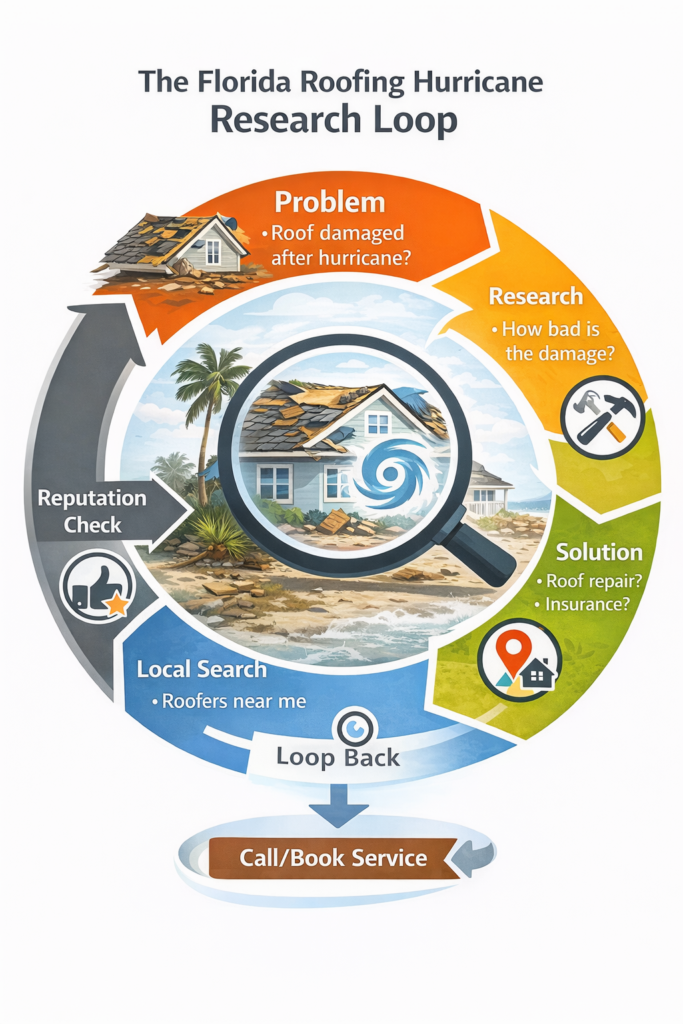
This pattern reveals something important: homeowners follow a predictable research cycle before, during, and after major storms. Understanding this cycle allows roofing companies to position their website at multiple stages of the homeowner’s decision process—long before the final “roof repair near me” search ever happens.
1. The Hurricane Preparedness Checklist (Lead Magnet)
This is one of the best possible assets for Florida roofing companies.
Example
Title
Florida Hurricane Roof Preparation Checklist
What it includes
• How to inspect your roof before a storm
• What photos to take for insurance
• Emergency tarp instructions
• When to call a roofer
• Insurance claim documentation tips
Offer it as:
Free Download (PDF)
Here is a free example you can download and brand as you like. Then create a pdf from it.
Why this works
Homeowners search for things like:
• “prepare roof for hurricane”
• “what to check on roof before storm”
• “hurricane roof inspection checklist”
If the roofer owns this content:
The homeowner may bookmark the site before the storm even hits.
That means when damage happens:
They already trust the company.
2. Hurricane Alert Email List
This is extremely powerful in Florida.
Offer:
Hurricane Season Roof Alerts
Example opt-in:
Get hurricane preparation reminders, roof inspection tips, and emergency repair guidance during Florida storm season.
Then send:
Example email sequence
May – Hurricane season prep
“5 things to check on your roof before June”
Storm forming
“What homeowners should do 48 hours before landfall”
Storm approaching
“How to prevent roof leaks during high winds”
After storm
“What to check before calling insurance”
Every email reinforces the roofer as the authority.
3. The “Storm Damage Guide”
Create a large cornerstone article.
Example:
Florida Roof Damage Guide After Hurricanes
Sections:
• Missing shingles
• Lifted flashing
• Water intrusion
• Structural damage
• Insurance claim steps
• Emergency repairs
This article captures searches like:
• “roof damage after hurricane”
• “signs of roof damage after storm”
This is exactly the research stage before the call.
4. The Hurricane Damage Photo Library
People search visually.
Create a page like:
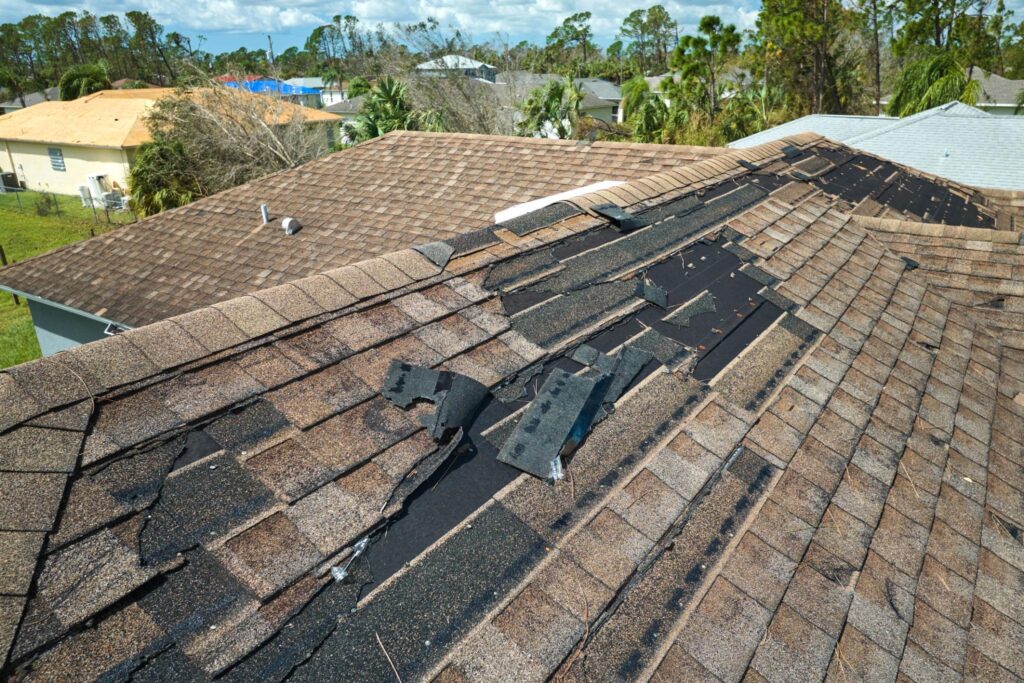
Examples of Hurricane Roof Damage
Include:
• Shingle blow-off
• Ridge cap damage
• Flashing failure
• Water intrusion points
This helps rank for:
• “what roof damage looks like after hurricane”
And builds trust
5. The Storm Tracker Page (Very Powerful)
Few roofing companies do this.
Create a page:
Florida Storm Tracker & Roof Damage Resources
Include:
• Active storm updates
• Areas of likely roof damage
• Safety tips
• Emergency roof repair steps
This creates topical authority around storms.
Google loves this.
6. Insurance Claim Walkthrough
This is huge.
Homeowners search:
• “roof insurance claim after hurricane”
• “does insurance cover roof damage”
Create:
Step-by-Step Hurricane Roof Insurance Claim Guide
Sections:
- Document damage
- Contact insurance
- Inspection process
- Contractor estimate
- Repair timeline
Now the roofer becomes the insurance guide.
7. The “Emergency Roofing Map”
Create a page:
Emergency Roof Repair in Tampa After Storms
Explain:
• Response times
• Temporary tarping
• Leak prevention
This captures the panic searches.
8. Hurricane Reminder Tool
Very simple but powerful.
Offer:
Free Annual Roof Inspection Reminder
User enters email.
Send reminders:
• May 1 – inspect roof
• August – mid-season check
• October – post-storm inspection
Now the roofer owns long-term customer memory.
9. Google Discover / AI Visibility Strategy
Your articles should answer questions like:
• What to do if roof leaks during hurricane
• How to check roof after storm
• Should I call insurance or roofer first
These are AI answer type questions.
If structured well, AI search tools reference the site.
10. The Big Strategy (Most Agencies Miss This)
Instead of competing after the storm, the roofer should dominate before the storm.
Search lifecycle:
1️⃣ Pre-storm preparation
2️⃣ Storm approaching
3️⃣ Damage inspection
4️⃣ Insurance research
5️⃣ Local roofer search
Most agencies only target:
Step 5
But the real opportunity is:
Steps 1–4
Since Google customizes content for searchers if they have previously been on your website you may end up higher in their future searches.
The End Result
When a hurricane hits:
The homeowner already knows:
• the company name
• the website
• the advice source
So instead of searching:
“roofers near me”
they go directly to:
“ABC Roofing Tampa”
Request A Quote
- The Diagnostic Form Is Your Best SalespersonHVAC AEO • Field Operations The Diagnostic Form Is Your Best Salesperson Why the contractors winning trust in 2026 stopped writing recommendations on the back of a service ticket — and what they’re using instead. … Read more
- When AI Engines Cite Your Resellers Instead of YouAEO Analysis — The Retailer Citation Problem When AI Engines Cite Your Resellers Instead of You Retailer page citations account for 10% of ChatGPT’s sources, 8% of Gemini’s, and 4% of Perplexity’s. For product brands, … Read more
- Three AI Engines, Three Completely Different Citation StrategiesAEO Research — Cross-Engine Analysis Three AI Engines, Three Completely Different Citation Strategies Across 546 citations spanning 15 verticals, ChatGPT, Perplexity, and Gemini disagree on what counts as an authoritative source. The overlap between them … Read more
- How Distributors Absorb AI Citations Meant for Industrial BrandsAEO Case Study — Industrial IoT How Distributors Absorb AI Citations Meant for Industrial Brands A study of 42 AI citations for a single ABB product — the Ability Smart Sensor — shows a pattern … Read more
- The Content Types That Actually Earn AI CitationsAEO Research — Content Type Analysis The Content Types That Actually Earn AI Citations Across 546 scored AI citations, technical PDFs, journals, and press releases consistently outscore blog content by 20 to 30 points on … Read more