
The Content Types That Actually Earn AI Citations
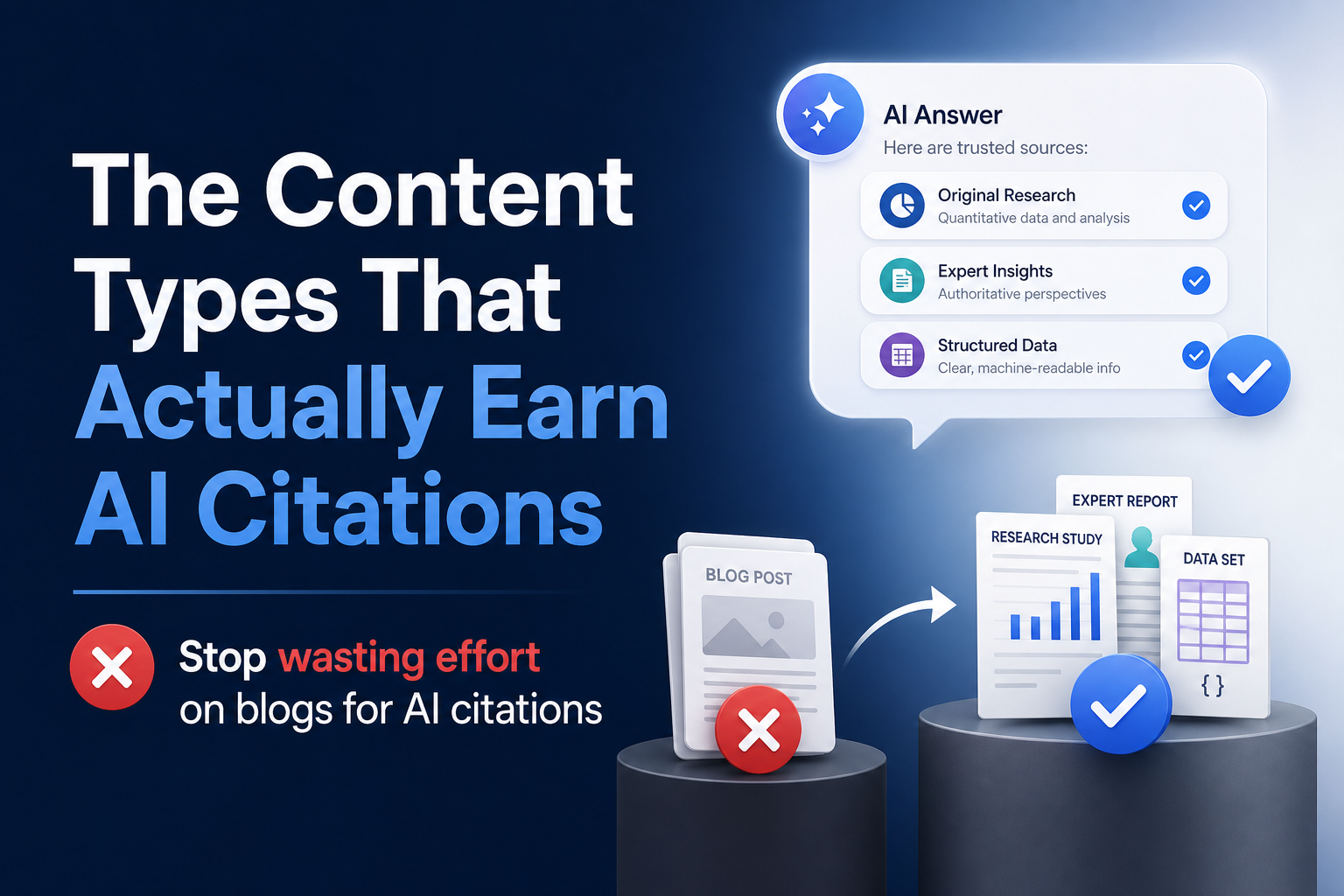
Across 546 scored AI citations, technical PDFs, journals, and press releases consistently outscore blog content by 20 to 30 points on the Page Structure Score rubric. The B2B AEO playbook that works is not content marketing as most agencies practice it — it is product documentation taken seriously.
What we measured and what PSS means
Every cited page in our phase two AI citation study received a Page Structure Score — a 0 to 100 composite measuring how readily an AI engine can extract a direct answer from the page. The formula weights Structure (25 points), Answer Clarity (20), Relevance (20), Depth (15), Authority (10), and Extractability (10).
Pages scoring 80 or higher are preferred citation sources. Pages at 70 to 79 are strong supporting sources. Pages below 50 are low-value filler that appear in citation pools only when higher-quality sources are absent. The gap between a PSS 85 page and a PSS 45 page is not subtle — it is the difference between getting cited and being invisible.
Journals and technical documents sit at the top of the structural quality scale
When we ranked every page type by mean PSS score, a clear pattern emerged. The highest-scoring content is not blog posts or thought leadership. It is journals, technical manuals, and product brochures — the kind of documentation most marketing teams treat as secondary.
Journals scored 91.0 on average across 4 citations. Technical manual PDFs scored 86.7 across 3 citations. Product brochure PDFs scored 84.0 across 5 citations. Technical documents, report pages, news articles, and press releases all cluster in the 82 to 84 range.
The lower end of the scale is populated by content that marketing teams often invest the most in: consultancy blogs (48), B2B lead-gen blogs (52), market research firm blogs (53), and marketplace blogs (50). Earned editorial averages 42.8. User-generated content and retailer editorial content trail at 29 and 23 respectively.
Why PDFs score so high — and blogs score so low
The PSS gap between technical PDFs and blog content is not because AI engines have a preference for file extensions. It is because the content patterns differ.
PDFs are structurally consistent
A technical manual or product brochure is built around a spec-first hierarchy. Product name, specifications, applications, performance data, operating conditions, compatibility notes. Each section answers a specific question in a declarative sentence, usually supported by a table or bulleted list. That structure matches the Answer Clarity and Extractability criteria directly.
Blogs optimize for narrative, not extraction
A typical consultancy blog post buries concrete facts inside anecdotes, framing, and thought-leadership setup. The most important sentence in a 1,500-word post might appear 900 words in, wrapped in conditional language (“one could argue that in most cases…”). AI engines cannot reliably extract a quotable answer from that structure.
Named authority helps, but it is not the full story
Peer-reviewed journals score high partly because of the Authority weight — JAMA and similar publications are recognized trust signals. But press releases (81.6) and report pages (83.7) score almost as high despite lacking peer review. The common thread is structural: declarative, fact-forward, extractable.
What the low-scoring content types have in common
Consultancy blogs (mean PSS 48)
Written to position the consultancy as thought leaders. Long, narrative-driven, full of caveats. Optimized for LinkedIn sharing and lead capture, not AI extraction.
B2B lead-gen blogs (mean PSS 52)
“Top 10” listicles from companies using ranking content as an ACL-style acquisition hook. Shallow, broad, and usually gated behind a form. AI engines cite them when nothing better is available, but they sit near the bottom of the quality scale.
Market research firm blogs (mean PSS 53)
Teaser content designed to sell a paywalled report. Extraction-hostile by design — the actual data lives behind a paywall, and the blog abstract deliberately hedges the numbers.
Earned editorial (mean PSS 42.8)
This one is counterintuitive. Earned editorial — the trade press coverage that PR teams work to secure — averages the second-lowest PSS of any major content category. The reason: trade press often rewrites brand press releases while adding editorial commentary and context, diluting the structural clarity of the original announcement. A direct press release typically scores higher than the trade coverage that follows it.
UGC and retailer editorial (PSS 23 to 29)
Reddit threads, Instagram posts, and retailer review-style content round out the bottom. These pages are cited when AI engines need consumer voice or sentiment, but they do not anchor factual claims.
What this means for content strategy
If your AEO investment is primarily consultancy-style blog content, you are producing pages that score 48 on average. The brands that dominate AI citation surface are producing technical PDFs, structured product pages, and press releases that score 80+ on the same rubric.
Prioritize these formats
- Product brochure PDFs hosted on owned domains, with visible text layer (not scanned images)
- Technical manuals with spec tables and declarative section headers
- Press releases announcing specific products, partnerships, or capabilities — written as news, not marketing
- Report pages with named findings and concrete data points
- Product pages where specs appear as structured HTML, not JavaScript-rendered content
De-prioritize or restructure these formats
- Thought-leadership blogs where the key fact appears buried in narrative
- Generic “top 10” listicles on your blog that compete with aggregator sites that do it better
- Gated content — AI engines do not cite what they cannot access
- Earned editorial as a primary citation strategy — the press release itself scores higher than the trade coverage that follows
Rebuild what you already have
- Extract key facts from existing blog posts and restructure them into spec tables, FAQ sections, or reference pages
- Convert PDF-only collateral into HTML pages with the PDF linked as supporting documentation
- Add structured schema (Product, FAQPage, HowTo, TechArticle) to pages that have the content but not the markup
Rescore your content for AI citation readiness
Tampa Web Technologies audits your existing content library against the Page Structure Score rubric, identifies the gap between what you publish and what AI engines cite, and rebuilds priority pages to clear PSS 70+.
Request a Content PSS Audit