
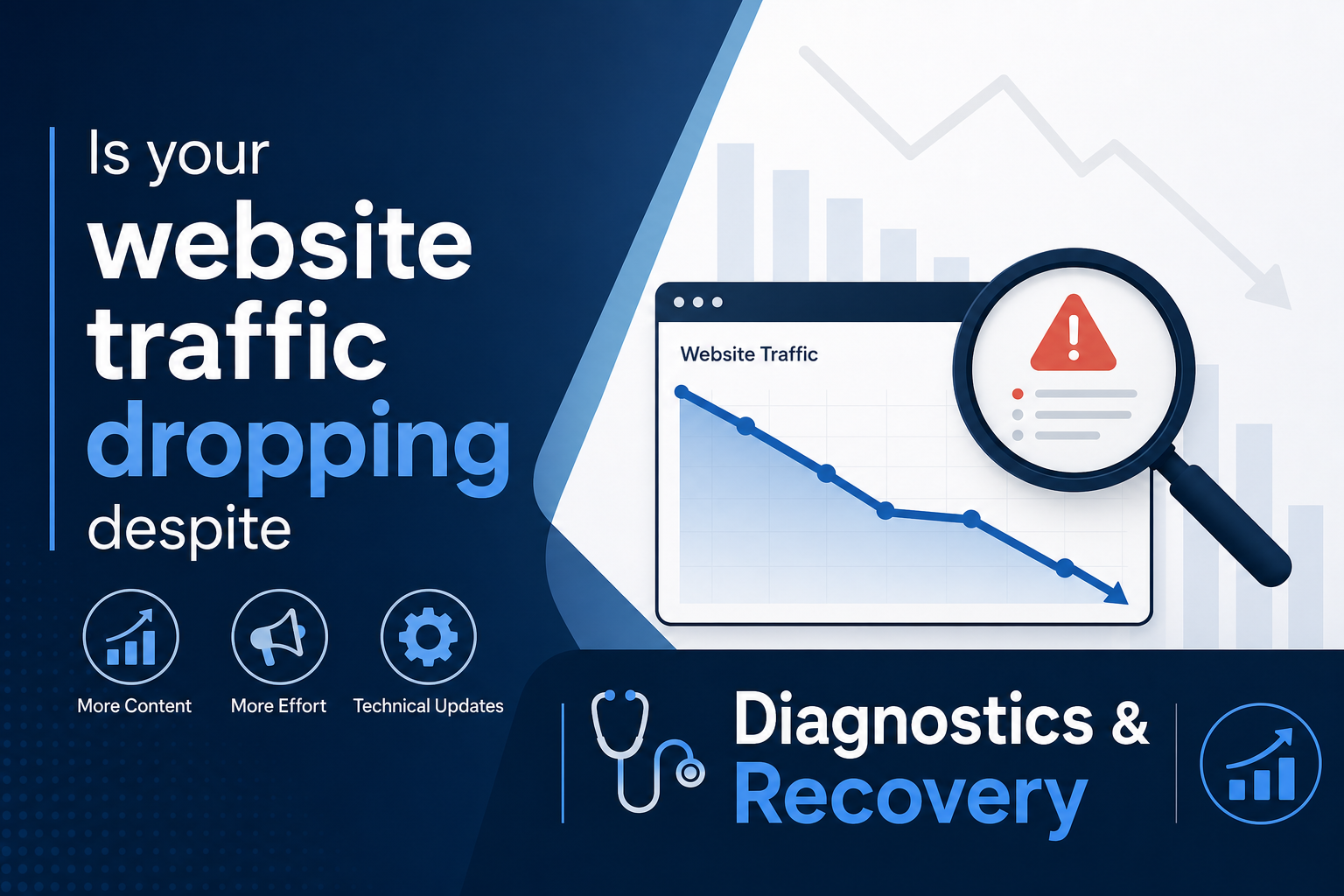
Your traffic dropped. Your rankings didn’t. Something else changed.
When the analytics graph turns the wrong direction, the cause is rarely what your old SEO checklist would catch. AI engines now sit between your site and your buyer — and most diagnostic playbooks haven’t caught up. This is where we document what actually causes traffic loss in 2026, and how to recover.
The diagnosis isn’t what it used to be.
For two decades, a traffic drop meant one of three things: a Google update, a technical regression, or a competitor outranking you. The fix was a checklist. Run it, find the issue, restore the rankings.
That diagnostic loop is now incomplete. Rankings can hold while traffic collapses because AI overviews, zero-click answers, and inline citations are intercepting the click. The site that gets cited isn’t always the one that ranks — and the brand that gets described accurately by AI isn’t always the one with the most pages.
Everything below is the new diagnostic playbook: what to check, in what order, when the old answers don’t fit.
Traffic & Ranking Diagnosis
5 articlesThe systematic walkthrough for figuring out why a site is bleeding traffic — including the diagnostics that didn’t exist when the old playbooks were written.
Why did my website traffic drop?
The full diagnostic flowchart. Algorithm, technical, content, AI overlay — how to figure out which one hit you, and how to triage in order.
How to diagnose a sudden drop
Step-by-step diagnostic process for a sudden, sharp traffic decline — what to check first, what’s usually a red herring, and when to escalate.
Why did my rankings drop in Google?
The narrower question: when the page used to rank and now doesn’t. Technical regressions, content cannibalization, and the new AI Overview displacement effect.
Why impressions drop in Search Console
When impressions fall but average position doesn’t — what’s happening behind the data. Often the canary for AI Overview displacement.
How to recover from a traffic drop
Once you’ve diagnosed it, what comes next. The recovery sequence, what timelines to expect, and which fixes accelerate vs. delay.
Trust & Narrative Failures
7 articlesWhen the issue isn’t ranking — it’s that AI describes you wrong, attributes your work to a competitor, or won’t recommend you despite obvious qualifications.
Trust Factors
What AI engines use to evaluate trust, why transparency in product catalogs and pricing wins citation, and the red flags homeowners look for that you might be triggering.
PR & AI Narrative Control
How brands lose control of how AI describes them — the Peloton case study — and the rule-based approach to rebuilding the narrative.
How a diagnostic engagement actually runs.
If you’re past reading and want someone to look at it, this is the sequence. No retainers required for the diagnosis itself.
Symptom capture
You send the analytics view, the date the drop started, and a few representative URLs. We confirm the symptom set is real and not a measurement artifact.
Multi-layer diagnosis
We check the four layers in order: technical regression, algorithm/update impact, AI Overview displacement, and citation/narrative drift. Most drops have one primary cause and two contributors.
Written report
A short document — what we found, in priority order, with the specific evidence. You decide whether to fix it yourself or have us do it. Either is fine.
Recovery, if engaged
If the fix is something we do (content, schema, citation rebuild, narrative repair), we scope it as a one-off project. No long retainers attached to the diagnostic.
If the graph is going the wrong direction, send it over.
A look at the analytics and a few URLs is usually enough to spot whether it’s a known pattern. We’ll tell you what we see, free of charge, before any engagement.
Request a diagnostic review →