
Public relations has always been about shaping how information moves through trusted channels.
Traditionally that meant influencing journalists, managing media relationships, and guiding how stories appeared in news coverage. But the information landscape has changed. Increasingly, public understanding is formed not just by articles or headlines, but by AI-generated answers that synthesize information from across the internet.
When someone asks an AI system about a company, an industry, or an issue, the response is not written by a journalist. Instead, the system analyzes patterns across thousands of sources and generates a condensed narrative.
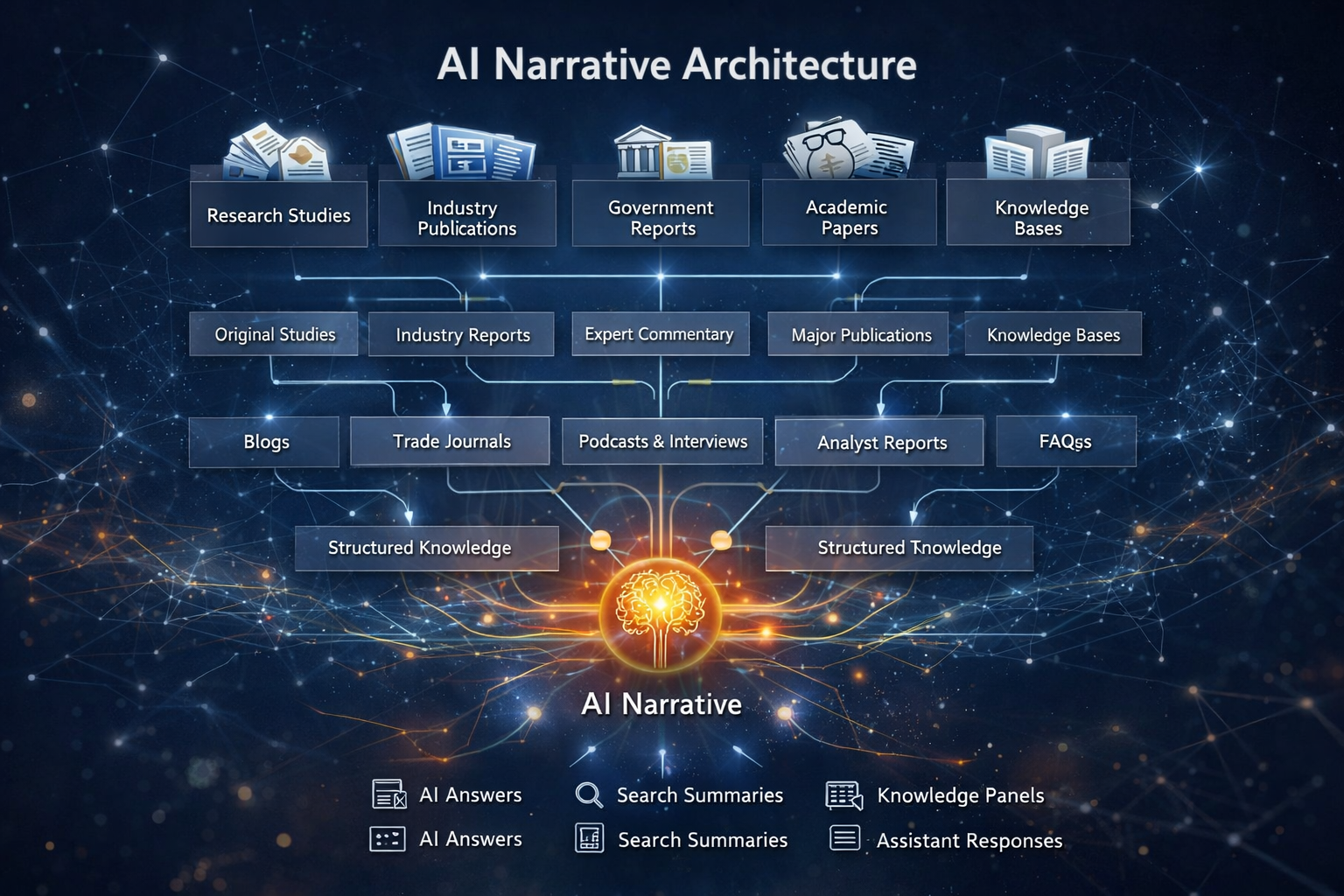
For PR professionals, this creates a new challenge. The narrative is no longer controlled solely through media placements or messaging. Instead, it emerges from the structure and distribution of information across the entire ecosystem.
This does not mean the narrative is uncontrollable. Like any governed system, AI synthesis follows rules. Understanding those rules allows organizations to shape how their story appears in AI-generated responses.
Experienced communications professionals have seen similar dynamics before. Platforms such as Wikipedia demonstrated years ago that narratives are not determined by opinion alone, but by sources, structure, and consensus.
AI systems operate in much the same way.
The following framework explains how PR teams can influence AI narratives by working within those rules.
Principle 1 — The Narrative Must Exist in Trusted Sources
AI systems cannot synthesize ideas that do not exist within their information environment.
If a concept or perspective does not appear in credible sources, the system has nothing reliable to reference or summarize.
For this reason, the first step in shaping an AI narrative is ensuring the idea exists in trusted and verifiable locations.
Examples of high-trust environments include:
• authoritative websites
• industry publications
• academic research
• technical documentation
• credible news outlets
• structured knowledge platforms
If the information does not exist in trusted sources, it cannot reliably appear in AI summaries.
Rule:
No source = no narrative.
Principle 2 — Authority Sources and Original Studies Anchor the Narrative
Not all sources influence AI narratives equally.
Certain sources function as authority anchors because they are widely cited and trusted across the information ecosystem.
Examples include:
• encyclopedic references
• academic journals
• government publications
• respected industry publications
• research institutions
One of the most effective ways to establish authority is to publish original research or studies.
Studies introduce new information into the ecosystem and provide primary data that other sources can reference.
Research-driven content has several advantages:
• it introduces new information into the ecosystem
• it creates a primary source that others can cite
• it positions the organization as a knowledge contributor rather than a commentator
• it generates secondary discussion across the industry
Example pattern:
Original study published
↓
Industry blog references the findings
↓
Trade publication discusses the research
↓
Experts cite the study
Once multiple sources reference the same research, it becomes an authority anchor for the narrative.
Rule:
Original studies create authority anchors that shape the narrative boundary.
Principle 3 — Control Multiple Sources to Establish Consensus
AI systems detect patterns across many sources.
When the same idea appears repeatedly across credible publications, the system interprets it as consensus knowledge.
Because of this, a narrative rarely becomes dominant through a single article or placement. Instead, it emerges when multiple sources reinforce the same idea.
Effective narrative strategy therefore focuses on developing an ecosystem of sources that consistently support the concept.
Examples of supporting sources include:
• industry blogs
• trade publications
• research summaries
• expert commentary
• interviews and podcasts
• educational articles
Example pattern:
Source A introduces the concept
Source B analyzes the concept
Source C references the concept
Source D summarizes the concept
When several credible sources repeat the same concept, AI systems detect the pattern.
Repeated concept across sources
↓
Pattern recognition
↓
AI interprets consensus
This is similar to how collaborative knowledge platforms like Wikipedia evaluate claims: ideas supported by multiple reliable sources carry the most weight.
Rule:
Narratives strengthen when multiple sources consistently reinforce the same idea.
Principle 4 — Control the Structure of Each Format
AI systems interpret structured information far more easily than unstructured commentary.
Content that follows clear structural patterns allows AI systems to identify definitions, concepts, and relationships more reliably.
For this reason, PR teams should intentionally control the structure of each format in which information appears.
Examples of structured formats include:
• definitions and explanations
• frameworks or models
• research summaries
• step-by-step processes
• taxonomies or categorized lists
• FAQ sections
• comparisons and breakdowns
A structured article might follow a format such as:
Definition
Overview of the concept
Principles or components
Process or methodology
Examples or applications
Summary
When information follows predictable structures, AI systems can more easily extract and summarize the key ideas.
Example pattern:
Structured article
↓
Clear definitions and sections
↓
AI extracts key ideas
↓
AI summarizes the concept
When multiple sources use structured formats to explain the same concept, the narrative becomes easier for AI systems to synthesize and repeat.
Rule:
Controlling the structure of each format improves how AI systems interpret and summarize the narrative.
The Emerging Model
When these principles work together, narrative formation begins to follow a predictable pattern:
Idea introduced
↓
Published in trusted sources
↓
Supported by authority anchors and studies
↓
Repeated across multiple sources
↓
Structured into clear frameworks
↓
AI detects patterns and consensus
↓
AI narrative forms
The Core Insight for PR Professionals
Public relations has always been about influencing the flow of information through trusted channels.
In the AI era, the same principle applies, but the system analyzing those channels has changed.
Instead of journalists alone shaping the narrative, AI systems now synthesize patterns across the entire information ecosystem.
The most effective strategy is not to argue directly with the output of these systems, but to shape the information environment they rely on.
When PR teams understand and operate within the rules of the system—sources, authority, repetition, and structure—they can influence how narratives emerge in AI-generated responses.
Turning AI Narrative Strategy Into Action
Understanding how AI narratives form is only the first step.
The real challenge for organizations is building the information ecosystem that shapes those narratives.
Many companies assume that if they publish content on their website or issue press releases, their story will naturally appear in AI-generated answers. In reality, AI systems synthesize information from across the broader information landscape—including research publications, industry commentary, structured knowledge sources, and widely cited authority materials.
Without a deliberate strategy, organizations often find that the AI narrative about their company or industry is shaped by outside voices, outdated information, or incomplete perspectives.
A structured AI narrative strategy focuses on:
• developing authoritative research and studies
• creating credible sources that others reference
• reinforcing key ideas across multiple publications
• structuring information so AI systems interpret it accurately
• building a stable ecosystem of sources that support the narrative
When these elements work together, the narrative begins to emerge naturally within AI-generated responses.
These Principles in Practice — Two Case Studies
The four principles above are not theoretical. They can be observed directly in how real brands have succeeded or failed to shape their AI narratives over time. Two contrasting cases illustrate the framework in action.
HubSpot — How to Build a Narrative the Ecosystem Adopts
In 2006, HubSpot co-founder Dharmesh Shah made a deliberate decision not to trademark or copyright the term “inbound marketing.” Instead, they seeded the concept freely across the information ecosystem — through a book, a conference, an academy, and annual research reports — and let independent sources adopt and repeat it on their own terms.
Twenty years later, every major AI platform defines inbound marketing using HubSpot’s framework. Optimizely, Salesforce, Adobe, Amazon Ads, and Forbes all teach HubSpot’s Attract, Engage, Delight model as if it were a neutral industry standard. When HubSpot’s blog lost over half its organic traffic in 2024 following Google algorithm updates, its AI narrative held — because the signals AI systems weighted were never stored on the blog. They were distributed across thousands of independent sources built over 15 years.
This is what all four principles look like when executed deliberately and at scale.
Read the full case study: How HubSpot Built an AI Narrative Nobody Can Touch
Peloton — What Happens When the Ecosystem Tells a Different Story
Peloton invested heavily in content, SEO, press releases, and survey-based research. None of it significantly influenced how AI systems describe the brand. When you ask any major AI platform about Peloton today, the response centers on high cost, declining long-term usage, unused equipment, and post-pandemic demand collapse — none of which came from Peloton’s own communications.
The narrative came from Reddit threads, YouTube videos, long-form cultural commentary, and mainstream media coverage — sources Peloton did not control and did not produce signals strong enough to counter. Their research lacked methodological transparency and was never independently cited. Their messaging did not align with what users actually experienced.
The result was a complete disconnect between what the company communicated and what the information ecosystem repeated — and AI systems synthesized the ecosystem, not the brand.
This is what happens when Principles 2, 3, and 4 fail simultaneously.
Read the full case study: How Peloton Lost Control of Its AI Narrative
What the Two Cases Tell Us Together
The difference between HubSpot and Peloton is not budget, effort, or content volume. Both companies published consistently. Both invested in communications strategy. The difference is whether the signals they produced were adopted, repeated, and amplified across independent sources that AI systems treat as authoritative.
HubSpot’s framework spread because it was useful and practitioners said so publicly across thousands of independent platforms. Peloton’s messaging did not spread because it did not align with what users actually experienced.
The framework on this page explains why. The case studies show what it looks like in practice.
Strategic AI Narrative Development
At Tampa Web Tech, we help organizations design and deploy the information architecture needed to influence how industries, technologies, and companies are represented in AI-generated responses.
Our work focuses on building the underlying narrative infrastructure, including:
• Original research and industry studies
• Authority content development
• Multi-source narrative ecosystems
• Structured knowledge frameworks
• AI-friendly information architecture
This approach moves beyond traditional SEO or PR tactics. Instead of simply trying to influence search rankings or media coverage, we help organizations shape the information environment that AI systems rely on to generate answers.
The Next Narrative Battlefield
As AI becomes the primary interface for discovering information, the organizations that understand how these systems synthesize narratives will have a significant advantage.
Those that do not may find their story written by others.
If your organization is interested in developing a strategic AI narrative architecture for your industry, we welcome the opportunity to discuss how this framework can be applied to your specific goals.
Contact Tampa Web Tech to begin building your AI narrative strategy.