
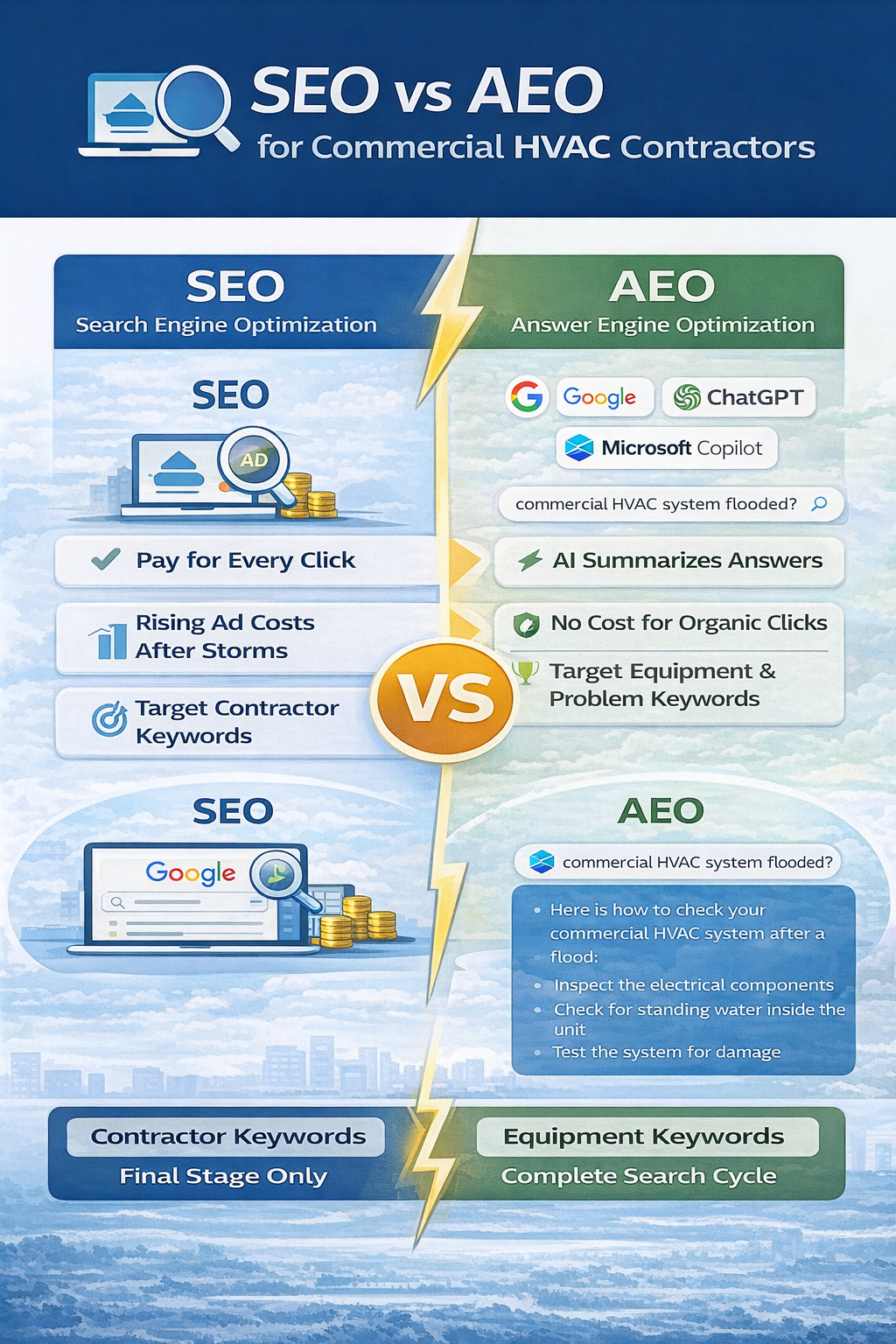
Why Modern Search Requires More Than Traditional SEO
Commercial HVAC contractors have relied on Search Engine Optimization (SEO) for years to generate service leads online. Ranking in Google search results for phrases like “commercial HVAC contractor” or “rooftop unit repair” has traditionally been the goal of most HVAC marketing strategies.
However, search behavior is evolving. AI-powered search systems now provide direct answers to many technical questions before users ever click on a website.
This shift has introduced a new concept known as Answer Engine Optimization (AEO).
While SEO focuses on ranking websites in search engine results, AEO focuses on structuring content so it can be used directly by AI systems to answer questions.
For commercial HVAC contractors, understanding the difference between SEO and AEO can significantly impact how potential customers discover their services.
What is SEO?
Search Engine Optimization is the process of improving a website so that it ranks higher in traditional search results.
For HVAC companies, SEO typically focuses on keywords related to services, such as:
commercial HVAC contractor
commercial HVAC repair
rooftop unit repair near me
These searches usually occur late in the decision process, when a building operator already knows they need a contractor.
SEO strategies often include:
service pages for repair services
location pages targeting local searches
blog articles related to HVAC topics
When implemented correctly, SEO helps contractors appear when businesses actively search for repair providers.
What is AEO?
Answer Engine Optimization focuses on creating content that AI-powered search tools can use to answer questions directly.
These tools include:
Google Gemini
ChatGPT
Microsoft Copilot
Instead of returning only a list of websites, these systems summarize answers to questions such as:
why is my rooftop unit not cooling
commercial HVAC compressor failure
chiller flood damage inspection
If a website provides clear explanations of these problems, AI systems may reference that content when generating answers.
This allows companies to appear earlier in the research process, before a facility manager even begins searching for contractors.
The Key Difference Between SEO and AEO
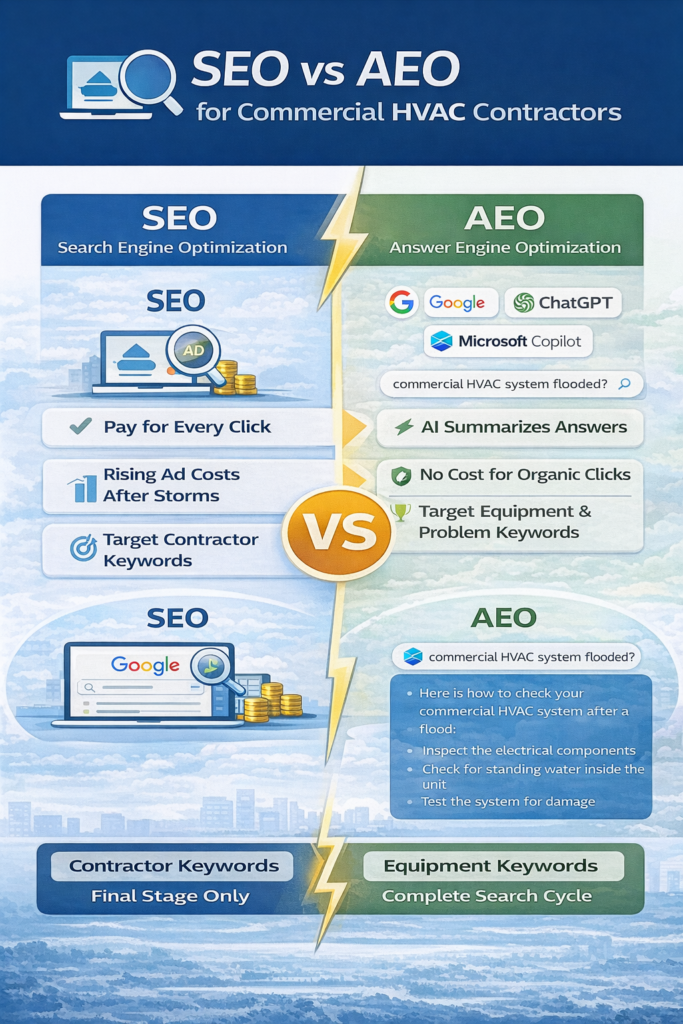
The biggest difference between SEO and AEO is where they appear in the search process.
Traditional SEO targets searches where the user already knows they need a contractor.
AEO targets searches where the user is still diagnosing the problem.
For example, a facility manager may begin by searching:
Trane rooftop unit troubleshooting
why is my chiller shutting down
During this stage, they are not yet looking for a contractor. They are trying to understand the issue.
If a contractor’s website provides helpful troubleshooting content, it can become the source used by AI systems to explain the problem.
By the time the facility manager searches for a repair company, that contractor may already be recognized as a trusted resource.
Why Commercial HVAC Search Is Equipment-Driven
Commercial HVAC search behavior is often centered around equipment rather than contractors.
Facility managers frequently search using:
equipment brands
system types
mechanical problems
Examples include:
Carrier chiller repair
Daikin VRF troubleshooting
Lennox RTU compressor issue
These searches occur earlier in the decision process and are ideal opportunities for AEO.
Contractors that publish equipment-specific repair guides and troubleshooting explanations can appear during these early research stages.
How AEO Reduces PPC Dependence
Many HVAC contractors rely heavily on paid advertising to generate emergency repair leads.
However, advertising costs often increase during peak demand periods, especially after severe weather events.
When storms damage rooftop units or mechanical systems, contractors often compete aggressively for emergency repair searches.
AEO can reduce reliance on paid advertising by allowing contractors to rank organically for searches such as:
rooftop unit storm damage
commercial HVAC flooded
HVAC system water damage
If these pages appear in search results or AI-generated answers, contractors can capture emergency demand without paying for every click.
SEO Still Matters
Although AEO is becoming increasingly important, traditional SEO remains essential.
Contractor-focused searches still generate high-intent leads, including:
commercial HVAC contractor near me
commercial HVAC repair company
These searches occur at the final stage of the decision process when a business is ready to schedule service.
A successful digital strategy combines both approaches.
SEO captures customers who already know they need a contractor.
AEO captures customers who are still researching the problem.
The Ideal Strategy Combines SEO and AEO
The most effective commercial HVAC websites are structured to support both types of search.
For example:
SEO targets contractor searches such as commercial HVAC repair.
AEO targets troubleshooting questions such as why a rooftop unit stops cooling.
Together, these strategies allow HVAC companies to appear throughout the entire research process.
Instead of competing only for contractor searches, they can become a trusted information source during the earlier diagnostic phase.
The Future of Commercial HVAC Search
As AI-powered search continues to expand, more technical questions will be answered directly through AI systems rather than traditional search results.
Contractors who structure their websites around:
equipment brands
system troubleshooting
repair explanations
storm damage guides
will have a stronger chance of appearing in both search results and AI-generated answers.
This approach allows commercial HVAC companies to attract customers earlier in the decision cycle while reducing dependence on paid advertising.
The Bottom Line
SEO and AEO are not competing strategies—they are complementary.
SEO ensures HVAC contractors appear when businesses search for service providers.
AEO ensures they appear when facility managers are diagnosing mechanical problems.
Commercial HVAC companies that align their websites with both strategies can capture visibility across the entire search process and generate more qualified service opportunities.
To understand how commercial HVAC search actually works, see our guide on Commercial HVAC Search Architecture.
Frequently Asked Questions
What is the difference between SEO and AEO for commercial HVAC contractors?
SEO helps commercial HVAC contractors rank in traditional search results for service and contractor-related searches. AEO helps their content appear in AI-generated answers by structuring pages around clear explanations, troubleshooting information, equipment-specific content, and direct answers to technical questions.
Why does AEO matter for commercial HVAC contractors?
AEO matters because facility managers and building operators often search for technical answers before they search for contractors. If an HVAC company publishes clear content about equipment brands, system problems, repair options, and storm damage, AI systems may reference that content during the research stage.
Is traditional SEO still important for commercial HVAC companies?
Yes. Traditional SEO is still important because contractor-focused searches such as commercial HVAC contractor near me or commercial HVAC repair company often happen when a business is ready to schedule service. SEO and AEO work best together.
What types of searches are best for commercial HVAC AEO?
The best AEO searches are usually equipment-based, system-based, and problem-based. Examples include rooftop unit not cooling, commercial HVAC flooded, Daikin chiller troubleshooting, or Carrier RTU repair questions.
Can AEO help commercial HVAC contractors reduce PPC costs after storms?
Yes. If a contractor ranks organically or appears in AI-generated answers for storm-related HVAC searches before or after severe weather, they may capture emergency demand without paying for every click during expensive storm-driven advertising periods.
Search technology is changing rapidly as artificial intelligence becomes part of how people research problems online. Many questions that once required browsing multiple websites are now answered directly by AI systems or search engine summaries. Because of this shift, websites increasingly focus on Answer Engine Optimization (AEO) and Generative Engine Optimization (GEO). AEO helps content appear as direct answers in search results, while GEO helps AI systems use a website as a trusted source when generating explanations. Together, these strategies help businesses stay visible during the early research stage of the customer journey. You can learn more about how these approaches work in our guide to AEO vs GEO and the future of search.