
How Businesses Actually Find Commercial HVAC Repair Services
Commercial HVAC systems are complex mechanical systems responsible for climate control in office buildings, hospitals, industrial facilities, retail centers, and large residential properties. When these systems fail, the responsibility for diagnosing and repairing the issue typically falls to facility managers, building engineers, or property managers.
Because these professionals work directly with building systems and equipment, their search behavior is very different from residential HVAC customers. Instead of immediately searching for contractors, they typically begin by researching the equipment itself.
This predictable research pattern forms what can be described as the Commercial HVAC Search Behavior Model.
Understanding this model allows HVAC contractors to structure their websites in a way that aligns with how commercial buyers actually search for service providers.
The Five Stages of Commercial HVAC Search
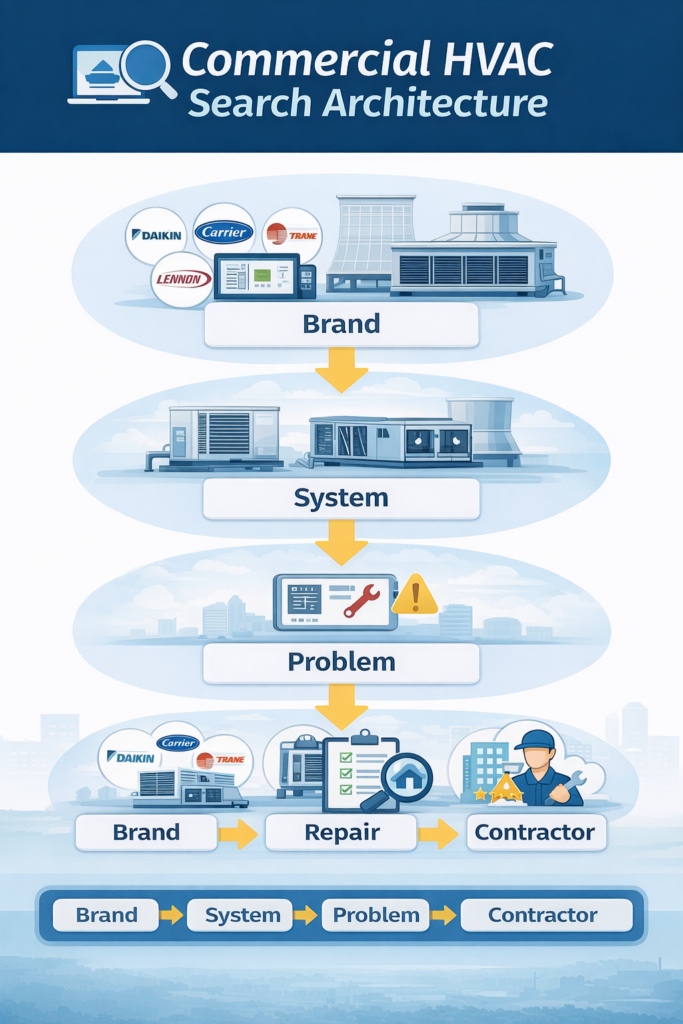
Commercial HVAC searches typically follow five stages as building operators move from identifying a problem to selecting a contractor.
The process usually looks like this:
Equipment Brand
↓
System Type
↓
Mechanical Problem
↓
Repair Research
↓
Contractor Selection
Each stage represents an opportunity for HVAC contractors to appear in search results.
Stage 1: Equipment Brand Searches
Commercial HVAC equipment is typically manufactured by major industry brands. Because facility managers often know which systems are installed in their buildings, their first searches frequently include the manufacturer name.
Common commercial HVAC brands include:
Daikin
Carrier
Trane
Lennox
York
Typical searches may include:
Trane rooftop unit troubleshooting
Carrier chiller repair
Daikin VRF system problems
These searches allow facility managers to determine whether a problem is common and what repair options might exist.
Websites that provide brand-specific repair information have a much better chance of appearing in these search results.
Stage 2: System Type Searches
After identifying the equipment brand, facility managers often search for information related to the system type.
Commercial HVAC systems vary widely depending on the building design and mechanical requirements.
Common system categories include:
Chillers
Rooftop Units (RTU)
Variable Refrigerant Flow (VRF) systems
Air handling units
Cooling towers
Commercial boilers
Example searches may include:
commercial chiller troubleshooting
rooftop unit repair
VRF system maintenance
Each of these system types represents a separate cluster of search activity.
Stage 3: Mechanical Problem Searches
Once the equipment and system are identified, the next step often involves diagnosing the specific problem.
Facility managers frequently search for troubleshooting information before contacting a contractor.
Examples include:
rooftop unit not cooling building
commercial HVAC compressor failure
chiller not starting
These searches are usually informational and focus on understanding the cause of the failure.
Websites that provide structured troubleshooting guides often appear during this phase of research.
Stage 4: Repair Research
After diagnosing the likely issue, facility managers begin researching potential repair solutions.
These searches may include:
RTU compressor replacement
commercial HVAC motor repair
chiller maintenance procedures
At this stage, building operators are determining whether the issue requires outside service or can be addressed through internal maintenance.
Providing clear explanations of repair options helps HVAC contractors establish credibility during this phase.
Stage 5: Contractor Selection
Once the problem and repair requirements are understood, the facility manager begins searching for qualified service providers.
Typical searches may include:
commercial HVAC contractor near me
rooftop unit repair service
commercial chiller repair company
Because commercial HVAC projects often involve significant costs, buyers typically evaluate several companies before scheduling service.
Contractors that have already appeared during earlier research stages often have a strong advantage during this step.
Why This Model Matters for HVAC SEO
Many marketing agencies focus only on contractor-focused keywords such as:
commercial HVAC contractor
commercial HVAC repair
However, these searches occur only at the final stage of the research process.
The Commercial HVAC Search Behavior Model shows that most searches happen earlier, when facility managers are researching equipment brands, system types, and troubleshooting information.
Contractors who structure their websites around this research process can appear earlier in search results and establish credibility before competitors are contacted.
The Role of Answer Engine Optimization
As search engines increasingly integrate AI-driven answers, technical questions are often answered directly through AI systems.
Tools such as:
- Google Gemini
- ChatGPT
- Microsoft Copilot
- Perplexity
frequently summarize information related to equipment problems and repair procedures.
Websites that provide clear explanations of HVAC systems and troubleshooting steps are more likely to be referenced by these AI tools.
This approach is known as Answer Engine Optimization (AEO).
By structuring content around equipment brands, system types, and mechanical problems, HVAC companies can increase their visibility in both traditional search results and AI-generated answers.
The Advantage for Commercial HVAC Contractors
Commercial HVAC projects are often high-value service opportunities involving complex mechanical systems and long-term maintenance relationships.
Contractors that understand how facility managers search for repair services can align their websites with the entire research process instead of competing only for contractor keywords.
This strategy allows HVAC companies to:
appear earlier in the research cycle
build credibility with technical audiences
capture high-intent equipment searches
reduce reliance on paid advertising
When websites reflect the real decision-making process of commercial buyers, they become far more effective at generating qualified service leads.
The Future of Commercial HVAC Search
As search engines continue integrating AI-generated answers and technical summaries, businesses increasingly rely on online research to diagnose mechanical issues and evaluate service providers.
Contractors who provide clear explanations of HVAC systems, troubleshooting guides, and repair resources will have a stronger chance of appearing in both search results and AI-driven responses.
By aligning their websites with the Commercial HVAC Search Behavior Model, HVAC companies can position themselves as trusted experts and attract more commercial clients searching for reliable service providers.
To understand how commercial HVAC search actually works, see our guide on Commercial HVAC Search Architecture.