
Severe storms and hurricanes often create sudden demand for roof inspections and repairs. However, most homeowners begin researching storm preparation and roof damage long before they actually contact a roofing contractor.
This creates an opportunity for roofing companies that combine Answer Engine Optimization (AEO), educational content, and retargeting advertising.
By providing helpful information before storms and using targeted retargeting ads afterward, roofing companies can stay visible during the entire homeowner research process and significantly increase conversions.
How Homeowners Research Roofing Problems Before Storms
Before severe weather arrives, many homeowners search online to understand how to protect their homes or identify potential roof damage.
Common searches include:
how to prepare roof for hurricane
roof inspection before storm
signs of roof damage after hurricane
These searches usually happen when homeowners are gathering information rather than looking for a contractor.
Roofing companies that publish educational guides on these topics can capture early search traffic through SEO and Answer Engine Optimization (AEO).
At this stage, the goal is not immediate sales but building awareness and trust with homeowners who may later need roof repairs.
Why AEO Matters in Storm Research
Search behavior is changing as more homeowners rely on AI-powered search tools to answer technical questions about home repairs.
Platforms such as:
Google Gemini
ChatGPT
Microsoft Copilot
often summarize answers to questions about roof damage, storm preparation, and inspections.
Websites that provide clear explanations and structured answers are more likely to appear in these AI-generated responses.
This approach is known as Answer Engine Optimization (AEO).
By creating helpful content about storm preparation and roof damage, roofing companies can appear during the earliest stage of homeowner research.
What Happens After the Visitor Leaves
Most visitors do not contact a roofing company the first time they read an article. Instead, they continue researching, compare contractors, or simply wait until a storm occurs.
However, if a roofing website includes tracking pixels from advertising platforms such as:
Facebook and Instagram
Google Ads
the visitor can later be reached through retargeting ads.
Retargeting allows roofing companies to show ads specifically to people who have already visited their website.
How Retargeting Ads Work
Retargeting works by placing a small piece of tracking code on a website. When someone visits a page, that visitor is added to a custom advertising audience.
The process often looks like this:
Homeowner reads storm preparation article
↓
Tracking pixel records the visit
↓
Visitor leaves the website
↓
Storm hits days or weeks later
↓
Retargeting ads appear on social media or websites
These ads remind homeowners of the roofing company they previously researched.
Why Retargeting Ads Convert Better
Marketing studies consistently show that retargeting ads perform significantly better than ads shown to completely new audiences.
According to research from Wordstream and AdRoll:
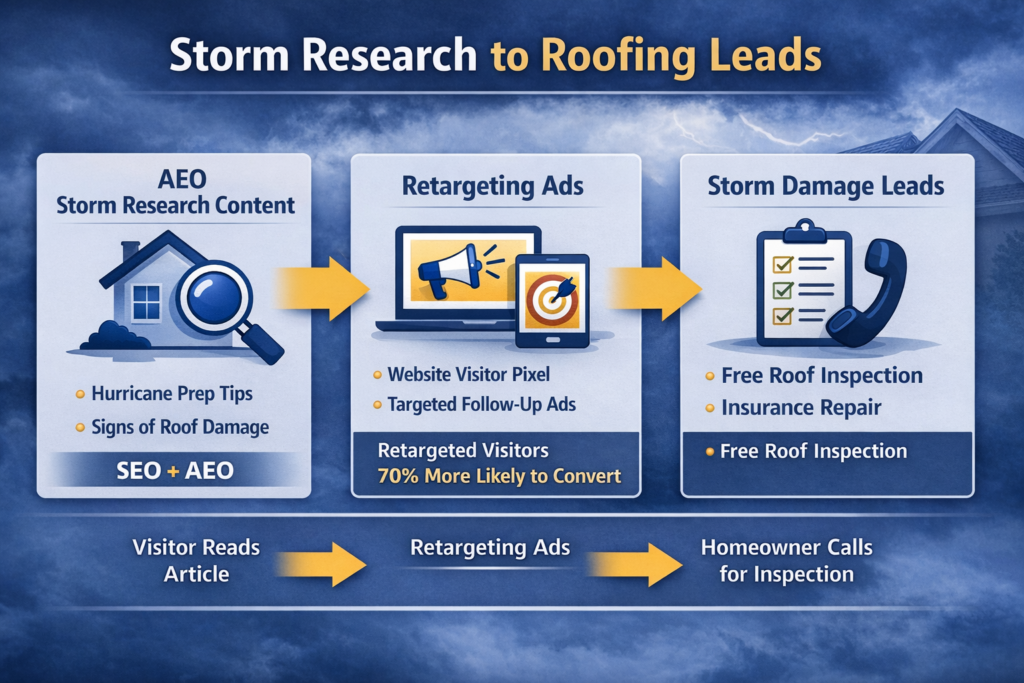
- Retargeted visitors are up to 70% more likely to convert than new visitors.
- Retargeting ads can generate 2–3 times higher conversion rates compared to cold advertising campaigns.
- Click-through rates for retargeting ads are often two to ten times higher than standard display ads.
This performance difference exists because the audience already knows the company from their previous research.
AEO + Retargeting Creates a Powerful Conversion Strategy
When roofing companies combine AEO content with retargeting ads, they create a marketing system that reaches homeowners during multiple stages of the decision process.
The strategy looks like this:
Homeowner researches storm preparation
↓
Educational article appears in search results or AI answers
↓
Visitor reads article and learns about storm damage
↓
Visitor added to retargeting audience
↓
Storm hits the area
↓
Targeted retargeting ads appear
↓
Homeowner schedules roof inspection
Instead of competing only when homeowners search for contractors, roofing companies can remain visible throughout the entire research cycle.
Geographic Targeting After Storms
One of the most powerful features of modern advertising platforms is geographic targeting.
Roofing companies can run ads specifically in areas affected by severe weather.
For example, ads can be targeted by:
city
ZIP code
county
radius around a storm-affected area
This allows roofing companies to show ads only to homeowners in areas where damage is most likely.
When geographic targeting is combined with retargeting audiences, the ads reach people who have already researched storm damage and live in the affected area.
Example Retargeting Strategy for Roofing Companies
A roofing company might publish helpful guides such as:
Roof Hurricane Preparation Checklist
How to Inspect Your Roof After a Storm
Signs of Hidden Roof Damage
When homeowners read these guides, they are added to a retargeting audience.
If a storm hits the region, the company can run targeted ads such as:
Free Post-Storm Roof Inspection
Local Roofing Experts After Hurricane Damage
Because the audience has already shown interest in storm-related roofing information, these ads often produce much higher response rates.
The Roofing Research and Retargeting Loop
When SEO, AEO, and retargeting are combined, the process becomes a continuous marketing loop.
Homeowner researches storm preparation
↓
Reads roofing article online
↓
Visitor added to retargeting audience
↓
Storm occurs
↓
Retargeting ads appear
↓
Homeowner schedules inspection
This approach allows roofing companies to stay visible throughout the entire decision process instead of competing only at the moment someone searches for a contractor.
The Future of Roofing Lead Generation
As search engines increasingly incorporate AI-generated answers and homeowners continue researching repairs online, roofing companies must adapt their marketing strategies.
Educational content attracts homeowners early through SEO and AEO.
Retargeting ads reconnect with those visitors when they are most likely to need service.
When these strategies are combined with geographic targeting after storms, roofing companies can create a marketing system that captures demand throughout the entire storm damage research cycle.
Search technology is changing rapidly as artificial intelligence becomes part of how people research problems online. Many questions that once required browsing multiple websites are now answered directly by AI systems or search engine summaries. Because of this shift, websites increasingly focus on Answer Engine Optimization (AEO) and Generative Engine Optimization (GEO). AEO helps content appear as direct answers in search results, while GEO helps AI systems use a website as a trusted source when generating explanations. Together, these strategies help businesses stay visible during the early research stage of the customer journey. You can learn more about how these approaches work in our guide to AEO vs GEO and the future of search.
Florida homeowners using AI to research roof damage are not just looking for a roofer. They are trying to understand financial exposure. This calculator supports that behavior by helping visitors estimate a realistic roof replacement budget range before they ever request an inspection. On a page about GEO and AI-driven roofing research, it adds useful decision-stage context at the exact moment people are asking how serious the damage may be, what replacement could cost, and whether they should act now.
Roof Replacement
Budget Range Calculator
Answer 7 quick questions. Get an honest project range — before a contractor ever knocks on your door.
Disclaimer: This calculator provides a general budget range for planning purposes only. It is not a formal quote, bid, or contract. Actual costs depend on site conditions, material availability, local permit requirements, and contractor pricing. Always obtain written estimates from licensed roofing contractors before making financial decisions.