Reading on Google?
Add Tampa Web Technologies as a preferred source to see more of our AEO and SEO research in your Top Stories.
Your SEO Rankings Don’t Predict Your AI Citations. Here’s the Data.
If the top Google result was also the top AI citation, we’d only need one optimization strategy. Our 550-citation study shows the overlap is smaller than most SEO professionals assume — and the implications for how you structure content are significant.
The engines agree less than you think
We tracked 550 citations across ChatGPT, Perplexity, and Gemini across 16 verticals. Here’s what the domain-level data shows about how much the three engines agree with each other — never mind how they agree with Google’s traditional organic rankings.
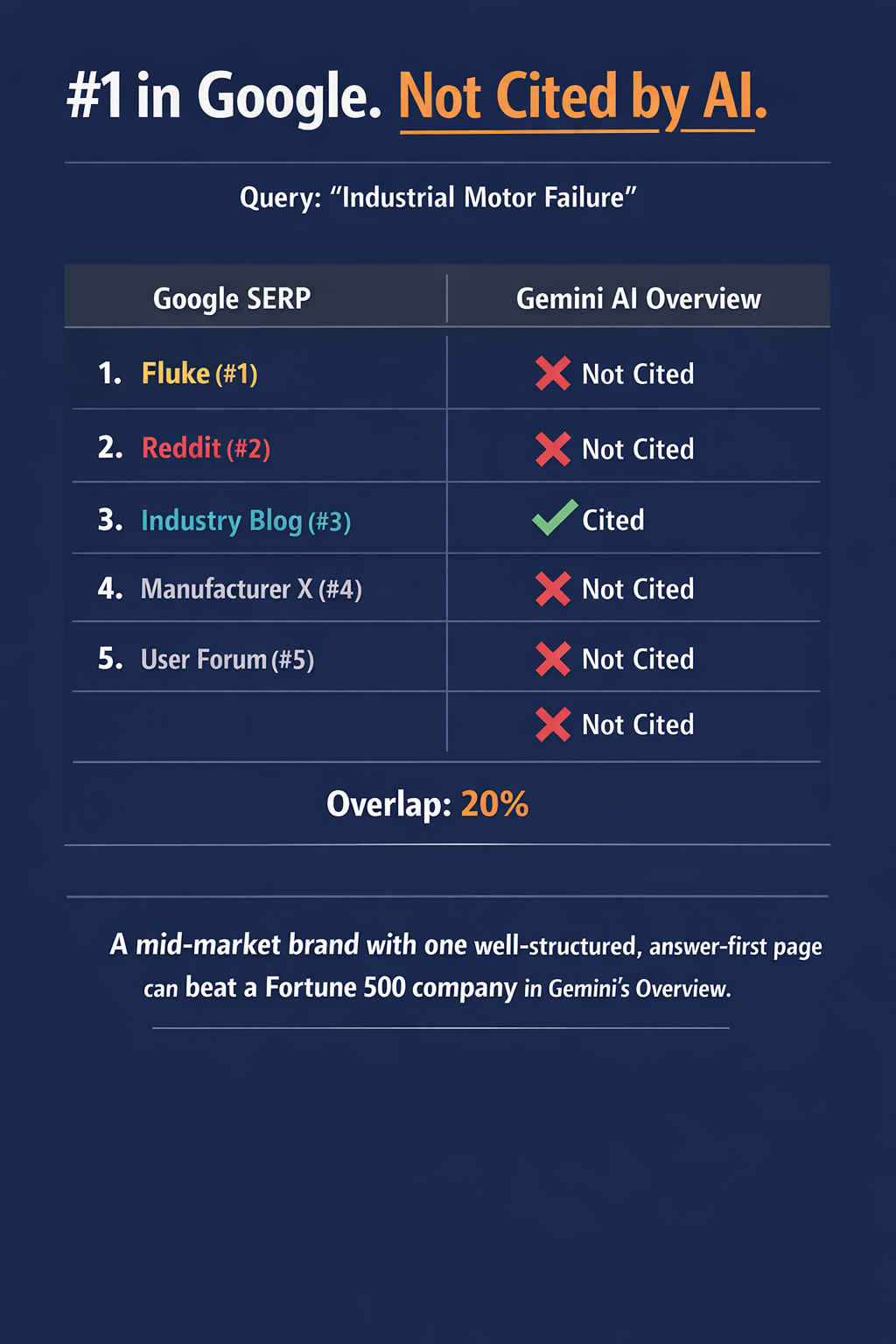
Only 20 domains appear across all three AI engines. Another 108 are unique to just one engine. That’s before we even compare AI citations to traditional Google organic results — because Google AI Overviews and traditional Google blue-link SERPs already disagree with each other on the same queries.
Where SEO and AEO still overlap, and where they don’t
Traditional SEO and AEO share foundations. Diverge sharply at specific checkpoints.
What this means for SEO practitioners
SEO is not obsolete — it’s incomplete
Ranking well in traditional Google search still drives significant traffic. But if your AEO strategy is “keep doing SEO and hope for the best,” the data says you’re going to miss citations your competitors are capturing with different work. Traditional SEO optimizes for click-through. AEO optimizes for extractability. Those are different engineering problems.
The pages that win both are the ones that look like AEO pages
Pages with direct factual statements, clear hierarchical structure, schema markup, and entity-validated authorship tend to perform in both traditional search and AI citations. The reverse is not true — plenty of high-ranking Google pages do not appear in AI citations, often because they are conversationally written without extractable structure.
Start measuring AI citations as a separate channel
If your reporting tracks only traditional organic rankings, you are missing half the picture. AI citation tracking is still imperfect, but it exists. At minimum, run manual queries in ChatGPT, Perplexity, and Gemini for your core commercial terms and document who gets cited. The gap between your Google ranking and your AI citation share is the size of the opportunity.
Related analysis

David Chamberlain is a search strategist and founder of Tampa Web Technologies, where he focuses on the intersection of AI and search visibility. His work centers on Answer Engine Optimization (AEO), Generative Engine Optimization (GEO), and the structural changes reshaping how businesses appear in AI-driven results. David has 17 Years of Tech Experience.
He writes regularly on AI search updates, industry shifts, and the evolving dynamics of zero-click discovery, providing analysis designed for business leaders and technical teams.