Reading on Google?
Add Tampa Web Technologies as a preferred source to see more of our AEO and SEO research in your Top Stories.

In 2009, I wrote a blog post that I was genuinely proud of.
It walked readers through a workflow I had figured out that felt like a cheat code. Upload one video to a site called TubeMogul, and it would simultaneously push that video to YouTube, DailyMotion, Yahoo Video, MySpace, MetaCafe, Veoh, Blip.tv, Vimeo, and about 17 other platforms. Connect your Facebook and Twitter accounts, and those would auto-post too. One upload. Twenty-five distribution points. Done before lunch.
At the time, that was the strategy. Search engines and social platforms were essentially raw aggregators — they rewarded volume, velocity, and surface area. Whoever occupied the most real estate won. I wasn’t gaming the system. I was the system.
That blog post is still sitting on the internet somewhere, complete with a TubeMogul badge, an embedded Google AdSense block from 2009, and a list of video platforms where at least half no longer exist.
It’s a perfect time capsule. And looking back at it now — through the lens of what digital visibility actually means in 2026 — it tells a story about something most marketing articles get wrong.
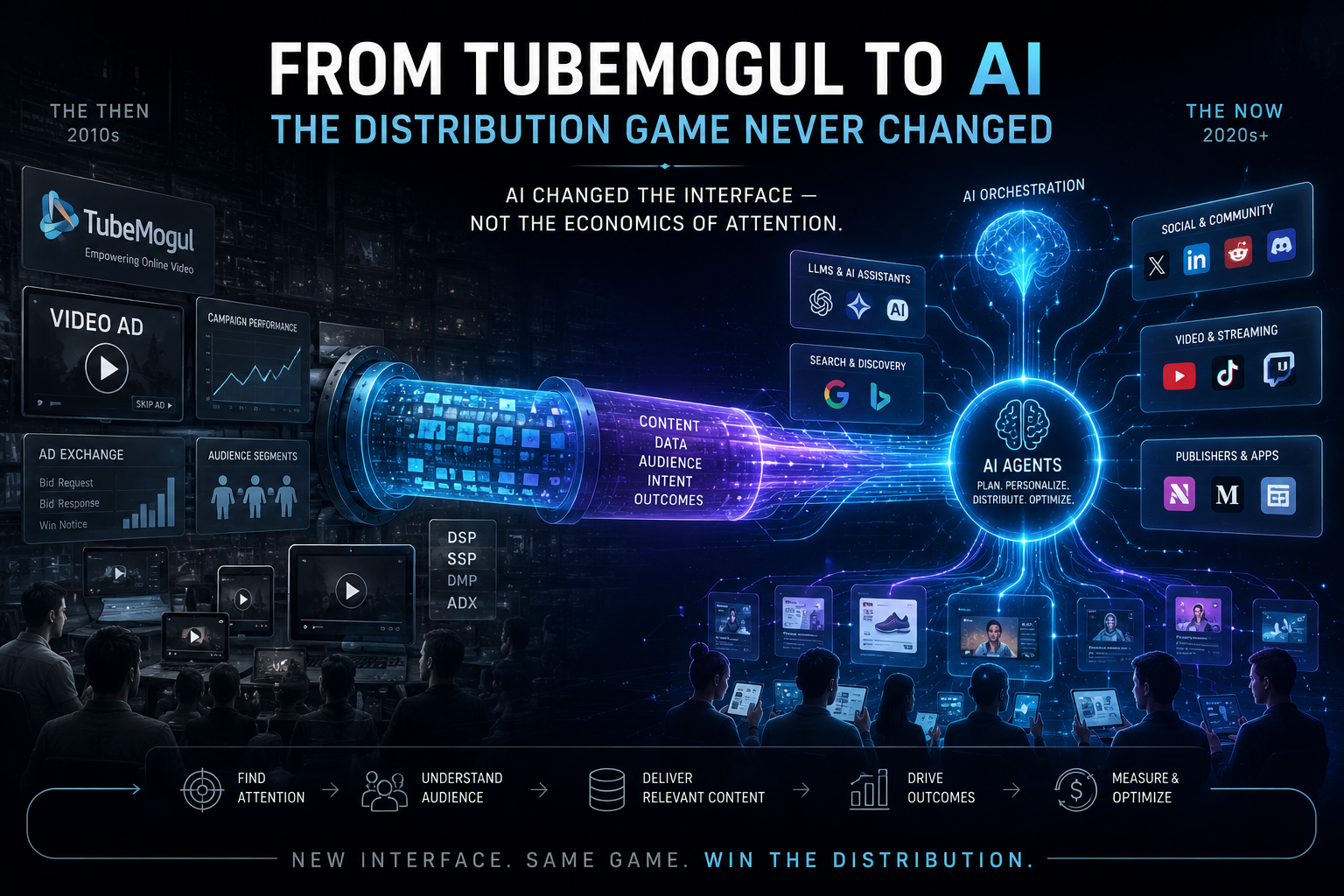
The tools have completely changed. The underlying logic never did.
The 2009 Playbook: Whoever Controls the Volume Controls the Narrative
The fundamental question in 2009 was simple: how many places can I be at once?
Google’s algorithm was heavily weighted toward keyword density and inbound link count. Social platforms showed content chronologically. There was no engagement scoring, no authority weighting, no semantic understanding. If you published more than your competitor and put your content in more places, you ranked higher and got seen more.
TubeMogul was a perfect expression of that logic. It didn’t make your content better. It made your content everywhere. And everywhere was what mattered.
The SEO equivalent was link velocity — building massive webs of interconnected pages, directories, and article submissions that forced Google’s crawlers to recognize your sheer presence. Exact-match domain names. Keyword-stuffed descriptions. RSS syndication to every aggregator that would take your feed.
It was gameable by anyone willing to put in the hours. And a lot of us did.
The 2015 Correction: The Platforms Got Smart
The party ended in waves.
Google’s Panda and Penguin algorithm updates systematically dismantled the link farm economy. Sites that had been riding keyword stuffing and manufactured backlinks to page one rankings got wiped overnight. The message was clear: volume without quality was now a liability, not an asset.
Social platforms made a parallel move, killing chronological feeds and replacing them with engagement algorithms. Organic reach collapsed. If your content didn’t generate immediate interaction, it effectively didn’t exist — and if you wanted guaranteed distribution, you paid for it.
The new game was authority. It was no longer about having the most links; it was about having the right links — citations from Wikipedia, coverage in Forbes, mentions in trade publications that Google had already decided to trust. Entity-based search started mattering. Who you were in Google’s knowledge graph was becoming as important as what keywords you targeted.
The underlying logic, though? Identical to 2009. Find the system’s trust mechanism. Saturate it. Control the narrative at the point of discovery.
The mechanism had just moved from volume to authority.
2026: The Mechanism Has Moved Again
Here’s what’s changed in the last two years that most marketing teams haven’t fully absorbed yet.
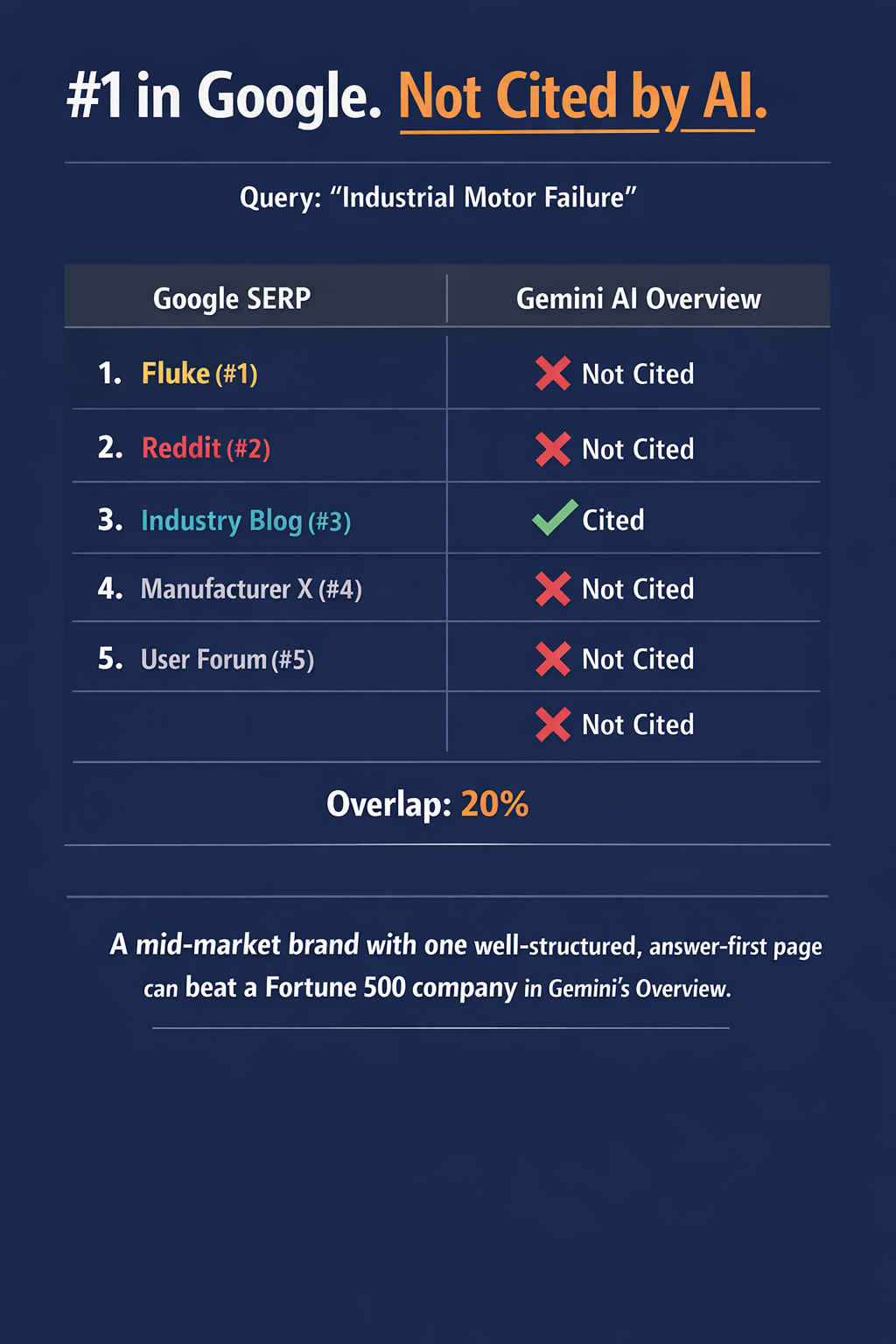
When someone needs to evaluate a vendor, understand an industry, or make a purchasing decision today, a significant and growing portion of them aren’t running a Google search and scanning ten blue links. They’re opening ChatGPT, Claude, or Perplexity and asking a direct question. They get a synthesized answer. They may never see a search results page at all.
The entity constructing that answer isn’t a crawler counting links. It’s a large language model retrieving contextual information from its training data and live sources — and assembling what it has determined to be the most accurate, authoritative response to the query.
This changes the distribution problem entirely.
In 2009, you needed your content on 25 platforms. In 2015, you needed your content cited by 25 authoritative sources. In 2026, you need your content structured so that an LLM retrieves it as a reliable answer to the 25 underlying questions it’s using to construct its response.
That’s Answer Engine Optimization. And it requires a fundamentally different approach to how you build and structure content.
The New TubeMogul: Structuring for LLM Retrieval
The TubeMogul insight in 2009 was that the platform rewarded distribution breadth, and one upload could serve all of it. The equivalent insight today is that AI engines reward semantic clarity and structured authority — and one well-architected content node can serve dozens of retrieval queries simultaneously.
What does that look like in practice?
Where 2009 content was optimized for keyword density, 2026 content is optimized for question resolution. An LLM isn’t scanning your page for the word “CNC spindle repair.” It’s asking: What does this source say about why spindles fail? What repair process does it describe? What expertise signals does it contain? Is this consistent with what other trusted sources say about this topic?
Where 2015 SEO chased backlinks from authoritative domains, 2026 AEO builds what’s sometimes called a citation architecture — a cluster of structured, interlinked content nodes that collectively signal topical authority to AI engines. Hub pages. Supporting detail pages. FAQ schema that matches the exact question patterns users are actually asking. Internal linking that reinforces entity relationships rather than just passing PageRank.
Where 2009 blasted content outward to claim surface area, 2026 strategy places highly structured, factual content on trusted data nodes — industry publications, verified databases, structured schema markup — so that AI systems naturally retrieve your framing as ground truth when they construct answers in your category.
The goal hasn’t changed. You still want to control the narrative at the point of discovery. The point of discovery has just moved from a search results page to the inside of an AI response.
What the Old Playbook Gets You Now
If you’re still running a 2015 SEO strategy — chasing backlinks, optimizing title tags, publishing press releases and hoping Google ranks them — you’re not necessarily losing ground in traditional search yet. But you’re building no presence whatsoever in the AI answer layer, which is where an increasing share of discovery is happening.
And if you’re running something closer to the 2009 playbook — volume, syndication, keyword targeting — you’re actively accumulating the kind of thin, undifferentiated content that LLMs learn to ignore or discount.
The inversion is real. What used to be a distribution advantage is now a trust signal liability.
The Throughline
I’m glad that 2009 blog post is still out there. Not because the tactics hold up — TubeMogul doesn’t exist anymore, and neither does most of the platform list — but because it’s honest evidence of what the game looked like from inside it.
Every era has a distribution mechanism. Every era has a trust signal that the dominant discovery system rewards. The practitioners who win are the ones who identify the current mechanism clearly, build deliberately for it, and don’t mistake the tools of the last era for timeless strategy.
In 2009, that mechanism was syndication volume. In 2015, it was editorial authority. In 2026, it’s semantic structure and LLM retrievability.
The question worth asking right now isn’t whether AI search is real or whether it applies to your industry. It’s whether the content you’re building today is structured to be retrieved, cited, and trusted by the systems that are increasingly constructing the answers your buyers are reading.
If it isn’t, you have a TubeMogul problem. Just a different kind.
David Chamberlain is the founder of Tampa Web Technologies, a digital agency specializing in AEO, GEO, and AI citation strategy for industrial and B2B clients.

David Chamberlain is a search strategist and founder of Tampa Web Technologies, where he focuses on the intersection of AI and search visibility. His work centers on Answer Engine Optimization (AEO), Generative Engine Optimization (GEO), and the structural changes reshaping how businesses appear in AI-driven results. David has 17 Years of Tech Experience.
He writes regularly on AI search updates, industry shifts, and the evolving dynamics of zero-click discovery, providing analysis designed for business leaders and technical teams.