Reading on Google?
Add Tampa Web Technologies as a preferred source to see more of our AEO and SEO research in your Top Stories.

GEO Is Not AEO. Here’s What We’re Still Figuring Out.
Generative Engine Optimization and Answer Engine Optimization get used interchangeably. They shouldn’t be. One is about being cited. The other is about being part of the generated answer itself — and the strategies are different enough to matter.
The difference that actually matters
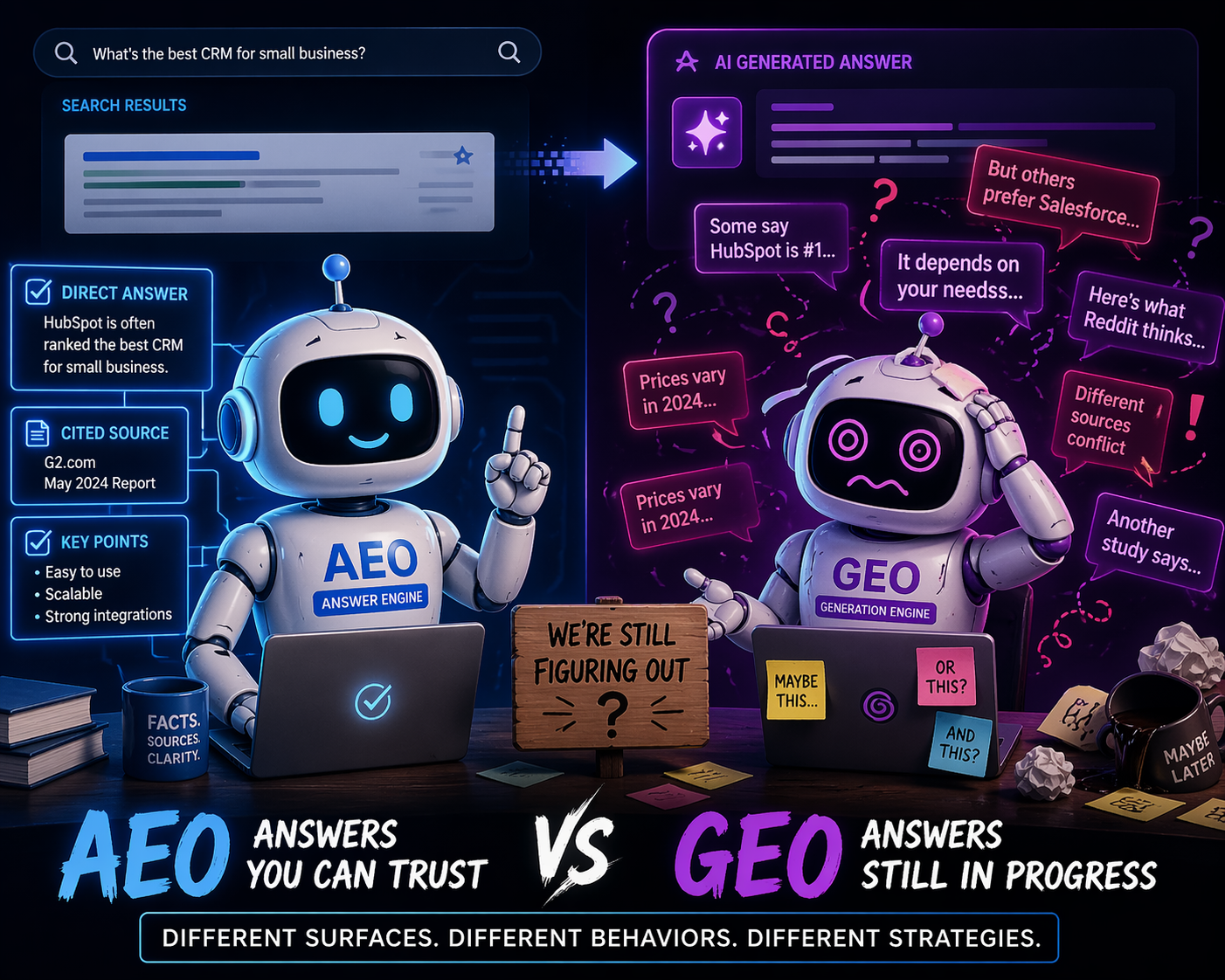
AEO is about being the source an AI engine cites when it answers a user question. GEO is about shaping the generated answer itself — the language, framing, and facts that end up in the response whether or not your URL is linked.
AEO
Optimizing to be cited. Structured content, clear facts, schema markup, and entity authority so AI engines point back to your page.
GEO
Optimizing the generated answer. Content distribution strategy that puts your facts, framing, and language into the training and retrieval data AI models pull from.
Put simply: AEO wins citations. GEO wins the narrative even when no citation appears. Both matter, but they’re different disciplines requiring different work.
What we know versus what we’re still measuring
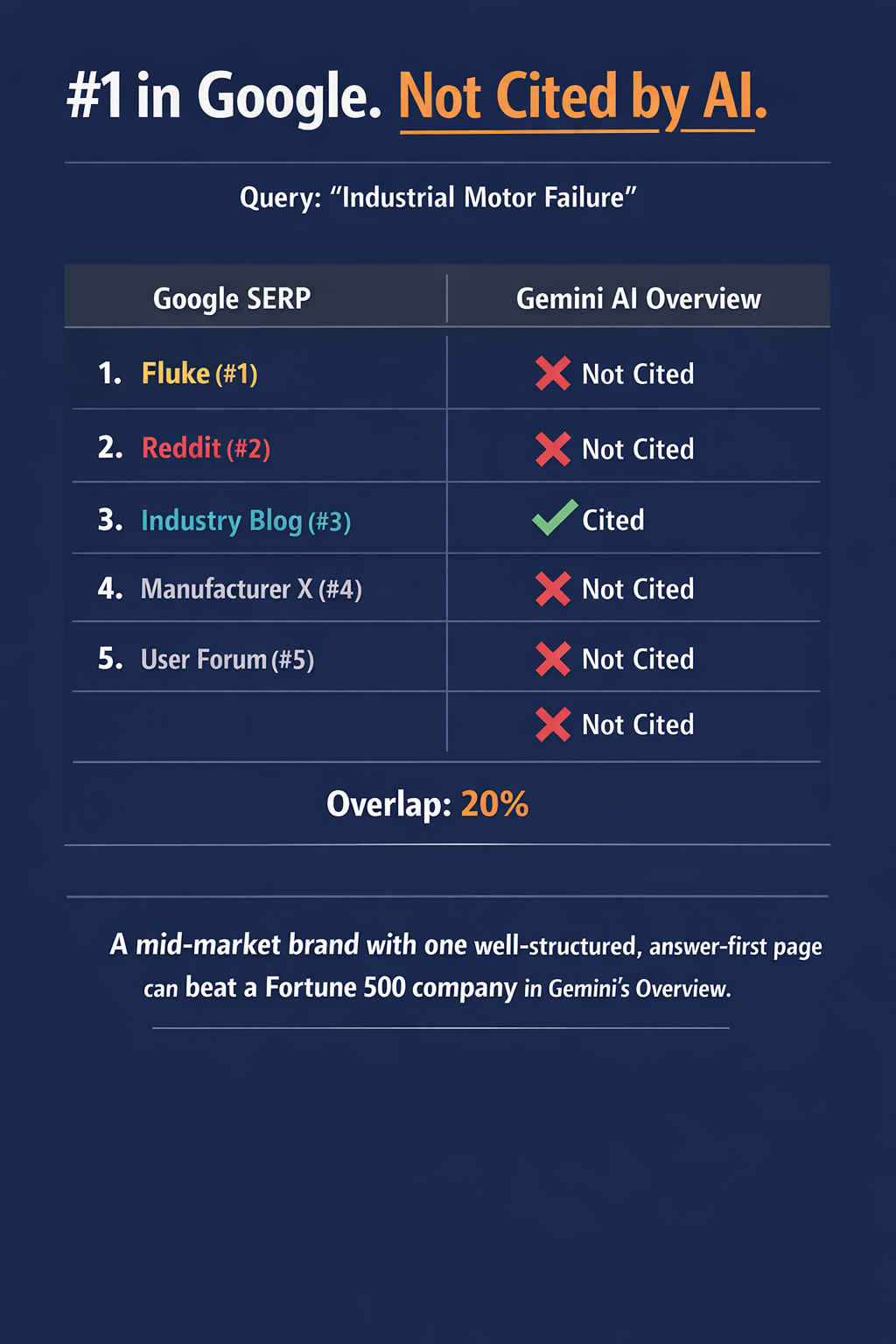
Our citation study measures what appears in AI answers — which makes it a clean AEO dataset. It doesn’t measure the language AI engines use when summarizing, paraphrasing, or generating responses without a citation. That’s where GEO lives, and honestly, that’s a harder thing to measure.
We have early signals. Brands whose content shows up consistently in AI citations also tend to have their phrasing echoed back in AI-generated answers. But we don’t have the data yet to publish a framework on how to deliberately shape AI-generated language the way we can publish a framework on how to earn citations.
Rather than publish GEO theory we haven’t tested, we’d rather wait until we have something worth saying.
What we’re working on: a methodology for measuring paraphrased and un-cited brand mentions in AI responses across ChatGPT, Perplexity, and Gemini. When that’s producing real numbers, we’ll publish.
The working hypothesis on GEO levers
Based on what we’ve observed but not yet formally tested, GEO likely depends on three things that AEO only partly overlaps with:
1. Consistency of phrasing across your content library
AEO rewards well-structured individual pages. GEO probably rewards repeated framing across many sources, so models learn to associate certain language with your brand or domain.
2. Third-party content reinforcement
AEO is heavily owned-content driven. GEO may lean more on third-party validation — trade publications, academic citations, industry reports — using the same factual claims you make. Repeated corroboration across the web becomes training signal.
3. Factual specificity over marketing language
AI models generate summaries from specifics. Brands that state exact numbers, mechanisms, and technical details likely get those specifics echoed back in generated answers. Marketing-language-heavy sites get paraphrased into generic summaries.
These are working theories, not proven frameworks. Our research pipeline is designed to test them.
Follow the research as it develops
We publish AEO and GEO research at Tampa Web Technologies — data-backed, no fabricated metrics.
Read the AEO Research
David Chamberlain is a search strategist and founder of Tampa Web Technologies, where he focuses on the intersection of AI and search visibility. His work centers on Answer Engine Optimization (AEO), Generative Engine Optimization (GEO), and the structural changes reshaping how businesses appear in AI-driven results. David has 17 Years of Tech Experience.
He writes regularly on AI search updates, industry shifts, and the evolving dynamics of zero-click discovery, providing analysis designed for business leaders and technical teams.