Reading on Google?
Add Tampa Web Technologies as a preferred source to see more of our AEO and SEO research in your Top Stories.

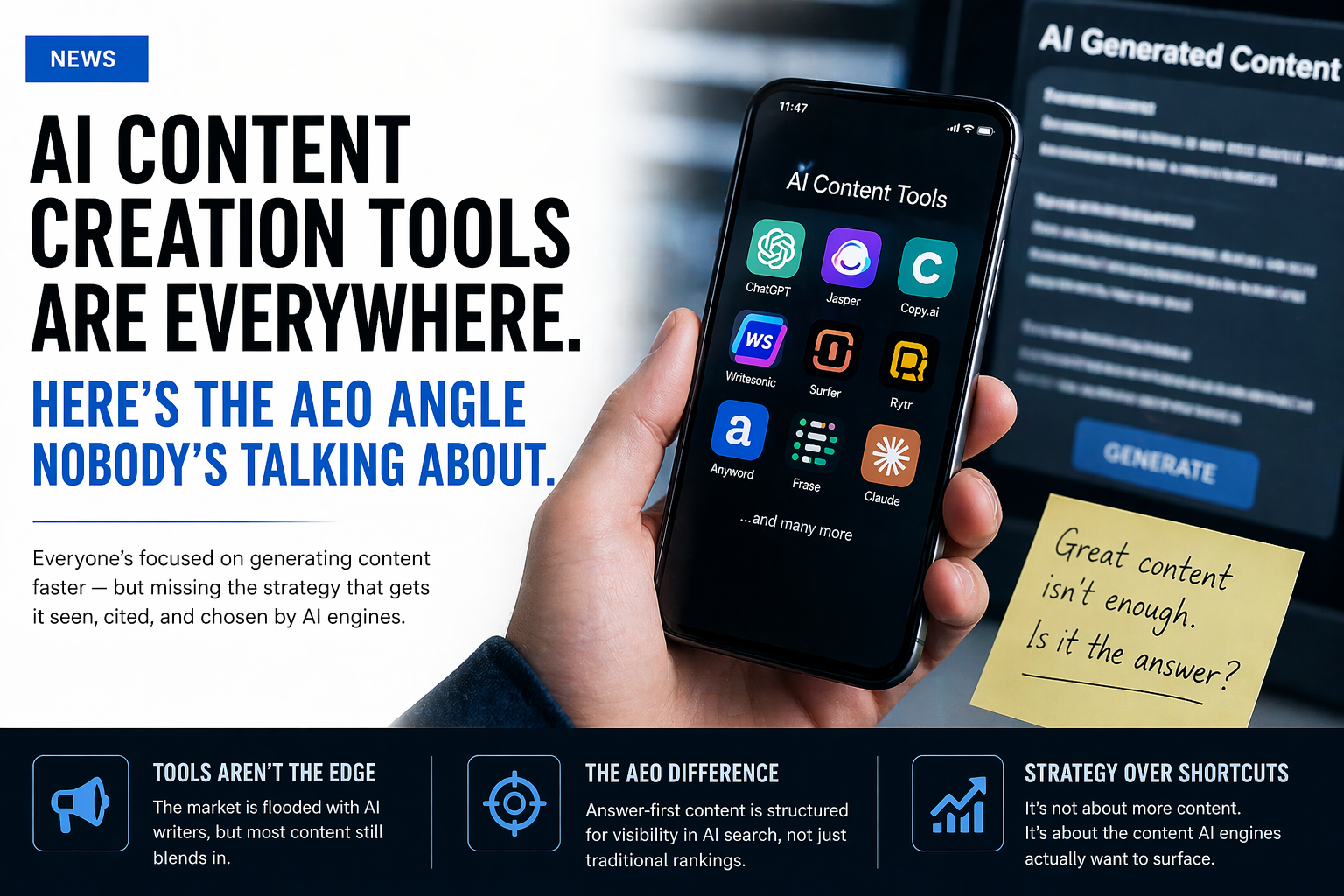
AI Content Creation Tools Are Everywhere. Here’s the AEO Angle Nobody’s Talking About.
Midjourney, Sora, ElevenLabs, Runway, Claude, ChatGPT — every week brings another content creation tool. Most AEO coverage treats these as a separate conversation from citation strategy. They shouldn’t be. How you use AI to make content has direct consequences for whether AI engines cite that content later.
The connection most coverage misses
AI content tools are being marketed around efficiency — ten blog posts in an hour, a hundred social images in an afternoon, a full product video in a weekend. The pitch is about volume.
The problem is that AI engines — the ones you want citing your content — are getting measurably better at detecting and deprioritizing AI-generated content that lacks original substance. Content that looks and reads like every other piece on the topic gets paraphrased away into generic summaries without attribution. Content with specific, verifiable, original claims gets cited.
The brands that will win AEO are not the ones producing the most AI content. They are the ones using AI to do the boring parts faster so human experts can write the specific, evidence-grounded claims that AI engines actually cite.
What each tool category means for AEO
AI text generation (ChatGPT, Claude, Gemini)
Use for: research synthesis, outline drafting, first-pass copy, editing assistance.
Do not use for: final published claims, technical specifications, statistics, proprietary methodology, or anything that needs to appear in AI citations.
AEO implication: Pure AI-generated content scores low on our Page Structure Score metric because it tends toward generic phrasing, vague claims, and missing specifics. The pages that get cited have an expert voice — AI can assist but cannot replace.
AI image generation (Midjourney, DALL-E, Stable Diffusion)
Use for: concept art, blog illustrations, hero images where specificity does not matter.
Do not use for: product photography, technical diagrams, process documentation, or anything where accuracy of what’s shown matters.
AEO implication: AI engines index images via alt text, surrounding captions, and schema. A beautiful AI image with generic alt text ranks worse than a basic real photo with detailed descriptive alt text. For AEO, the metadata matters more than the visual.
AI video generation (Sora, Runway, Veo)
Use for: explainer animation, motion graphics, concept videos, social content.
Do not use for: demonstrable proof of product function, real customer footage, expert interviews, or technical walkthroughs.
AEO implication: YouTube is one of the highest-frequency citation sources in our dataset (24 Gemini citations, 16 Perplexity citations). But what’s cited is substantive content — product demos, expert explanations, technical breakdowns. AI-generated filler video rarely gets cited because the transcripts lack specific information worth extracting.
AI voice and audio (ElevenLabs, Suno, podcast tools)
Use for: voiceover on training content, language localization, accessibility features.
Do not use for: original podcast content claiming expertise, audio testimonials, any audio that will be transcribed and cited as a primary source.
AEO implication: Audio content gets indexed via transcripts. AI-generated audio with AI-generated scripts produces transcripts that look like everything else. Original audio with specific expert claims produces citable text.
The working rule for AI content creation in an AEO-aware workflow
Use AI for production. Use humans for claims.
Production means: outlines, drafts, images, visual assets, transcription, editing, format conversion, localization. Claims means: the specific facts, statistics, methodology, case study details, technical specifications, and expert interpretations that make content worth citing.
A human-written article with AI-assisted editing outperforms a fully AI-generated article in AEO almost every time. A real product photo with detailed alt text outperforms a Midjourney image with generic alt text. A real expert on video with clear production outperforms a fully synthetic presenter reading a generic script.
This is not an argument against AI tools. It is an argument for using them intentionally — where they accelerate work without stripping the originality that makes content citable in the first place.
Content audits that look at what AI engines actually see
Tampa Web Technologies reviews how your published content — AI-assisted or human-written — scores for AI citation extractability across ChatGPT, Perplexity, and Gemini.
Request an AEO Content Audit
David Chamberlain is a search strategist and founder of Tampa Web Technologies, where he focuses on the intersection of AI and search visibility. His work centers on Answer Engine Optimization (AEO), Generative Engine Optimization (GEO), and the structural changes reshaping how businesses appear in AI-driven results. David has 17 Years of Tech Experience.
He writes regularly on AI search updates, industry shifts, and the evolving dynamics of zero-click discovery, providing analysis designed for business leaders and technical teams.