Reading on Google?
Add Tampa Web Technologies as a preferred source to see more of our AEO and SEO research in your Top Stories.

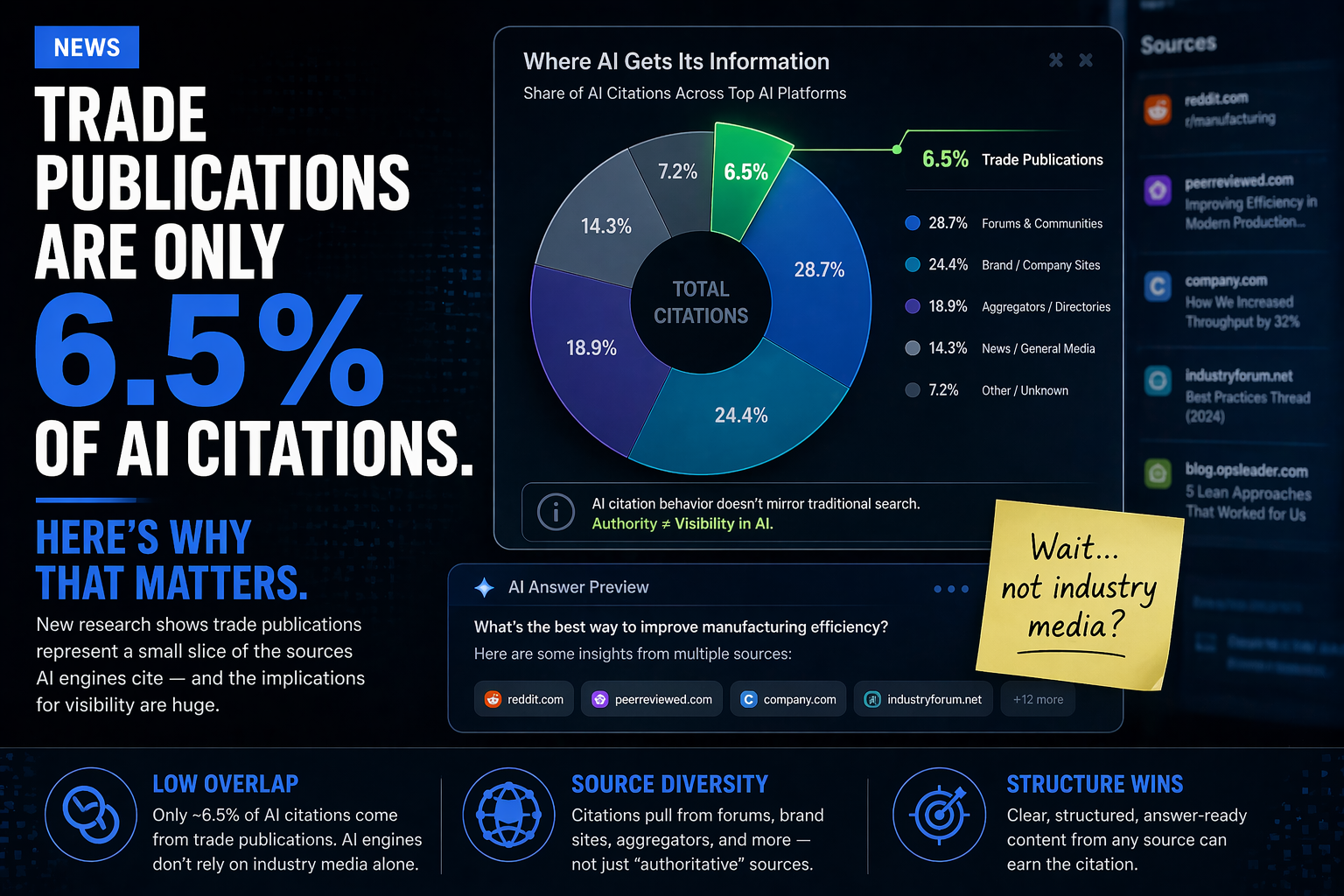
Trade Publications Are Only 6.5% of AI Citations. Here’s Why That Matters.
For decades, getting featured in a trade publication was the B2B marketing trophy. Our 550-citation AEO study shows trade pubs still matter — but far less than the industry assumes, with sharply vertical-specific patterns most PR strategies ignore.
The headline numbers
Across 550 AI citations covering ChatGPT, Perplexity, and Gemini across 16 verticals, here’s what trade publications contributed.
Trade publications accounted for 36 of 550 citations — below owned brand content (46.4%), independent sources (22.7%), and third-party references (16.4%). The PR assumption that trade press is an AEO lever needs serious revision.
Where trade publications actually show up in AI citations
Distribution is sharply vertical-specific. Some categories get heavy trade pub coverage; others get none at all.
Half the verticals in our study have zero trade publication citations. If you sell roofing services, automation technology, healthcare software, or industrial IoT, chasing trade press coverage for AEO purposes is investing in a surface that does not exist for your category.
Why trade publication PSS runs so low
Page Structure Score measures how extractable content is for AI — direct factual statements, clear hierarchy, schema markup, topical alignment. Trade publications score consistently below other citation types.
Three reasons trade pub content underperforms on extractability.
One. Trade publications are built for trade-reader skimming. Headlines and ledes are crafted for clicks, not for clean factual extraction. A trade headline often makes a claim the article body then qualifies heavily, which fragments the extractable fact.
Two. Most trade pubs underinvest in schema markup, structured data, and technical SEO. Compare a typical Equipment World article to a Schneider Electric product page — the brand page has Article, Product, and FAQ schema layered in. The trade article often has none.
Three. Trade pub rankings and “10 best” articles tend to be thin. The IndustryWeek US 500 listing we saw cited (PSS 10) is a table of company names. The actual analysis sits behind a paywall or in a PDF. AI engines extract what’s visible.
The pattern that actually matters
When a trade publication citation does land a high Page Structure Score, it shares specific traits. The two highest-scoring trade citations in the dataset illustrate what works:
Distribution Strategy’s Carrier Abound coverage scored PSS 74 on Gemini. The article is structured like a tutorial — headline states the claim, body delivers specifics about the Tell Me More feature, quote blocks from Carrier leadership, clear product naming throughout. It reads like extractable reference content, not puffery.
Trucking Info’s Terex HyPower IM coverage scored PSS 73 on Perplexity. The article opens with concrete fuel reduction numbers, names the specific product model, and maintains factual density throughout. No marketing abstractions.
High-scoring trade pub citations read more like well-written product documentation than journalism. When trade press gets cited by AI, it’s usually the articles that look like owned content.
That has a specific implication. If you’re working with trade publications, treat placement as a factual density exercise, not a brand awareness exercise. The article you want written is not “Brand X is leading the industry forward.” It’s “Brand X’s Product Y reduces Z by W percent because of mechanism V.” One is paraphrased away in AI responses. The other gets cited.
What this means for your PR and AEO strategy
Check whether your vertical even has trade pub AEO surface
Before you invest in trade publication placement for AEO purposes, run the test. Query ChatGPT, Perplexity, and Gemini about your category’s most-cited brands. Count how many trade pub URLs appear. If the answer is zero or near-zero across all three, trade press is not an AEO lever for your vertical. It may still have value for brand building and lead generation — but not for citation strategy.
If your vertical does use trade pubs, pick the ones AI actually cites
Utility fleet vehicles cited Trucking Info and MWS Magazine. Industrial equipment cited Equipment World and IndustryWeek. Precision agriculture cited MSU Extension and CropLife. These are specific, measurable placements. Vague “trade press outreach” across random publications does not move AEO needles.
Write for factual density, not narrative
The trade articles that got cited at PSS 70+ read like technical reviews. Specific product names. Exact numbers. Named mechanisms. If you are drafting contributed articles or working with trade publication writers, push for concreteness. The article with ten named facts gets cited. The article with one named fact and nine paragraphs of narrative gets paraphrased away.
Owned content still outperforms
Across every vertical with trade pub citations, owned brand content was cited more frequently and at higher quality scores. Trade press is a supplementary channel at best. The foundation is still your own website documenting your own products at extractable quality.
Related analysis
The earned media myth
Why the widely-cited “85% of AI answers come from earned media” claim does not match the data.
Read →Reddit and LinkedIn reality check
Combined they’re 2.7% of citations and never drive the answer. The LinkedIn discourse has it wrong.
Read →AEO Research
How the three AI engines cite content, broken down by engine and vertical.
Read →Know where your AI citations actually come from
Tampa Web Technologies audits your real AI citation mix — which surfaces drive answers in your vertical versus which ones are noise.
Request an AI Citation Audit
David Chamberlain is a search strategist and founder of Tampa Web Technologies, where he focuses on the intersection of AI and search visibility. His work centers on Answer Engine Optimization (AEO), Generative Engine Optimization (GEO), and the structural changes reshaping how businesses appear in AI-driven results. David has 17 Years of Tech Experience.
He writes regularly on AI search updates, industry shifts, and the evolving dynamics of zero-click discovery, providing analysis designed for business leaders and technical teams.