
Marine Construction · Strategic Intelligence · 2026
The 2026 Marine Procurement Gap: How AI Search and Risk Management are Redefining Tampa Waterfront Construction
In 2026, the marine contractor with the strongest digital presence is not necessarily the one with the best design. It is the one that makes complex work easiest to understand, trust, and cite.
Executive Brief
A structural procurement shift is underway in the Tampa Bay waterfront construction market. Developers, marina stakeholders, and commercial project teams are no longer just evaluating what a contractor builds — they are evaluating how well a contractor manages schedule risk, permitting complexity, documentation discipline, and project uncertainty. In this environment, a marine contractor’s digital presence is not a marketing asset. It is part of the risk-reduction infrastructure a buyer evaluates before the first call. The firms that publish interpretable, technically specific, buyer-centered content will increasingly win discovery, trust, and shortlist position over firms with equal or better field capability and a weaker information layer.
The End of Handshake Discovery
For decades, marine contractor selection in markets like Tampa Bay operated through a fairly predictable channel. Referrals. Repeat relationships. Local reputation built through visible project work on the waterfront. The contractor who had done the marina two miles up the coast was the one who got the call.
That channel still exists. But it no longer operates alone — and for a growing share of commercial projects, it is no longer the primary one.
Developers sourcing contractors for waterfront mixed-use projects, marina operators evaluating reconstruction bids, and port facility managers assessing commercial dock contractors are all doing structured digital research before the first conversation. They are using search engines. They are using AI Overviews and answer engine tools that synthesize contractor information across multiple sources. They are reviewing LinkedIn profiles, project documentation, and published technical content as part of an internal due diligence process that may involve multiple stakeholders.
In this environment, consider a simple but consequential scenario: a developer’s project team asks an AI assistant which Tampa marine contractors appear most prepared for permitting coordination and schedule management on a commercial waterfront project. The AI does not know who won the last handshake deal. It cites the firms whose digital content most clearly demonstrates those capabilities — in structured, interpretable, specific language. The contractors who have published that content are in the room. The contractors who have not are invisible in a conversation they did not know was happening.
How Contractor Discovery Has Changed
| Discovery Factor | Legacy Model | 2026 AI-Era Model |
|---|---|---|
| Primary sourcing channel | Referral networks, local reputation, project visibility | Search, AI Overviews, answer engines, internal digital research |
| Credibility signal | Completed project photos, word of mouth | Structured technical content, permitting fluency demonstrated in writing |
| Shortlist formation | Based on known relationships and local visibility | Increasingly shaped by digital presence before any contact |
| Evaluation criteria | Field capability, price, availability | Risk reduction, schedule certainty, documentation discipline, permitting fluency |
| AI citation eligibility | Not a factor | Determined by content specificity, structure, and interpretability |
| Who wins the introduction | The contractor with the best local network | The contractor with the clearest, most interpretable digital presence |
The 2026 Risk-Management Buyer
The commercial waterfront buyer in 2026 is operating in a project environment shaped by labor shortages, cost volatility, insurance scrutiny, and a permitting landscape that has grown more complex with each regulatory cycle. They are not just hiring someone to build a dock. They are trying to manage risk exposure across a project timeline that touches multiple agencies, involves significant capital, and carries real schedule consequences if something goes wrong.
That framing changes what they are looking for in a contractor — and it changes what a contractor’s website needs to communicate. The evaluation criteria that serious commercial buyers bring to the research phase now include:
- Evidence of permitting fluency — not just “we handle permits” but demonstrated understanding of the specific regulatory process
- Schedule discipline — signals that the contractor manages timelines predictably and communicates proactively when conditions change
- Documentation practice — evidence that the firm produces traceable project records, not just finished work
- Communication systems — indication that the contractor has structured processes for keeping stakeholders informed
- Operational visibility — some indication of how the firm manages active-site complexity, phased execution, and constraint management
- Commercial project experience — clear differentiation from residential or light-commercial work at smaller scale
The best marine contractor website in 2026 is not the one with the prettiest gallery. It is the one that creates the most information gain for a buyer trying to reduce risk.
A website that addresses none of these criteria — that shows finished work without explaining the discipline behind it — is not a neutral asset in this environment. For a sophisticated buyer running a structured evaluation, it is a gap in the evidence they need to move forward with confidence.
Documentation Is Not a Back-Office Function. It Is a Trust Signal.
There is a mindset shift happening among the most commercially sophisticated marine contractors that has not yet made its way onto most of their websites. The shift is this: project documentation, client communication systems, and operational traceability are no longer back-office functions. They are front-facing evidence of how a firm operates.
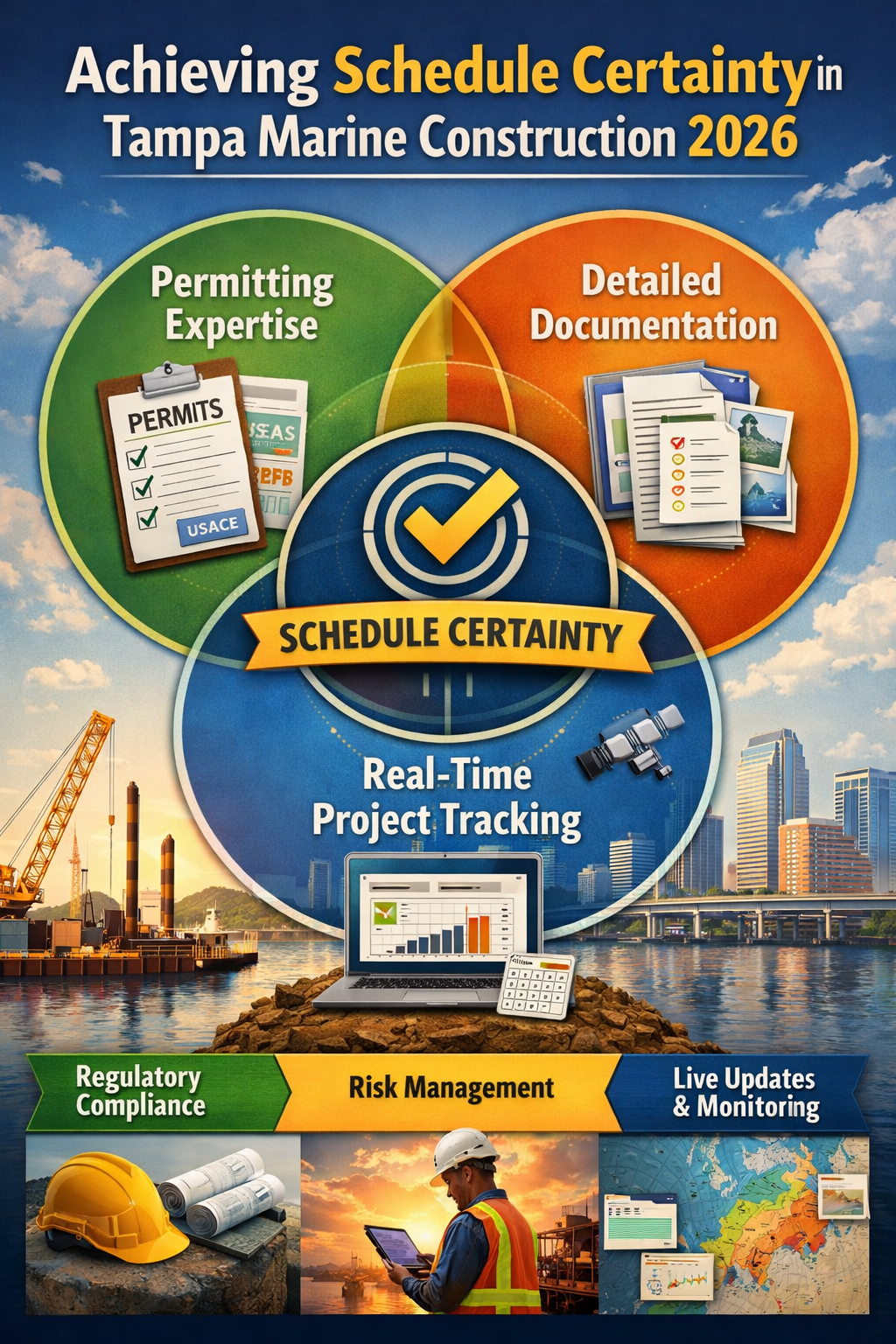
A contractor that describes its documentation practice — how progress is tracked, how site conditions are recorded, how stakeholders are kept informed, how permit milestones are logged — is communicating something important to a risk-management buyer. It is communicating that the firm runs a structured operation, not just a capable crew.
What Sophisticated Buyers Notice
Project portals, structured progress reporting, and systematic permit tracking are increasingly visible features of marine contractors who operate at higher commercial tiers. When a buyer sees that a firm has built communication infrastructure around its projects — not just field capability — it changes how they perceive delivery risk. It signals operational maturity that photographs of finished work cannot convey.
This does not require a contractor to build a client portal tomorrow. It requires them to describe, on their website, how they manage project communication, documentation, and operational visibility. That description — even in plain language, without proprietary tools — is more valuable to a commercial buyer evaluating risk than an additional gallery of completed docks.
The website is not separate from the operation. For buyers who cannot yet see the operation, the website is the operation. What it describes is what they assume exists.
From Photo-Only Proof to Bathymetric Authority
Most marine construction websites show a finished dock, a completed seawall, a reconstructed marina. The photography is often excellent. The work is real. What is missing is the technical context that transforms a visual record into a credible demonstration of expertise.
Consider two approaches to documenting the same seawall reconstruction project:
Photo-Only Proof
- Before and after photographs
- Caption: “Seawall Reconstruction — Tampa Bay”
- No site conditions described
- No permitting context
- No scope or constraint explanation
- No indication of commercial vs. residential
- Buyer must infer all relevance
Technical Case Study
- Shoreline conditions and soil boring summary
- Tidal range and access constraint context
- Permitting pathway and agency coordination noted
- Sequencing logic explained for active-site constraints
- Scope differentiated: commercial, load-bearing, operational
- Material rationale described
- Buyer can evaluate fit without a phone call
The second approach does not require the contractor to publish proprietary engineering data. It requires them to write about the work with enough technical specificity that a buyer — and an AI system — can understand why the decisions made were the right ones for that site.
Bathymetric context, soil conditions, access constraints, environmental buffers, permit sequencing, and material selection rationale are not trade secrets. They are the vocabulary of competence. Publishing them is how a firm demonstrates expertise rather than merely implying it. Technical explanation is the new proof of work — and in a market where most competitors are still relying on photographs, it is a significant differentiator.
The March 2026 USACE Permit Reissuance: A Live AEO Opportunity Most Contractors Missed
On January 8, 2026, the U.S. Army Corps of Engineers published the reissuance of its Nationwide Permits, effective March 15, 2026. For marine contractors operating in Florida’s waterfront construction market, this is a consequential regulatory event — one that affects how common project types are permitted, what conditions apply, and how contractors should be advising clients on project timing and scope.
It is also a live illustration of exactly the kind of content opportunity that separates marine firms with a real AEO strategy from those with a static website.
What a Timely Answer Asset Looks Like
A Tampa marine contractor who publishes a practical interpretation piece — explaining what the 2026 NWP reissuance means for marina reconstruction, seawall projects, dock replacement, or commercial waterfront work in Florida’s permitting environment — creates exactly the kind of content that AI systems extract and buyers consult. It is specific. It is timely. It is geographically grounded. It demonstrates permitting fluency in plain language without making legal claims. And it is the type of content that almost none of their competitors have published.
This is not theoretical SEO strategy. It is a concrete example of how technical, timely, buyer-centered content creates information gain. A developer evaluating contractors for a Tampa Bay project who searches for guidance on how the 2026 permit changes affect their seawall or marina work is not looking for a photo gallery. They are looking for a contractor who understands the regulatory environment well enough to explain it clearly. Publishing that content is how a firm earns trust — and citation — before the first phone call.
The Nationwide Permit cycle happens on a defined schedule. Every reissuance is a recurring opportunity. The contractors who have built a content infrastructure around these events will accumulate authority over time. The ones who have not will continue to wonder why the phone rings less than it should.
Why Data-First Content Becomes the Center of Gravity
The procurement gap described in this article does not close with a single page or a redesigned homepage. It closes through a deliberate content architecture — a cluster of interrelated pages and articles that each address a specific dimension of the buyer’s evaluation process, and that collectively establish a firm as the most interpretable, most trustworthy option in the market.
The strategic themes connect directly:
How the Content Architecture Holds Together
- Asking for the lead too early — Buyers who cannot yet evaluate fit will not fill out a form. Decision-support content is what earns the inquiry, not conversion pressure applied before confidence exists.
- Photo-heavy sites that lose qualified buyers — Disconnected project imagery without technical context requires the buyer to do all the interpretive work. That friction causes bounce, not engagement.
- Marine construction content AI can cite — Structured, specific, buyer-centered pages on project types, site conditions, permitting realities, and service distinctions are the assets that AI systems extract and surface. Galleries and brochure copy are not.
- Permit updates as live AEO — Timely, practical interpretations of regulatory events like the 2026 USACE Nationwide Permit reissuance are examples of answer content that demonstrates expertise, earns search visibility, and builds trust before any sales conversation.
- Technical case studies as the new proof layer — Bathymetric context, soil conditions, sequencing logic, and permitting rationale published as project documentation do more to establish credibility with commercial buyers than any amount of polished photography.
Each of these content investments compounds. A buyer who reads a practical permit update article, follows it to a detailed seawall reconstruction case study, and finds a clear FAQ section addressing their specific project type and site conditions has traveled a substantial evaluation journey — entirely on the firm’s website, entirely before any contact. That is not a marketing funnel. That is a trust architecture. And in a high-friction, high-stakes industry like Tampa Bay marine construction, trust architecture is a durable competitive advantage.
Confidence Before the First Call
The marine procurement gap in 2026 is not primarily a technology gap or a marketing gap. It is an information gap. The contractors who close it — who build content that is interpretable, specific, technically grounded, and organized around the questions commercial buyers actually carry — will outperform firms with equal or better field capability for as long as that gap remains open.
In Tampa Bay’s waterfront construction market, the competitive bar on digital content remains remarkably low. Most firms are still relying on photography and brochure language built for a different era of buyer behavior. That creates a window — one that will not stay open indefinitely as more firms recognize the shift and begin investing in their information layer.
Developers evaluating waterfront projects are not buying a dock, a seawall, or a marina reconstruction. They are buying confidence that a complex project will not get trapped in permitting delays, documentation failures, or schedule uncertainty that nobody anticipated. The website is not where that confidence gets fulfilled. It is where it begins. And in an environment where the first evaluation happens before the first conversation, the firm that delivers the most information gain — before anyone picks up the phone — is the firm that earns the right to compete for the work.
Tampa Web Technologies builds content infrastructure for marine contractors and specialized service businesses operating in complex, trust-sensitive markets. If your current digital presence was designed for a discovery model that has already changed, we can help you assess what a more interpretable, more citable structure would look like in 2026 and beyond.
Common Questions
What Tampa Marine Contractors Are Asking About the 2026 Procurement Shift
Marine Construction AEO Series
The Complete Guide to Marine Construction Digital Strategy
This series covers the full picture of why capable Tampa Bay marine contractors lose ground online — and what it takes to build a digital presence that earns discovery, trust, and qualified inquiries before the first call.