
How Medical Device Companies Can Reduce PPC Costs With Better AEO, GEO, and Search Architecture
Paid search gets expensive when the website is unclear. For many medical device companies, PPC spend is not a traffic acquisition problem — it is a structural tax on a website that wasn’t built to convert the traffic it already receives. Better AEO, GEO, and content architecture doesn’t replace paid search. It makes every paid click work harder and cost less.
Why Medical Device PPC Often Pays for Problems the Website Created
The standard explanation for high PPC costs in medical device marketing is competitive keyword pricing. That is partly true. But a significant portion of paid search waste in this category is self-inflicted — driven not by bid competition but by structural weaknesses in the website that paid traffic is sent to.
When a buyer clicks an ad and lands on a page that doesn’t clearly explain who the device is for, how it is used, or what distinguishes it from alternatives, the click converted to nothing. The ad spend was not a targeting failure. It was a landing page failure. And landing page failures at scale compound into budget waste that keyword optimization alone cannot fix.
The pattern is consistent: thin product pages drive high bounce rates. Broad category targeting sends mixed-intent traffic to pages that answer no specific question. PDFs block evaluation. Unanswered buyer questions push evaluators back to search — sometimes toward a competitor’s ad. In each case, the PPC budget is compensating for an architecture problem, not solving a traffic problem.
Thin Product Pages
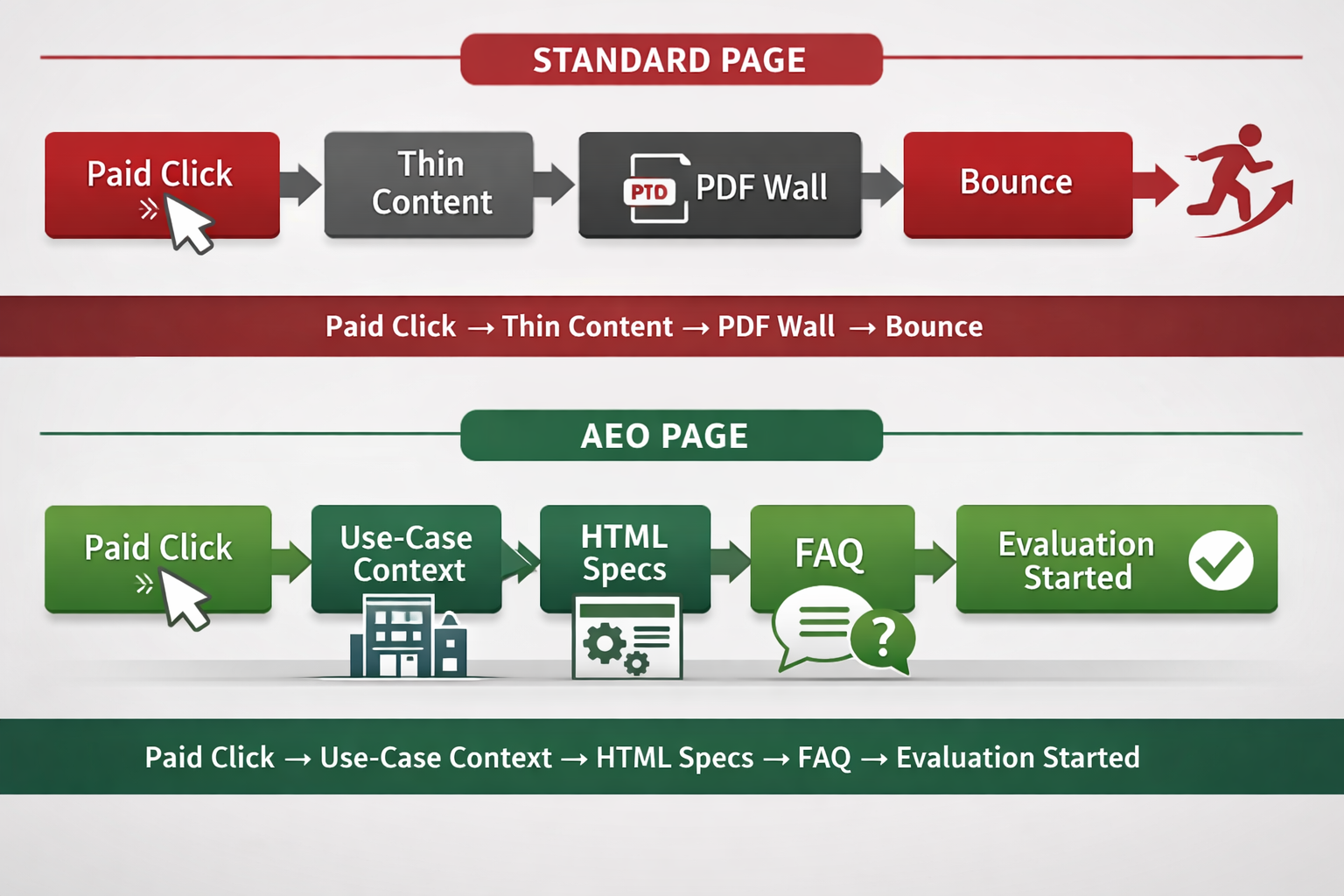
A buyer clicks an ad, lands on a spec-only product page, finds no use-case context or comparison framing, and leaves. The click cost was paid. The evaluation never started.
Broad Keyword Mismatch
Campaign targets a category term. Traffic arrives at mixed intent stages. The page addresses none of them specifically. High volume, low signal, expensive waste.
PDF-Gated Information
Buyer clicks ad, reaches product page, needs technical details, hits a PDF download wall. Many don’t download. Those who do rarely return. The evaluation chain breaks at the first friction point.
Unanswered Deciding Questions
Late-stage buyers land on a page that doesn’t address compatibility, reprocessing, or total cost. They return to search for answers — sometimes finding a competitor’s ad. PPC paid for a session that sent a buyer to a competitor.
How Product Pages and Category Pages Reduce Post-Click Friction
Post-click friction is what happens between the ad click and the evaluation decision. Every unanswered question, every missing use-case explanation, every spec buried in a PDF represents a friction point that increases the likelihood the paid visit converts to nothing. Reducing that friction is not a creative problem — it is a page structure problem.
Product Page: Before vs. After Structural Improvement
Buyer clicks ad for a specific device. Lands on a page with model numbers, a PDF spec sheet link, and three feature bullets with no clinical context.
No intended user identified. No workflow framing. No comparison criteria. No FAQ. The buyer’s evaluation questions are entirely unanswered.
The buyer either calls sales immediately or leaves. Most leave.
Buyer clicks the same ad. Lands on a page that identifies the intended user by role, explains workflow context, surfaces the decision-relevant specs with brief explanations, and addresses compatibility and reprocessing in plain HTML.
A structured FAQ answers the questions the buyer was about to search for separately.
The buyer completes their evaluation on the page. They contact sales with a specific question rather than a general inquiry — or they don’t need to contact sales at all.
Category pages serve a different but equally important PPC function. Non-brand campaigns targeting category terms — “surgical retractor systems,” “infusion safety devices,” “patient monitoring solutions” — attract buyers at varying stages of evaluation. Sending all of that traffic to a single product page creates immediate mismatch for everyone except the buyer who already knew which product they wanted.
A well-built category page lands that traffic correctly. It orients buyers who are still comparing options, surfaces the product families that fit different use cases, and gives every stakeholder — clinical, procurement, biomedical — a pathway to the specific information they need. For non-brand PPC, a category page is usually a more efficient landing destination than any individual product page.
Why PDF-Heavy Sites Waste Paid Traffic
A buyer who clicks a paid ad has already expressed intent. They are willing to evaluate. The job of the landing page is to make that evaluation as frictionless as possible. A PDF is the opposite of frictionless. It interrupts the evaluation flow, requires an additional action, renders poorly on mobile, and provides no structural pathway back to the page or to a conversion action.
The paid traffic waste from PDF-dependent product pages compounds in a specific sequence:
Ad click — intent confirmed
Buyer searches for a specific device or category. Clicks your ad. Intent is real. The paid click has value — but only if the landing page earns it.
Landing page — evaluation begins
Buyer scans the page. Finds model numbers and generic feature bullets. Needs technical details to continue evaluating. Sees a link: “Download the full spec sheet.”
PDF wall — evaluation chain breaks
Many buyers don’t download. Those who do open a 12-page document looking for two specific answers. They may or may not find them. The page context, the conversion path, and any retargeting continuity are all severed.
Return to search — competitor opportunity
Buyer closes the PDF, returns to the browser, and searches for the specific answer they couldn’t find easily. That search may return your competitor’s ad. The paid click that started with your brand ended somewhere else.
HTML page — evaluation completes
The alternative: key technical content is on the page in structured HTML. The buyer scans, finds the answers, evaluates completely, and either contacts sales or proceeds. The PDF is still available — as supplementary documentation, not the primary information delivery mechanism.
How Intent-Stage Mapping Improves Landing Page Strategy
The most common PPC structural error in medical device marketing is sending all paid traffic — regardless of query intent, buyer role, or evaluation stage — to the same product page. The best click is the one that lands on a page built for the right stage of evaluation. Matching landing page type to query intent is the single highest-leverage structural change most medical device PPC programs can make.
| Intent Stage | Query Type | Right Landing Page | Wrong Landing Page |
|---|---|---|---|
| Early-Stage | “what is [device type]” / “how [device] is used in [setting]” / “types of [device category]” | Category page with plain-language summary, use-case framing, and audience identification | Specific product page — buyer isn’t ready to evaluate a single device |
| Mid-Stage | “[device] comparison” / “what specs matter for [device]” / “[device] compatibility” / “questions before buying [device]” | Comparison or evaluation page — or a category page with a strong comparison section and links to product pages | Generic product page with no comparison framing — creates mismatch for buyers actively weighing options |
| Late-Stage | “[device] for [specific facility]” / “is [device] compatible with [system]” / “how to evaluate [device] before purchase” / “[vendor] [device] support” | Intent-structured product page with compatibility, buyer criteria, FAQ — or a dedicated decision-stage landing page built for the specific query | Homepage or catalog page — buyer has a specific deciding question, a general page answers nothing |
The cost of stage mismatch
An early-stage buyer landing on a product page bounces because they’re not ready to evaluate a specific SKU. A late-stage buyer landing on a category page has to work backward to find the specific compatibility answer they need. In both cases, the click cost was paid for an experience that didn’t match the buyer’s actual position in the evaluation process — and a re-search becomes likely.
Why AEO, GEO, and PPC Work Better Together
The argument here is not that better organic architecture eliminates the need for paid search. In competitive medical device categories, PPC will remain a necessary part of the visibility mix — especially for new product launches, competitive conquesting, and time-sensitive campaigns. The argument is that PPC performs more efficiently when the pages it drives traffic to are already built for the right stage of evaluation.
The relationship between content architecture and paid search efficiency operates across several specific dimensions:
Quality Score and Landing Page Relevance
Google’s Quality Score penalizes ads that send traffic to landing pages with poor relevance to the query. An intent-structured landing page — built around the specific question the ad targets — directly improves Quality Score, which lowers cost-per-click for the same ad position.
Reduced Bounce Rate and Wasted Spend
When a paid visitor lands on a page that answers their actual question, they stay longer and engage more deeply. Reducing bounce rate on paid landing pages is a direct budget efficiency gain — the same spend drives more evaluated sessions.
Organic Coverage Reduces PPC Dependency
When AEO and GEO-structured pages rank organically and appear in AI Overviews for mid-stage and late-stage queries, paid coverage of those terms becomes optional rather than required. Budget can shift to competitive terms where organic visibility is limited.
FAQ Architecture Reduces Sales Team Load
When the deciding questions are answered on the page — in HTML, with schema — buyers who arrive via paid search complete more of their evaluation independently. Fewer paid visits result in unqualified or premature sales inquiries, which improves the efficiency of both the paid program and the sales team.
Retargeting Becomes More Precise
A buyer who visited a specific product page is a different retargeting audience than one who visited a general category page. When the site has intent-structured pages at every stage, retargeting audience segmentation reflects actual evaluation depth — not just site visit volume.
AI Overviews Reduce Competitive Ad Pressure
When your category and product pages are cited in AI Overviews for the queries your competitors are bidding on, you receive qualified traffic from those queries without paying for it. AEO/GEO citability is a structural advantage that compounds over time while PPC costs remain fixed or increase.
Defensive PPC: Why Strong Architecture Makes Brand Bidding Almost Free
Even when you rank organically in position one and appear in the AI Overview for your own product terms, there is still a case for bidding on your brand name. Competitors run conquest campaigns — bidding on your brand terms to intercept buyers who searched specifically for you. Ceding that paid slot, even while holding the organic position, hands a motivated competitor a seat at the exact moment a buyer has identified you by name.
The structural advantage here is significant and underappreciated. When your landing page is well-built — clear intended use, strong FAQ, HTML-structured evaluation content — your Quality Score for your own brand terms is high. Google rewards relevance. Your page is maximally relevant to your own brand query. The result: your brand CPC drops to a fraction of what a competitor must pay to attempt the same placement.
High Quality Score — your page is the most relevant result for your own brand term. CPC: pennies. You hold the paid slot for near-zero incremental cost while owning the organic position and AI Overview above it.
Low Quality Score — their page has no relevance to your brand term. Google charges a premium for low-relevance placements. CPC: multiples of yours. They pay a structural tax to fight for a slot you’re holding cheaply.
The asymmetry compounds. A competitor bidding on your brand against a structurally weak page has a genuine shot at intercepting traffic at a reasonable cost. A competitor bidding against a well-structured, high-Quality-Score page is paying a premium to fight uphill — while you hold the organic result, the AI Overview, and the paid slot simultaneously. At that point, the paid slot is insurance, not spend.
Better Architecture Lowers Paid Search Waste
The medical device companies spending the most on PPC are not always the ones with the strongest market positions. Many are spending heavily to compensate for website structures that fail to convert the intent they already have. A buyer who clicked a paid ad already expressed willingness to evaluate — the website’s job is to honor that intent with a page that makes evaluation possible.
The fix is not a more sophisticated bidding strategy or a larger keyword set. It is building the pages that paid traffic is sent to — product pages, category pages, comparison pages, FAQ pages — to actually answer the questions buyers arrive with. When those pages are built correctly, Quality Scores improve, bounce rates fall, evaluation depth increases, and the cost-per-meaningful-session decreases without changing a single bid.
AEO and GEO don’t replace paid search in competitive medical device categories. They change the return on every paid click — by ensuring that the buyer who clicks the ad finds an answer, completes their evaluation, and moves forward instead of returning to search to find what the landing page didn’t provide.
Frequently Asked Questions
Questions marketing and commercial teams ask about PPC efficiency, landing page structure, and medical device AEO/GEO.
Competitive keyword pricing is a factor, but it explains less of the waste than most teams assume. A significant portion of medical device PPC cost is structural: paid traffic sent to product pages that don’t explain intended use, category pages that don’t differentiate options, or landing pages that gate key technical information behind a PDF download. In these cases, the cost isn’t in the bid — it’s in the bounce. A well-targeted click that lands on a page that fails to answer the buyer’s evaluation questions produces no return, regardless of how precisely the keyword was targeted.
Yes, indirectly. Google’s Quality Score — which directly influences cost-per-click and ad position — incorporates landing page experience as a component. A landing page that closely matches the intent of the ad’s keyword, loads quickly, and provides relevant content to the query will score higher than a generic product or category page. Higher Quality Score means lower cost for the same position. The structural improvements that serve AEO and GEO — clear intended use, FAQ content, HTML-based technical summaries — are the same improvements that improve landing page relevance scores in Google Ads.
The answer depends on the intent stage of the query, not on a universal preference. Non-brand category queries — broad terms like “surgical retractor systems” — typically perform better with category page landing destinations, because the buyer hasn’t indicated a specific product preference and needs orientation before evaluation. Brand or product-specific queries — including competitor conquesting or model-specific terms — perform better with intent-structured product pages that directly answer the specific comparison or evaluation question implied by the query. Sending all paid traffic to a single destination regardless of query type is where most stage mismatch waste originates.
When AEO and GEO-structured pages rank organically and appear in AI Overviews for mid-stage and late-stage queries, paid coverage of those terms shifts from required to optional. Budget can be reallocated toward the competitive terms where organic visibility remains limited — typically high-volume category terms and competitor brand terms — rather than spread across the full intent spectrum. The compounding effect: as more pages enter organic and AI-cited visibility, the list of queries that require paid coverage shrinks, and the efficiency of the remaining paid spend increases because it is concentrated on the queries that genuinely cannot be won organically.
The highest-impact starting point varies by site, but the most consistent quick wins are: converting the top three or four product pages that receive the most paid traffic from spec-only pages to intent-structured pages with use-case framing and HTML FAQ sections; replacing PDF-gated technical summaries with inline HTML content on those same pages; and auditing the landing page assignments in existing campaigns to ensure non-brand category traffic is sent to category pages rather than individual product pages. These three changes address the most common sources of post-click friction without requiring a full site rebuild — and their effect on bounce rate, session depth, and conversion rate is typically measurable within 30 to 60 days.