
In 2006, HubSpot co-founder Dharmesh Shah made a decision that most brand strategists would consider a mistake.
When HubSpot coined the term “inbound marketing,” they chose not to protect it. No trademark. No copyright. Shah later described the reasoning directly: “We did not trademark it or copyright it or say, ‘Oh, that’s our term. No one else can use it.’ We wanted everyone else to use inbound marketing as a term. We wanted it to be a thing — because we are going to be the company that’s most known for that thing.”
They gave the concept away. And in doing so, they built one of the most durable brand narratives in modern marketing history.
What That Decision Looks Like Today
Type “inbound marketing” into Google in 2026 and examine what the AI summary surfaces. Every source appearing above the fold is either published by HubSpot or uses HubSpot’s framework to explain the concept. HubSpot Academy defines it. HubSpot’s own site anchors it. And then Optimizely, Adobe for Business, and Amazon Ads — major independent platforms with no commercial reason to favor HubSpot — all teach the Attract, Engage, Delight model as if it were a neutral industry standard.
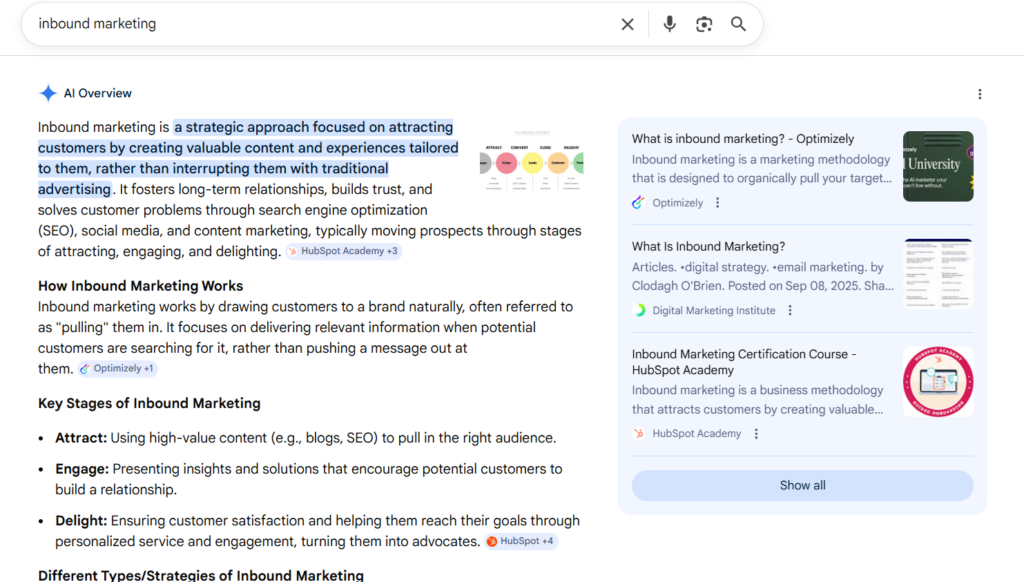
Inbound marketing is a strategic approach focused on attracting customers by creating valuable content and experiences tailored to them, rather than interrupting them with traditional advertising. It fosters long-term relationships, builds trust, and solves customer problems through search engine optimization (SEO), social media, and content marketing, typically moving prospects through stages of attracting, engaging, and delighting. [1, 2, 3, 4]
How Inbound Marketing WorksInbound marketing works by drawing customers to a brand naturally, often referred to as “pulling” them in. It focuses on delivering relevant information when potential customers are searching for it, rather than pushing a message out at them. [3, 5]
Key Stages of Inbound Marketing
- Attract: Using high-value content (e.g., blogs, SEO) to pull in the right audience.
- Engage: Presenting insights and solutions that encourage potential customers to build a relationship.
- Delight: Ensuring customer satisfaction and helping them reach their goals through personalized service and engagement, turning them into advocates. [1, 3, 4, 6, 7]
Different Types/Strategies of Inbound Marketing
- Content Marketing: Creating blogs, videos, and ebooks to attract and educate.
- Search Engine Optimization (SEO): Optimizing website content to increase visibility in search results.
- Social Media Marketing: Building engagement and sharing content on platforms like LinkedIn, Facebook, and Instagram.
- Email Marketing: Nurturing prospects and retaining customers with tailored content.
- Lead Generation/Nurturing: Using content, landing pages, and calls-to-action (CTAs) to convert visitors into leads. [3, 4, 8, 9, 10, 11]
Benefits of Inbound Marketing
- Cost-Effective: Often cheaper than traditional methods, especially for small businesses.
- Builds Trust: Provides educational resources that build long-term credibility.
- High Quality Leads: Attracts customers who are already searching for solutions to their problems.
- Sustainable Results: Content continues to work over time to drive traffic, whereas ads stop working once payment ends. [3, 4, 12, 13, 14, 15]
AI can make mistakes, so double-check responses
[1] https://www.salesforce.com/marketing/b2b-automation/inbound-marketing-guide/
[2] https://academy.hubspot.com/courses/inbound-marketing
[3] https://www.optimizely.com/optimization-glossary/inbound-marketing/
[4] https://digitalmarketinginstitute.com/blog/what-is-inbound-marketing
[5] https://www.youtube.com/watch?v=_jUEPXz5eZw
[6] https://www.hubspot.com/inbound-marketing
[7] https://www.coursera.org/articles/inbound-marketing
[8] https://advertising.amazon.com/library/guides/inbound-marketing
[9] https://mailchimp.com/resources/inbound-marketing/
[10] https://www.youtube.com/watch?v=qIA0-3sXCx4
[11] https://www.youtube.com/watch?v=NOvw-xEGUX4
[12] https://business.adobe.com/blog/basics/inbound-marketing
[13] https://monday.com/blog/marketing/inbound-marketing-strategy/
[14] https://www.pipedrive.com/en/blog/inbound-marketing
[15] https://leadg2.thecenterforsalesstrategy.com/what-is-inbound-marketing
It is an industry standard now. But it wasn’t always. HubSpot made it one — deliberately, systematically, and over a long enough period that the strategy became invisible. What looks like organic consensus is the result of an intentional information architecture built over 15 years.
Why This Matters for PR Professionals
Most PR agencies are familiar with HubSpot as a CRM or a content platform. Fewer have examined what HubSpot actually did at the narrative level — and why it worked so completely that marketing professionals today experience the result as instinct rather than influence. When someone who has spent years in this industry hears “inbound marketing,” they think HubSpot. Not as a brand preference. As a reflex.
That reflex is not an accident. It is the intended outcome of a strategy that understood something most brands still don’t: in an ecosystem where AI systems synthesize information from thousands of independent sources, the brand that shapes how a concept is defined across that ecosystem owns the narrative — regardless of what any single channel publishes.
The Peloton case study on this site showed what happens when a brand loses control of its AI narrative. The HubSpot case shows what it looks like when a brand builds one deliberately — and what PR agencies can learn from both.
How HubSpot Built the Narrative — The 15-Year Ecosystem Play
HubSpot did not build its AI narrative through a content calendar. It built it through a sequence of deliberate moves that embedded the inbound marketing concept so deeply into the information ecosystem that no competitor, algorithm update, or market shift has been able to dislodge it.
In 2006, HubSpot coined the term inbound marketing and immediately began seeding it freely across the ecosystem — blog posts, speaking engagements, and industry conversations that had no requirement to mention HubSpot at all. The concept spread because it was useful, not because it was branded.
In 2009, they published the book. Inbound Marketing: Attract, Engage, and Delight Customers Online gave the concept a citable authority anchor — something independent sources could reference, assign in courses, and build arguments around. Books generate citations for years after publication in ways that blog posts rarely do.
In 2012, they launched the INBOUND conference. By 2019 it was drawing over 26,000 attendees from 110 countries. Every year the conference generated independent media coverage, speaker content, attendee posts, and industry commentary — none of it controlled by HubSpot, all of it reinforcing the same core narrative.
HubSpot Academy followed, making the framework teachable and certifiable. Hundreds of thousands of marketing professionals earned HubSpot certifications, then went on to write about, teach, and implement inbound marketing in their own words across their own platforms. Each of those practitioners became an independent node in the ecosystem, repeating HubSpot’s framework without being asked to.
By the time AI systems began synthesizing the information landscape, the term “inbound marketing” had been defined, taught, certified, conferenced, published, and independently repeated across the ecosystem for over a decade. HubSpot did not need to be mentioned for the narrative to serve them. The framework itself carried the attribution.
When the SEO Strategy Failed, the Narrative Held
In 2024, HubSpot’s blog traffic collapsed. The company had spent years expanding its content operation into topics far outside its core domain — resignation letter templates, inspirational quotes, general productivity advice. When Google’s algorithm updates hit, that broad content strategy took significant damage. Traffic dropped from approximately 13.5 million visits in November 2024 to around 6.1 million by January 2025.
For most brands, a traffic drop of that magnitude would signal a narrative crisis.
For HubSpot, it didn’t — because the narrative and the blog traffic were two separate things.
Despite the SEO decline, HubSpot maintained a 35.3% share of voice in AI-generated answers for their category, cited in nearly every AI-generated response for CRM and inbound marketing. The Gemini summary at the top of this article — every source defining inbound marketing using HubSpot’s framework — was produced during this same period of significant organic traffic loss.
HubSpot themselves acknowledged what had happened. They described shifting their strategy from “influence over information” and noted that while traffic had fallen for many informational keywords, AI systems continued to recognize their content as high-quality reference material.
The reason is structural. The ecosystem signals that AI systems weighted — the book, the conference, the certifications, the decade of independent third-party repetition of the Attract-Engage-Delight framework — were not stored on HubSpot’s blog. They were distributed across thousands of independent sources that no algorithm update could reach simultaneously.
The blog traffic collapsed. The narrative infrastructure did not.
What This Means for the Brands You Represent
For PR agencies, the distinction between SEO traffic and AI narrative is now one of the most important strategic conversations you can have with a client.
A brand can have strong organic traffic and a weak AI narrative — if its content lives primarily on owned channels without generating independent citation or repetition. And as the HubSpot case demonstrates, a brand can lose significant organic traffic and maintain a dominant AI narrative — if it built ecosystem-level authority in its core domain.
The question is not how much content your client is publishing. The question is whether that content is generating the kind of independent repetition across the ecosystem that AI systems treat as consensus.
HubSpot’s blog stumbled. Its category ownership did not. Those are two different assets — and only one of them shapes what AI says about your brand.
How HubSpot’s Strategy Maps to the Four Principles
The HubSpot narrative didn’t form by accident. Every major decision the company made between 2006 and today maps directly onto the principles that govern how AI narratives form.
Principle 1 — The Narrative Must Exist in Trusted Sources
HubSpot’s first move was to publish — and to seed the inbound marketing concept into environments they didn’t control. Industry publications, university curricula, third-party training platforms. By the time AI systems began synthesizing the information landscape, “inbound marketing” existed across thousands of independent trusted sources. No single platform update could remove it.
Principle 2 — Authority Sources and Original Studies Anchor the Narrative
HubSpot created three authority anchors more durable than any blog post.
The 2009 book gave the concept a citable primary source that generated citations for years. The annual State of Marketing report introduced fresh original data every year, giving independent sources something to reference and repeat. And HubSpot Academy certified over 305,000 marketing professionals in HubSpot’s framework — each one going on to publish, teach, and consult in their own words across their own platforms, independently reinforcing the same concepts without any further involvement from HubSpot.
That is what an authority anchor looks like at scale.
Principle 3 — Multiple Sources Establish Consensus
The INBOUND conference drew over 26,000 attendees from 110 countries by 2019, generating independent media coverage, speaker content, and attendee commentary every year — none of it controlled by HubSpot, all of it reinforcing the same narrative. Combined with the annual research reports and Academy certifications, HubSpot achieved genuine multi-source consensus. Not manufactured through coordinated messaging, but organic — because the concept was useful enough that thousands of independent sources repeated it on their own terms.
When AI systems detect that pattern, they treat it as established knowledge.
Principle 4 — Structure Makes the Narrative Repeatable
The Attract, Engage, Delight framework is not just a marketing model. It is a structured taxonomy that made inbound marketing easy for any source to adopt and teach consistently.
The Gemini summary at the top of this article shows the result. Optimizely, Adobe for Business, Amazon Ads — all describing inbound marketing using HubSpot’s three-stage framework. They didn’t develop their own models. They adopted HubSpot’s structure because it was already dominant. When multiple independent sources use the same framework, AI extracts it as the standard definition. HubSpot’s structure became the industry’s structure — and therefore what AI returns every time someone asks what inbound marketing means.
Three AI Platforms. One Framework. One Origin.
To understand how completely HubSpot’s narrative has embedded itself into the AI information ecosystem, we tested three major AI platforms with the same starting prompt: “inbound marketing.” No brand name. No leading question. Just the concept.
The results were consistent across all three — and revealing in different ways.
Gemini — Passive Attribution
A one-word search for “inbound marketing” in Google triggered an AI Overview that surfaced multiple sources above the fold. Every source was either published by HubSpot or used HubSpot’s framework to define the concept. HubSpot Academy, HubSpot’s own site, Optimizely, Adobe for Business, and Amazon Ads all appeared — each teaching the Attract, Engage, Delight model as if it were a neutral industry standard.
HubSpot was not asked about. It simply appeared — because the ecosystem that AI synthesized has adopted HubSpot’s framework as the default definition of the concept.
Claude — Unrequested Framework, Attribution on Request
When prompted with “inbound marketing,” Claude returned the four-stage framework without mentioning HubSpot. The framework was presented as general industry knowledge.
When asked directly who created the framework and what sources it was drawing from, the response was unambiguous:
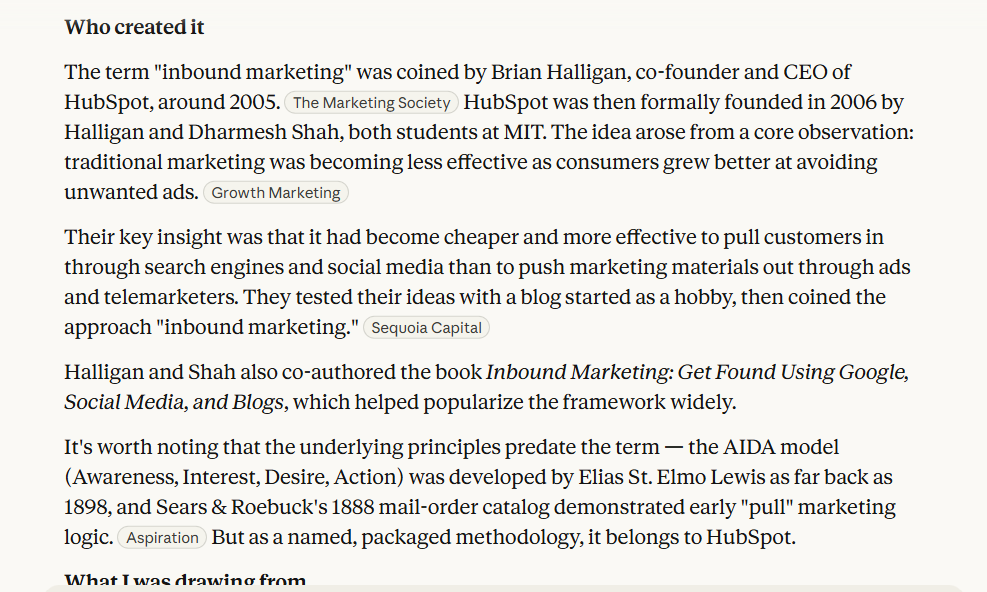
“The term inbound marketing was coined by Brian Halligan, co-founder and CEO of HubSpot, around 2005. HubSpot was then formally founded in 2006 by Halligan and Dharmesh Shah, both students at MIT.”
Claude then acknowledged something more revealing: it had initially presented HubSpot’s proprietary model as neutral industry vocabulary without attribution. In its own words, the framework “has essentially become the industry-standard vocabulary for this approach.”
Great question — and worth being transparent about both.
Who created it
The term “inbound marketing” was coined by Brian Halligan, co-founder and CEO of HubSpot, around 2005. HubSpot was then formally founded in 2006 by Halligan and Dharmesh Shah, both students at MIT. The idea arose from a core observation: traditional marketing was becoming less effective as consumers grew better at avoiding unwanted ads.
Their key insight was that it had become cheaper and more effective to pull customers in through search engines and social media than to push marketing materials out through ads and telemarketers. They tested their ideas with a blog started as a hobby, then coined the approach “inbound marketing.”
Halligan and Shah also co-authored the book Inbound Marketing: Get Found Using Google, Social Media, and Blogs, which helped popularize the framework widely.
It’s worth noting that the underlying principles predate the term — the AIDA model (Awareness, Interest, Desire, Action) was developed by Elias St. Elmo Lewis as far back as 1898, and Sears & Roebuck’s 1888 mail-order catalog demonstrated early “pull” marketing logic. But as a named, packaged methodology, it belongs to HubSpot.
What I was drawing from
My initial diagram was based on general training knowledge — the Attract → Engage → Convert → Delight framework is HubSpot’s own four-stage model, which they’ve promoted extensively through their platform, certifications, and content. It’s essentially become the industry-standard vocabulary for this approach.
That said, a few caveats worth knowing: HubSpot has since updated their own framing — they replaced the funnel with what they call the “flywheel,” where rather than customers falling out of the bottom of the funnel, they loop back and feed new growth. The four-stage funnel I showed is still widely taught and used, but it’s technically HubSpot’s older model. The flywheel version emphasizes that delighted customers drive momentum rather than just being an endpoint.
One additional detail is worth noting. Claude pointed out that HubSpot has since replaced the four-stage funnel with what they call the flywheel model. Yet AI systems are still teaching the older framework as the standard definition. Once a narrative embeds at ecosystem level, even the originating brand cannot fully update it. The independent sources that adopted the original framework continue repeating it regardless of what HubSpot now publishes on its own channels.
Perplexity — The Ecosystem Made Visible
Perplexity’s response was the most revealing of all — not because of what it said about HubSpot, but because of who it cited teaching the framework.
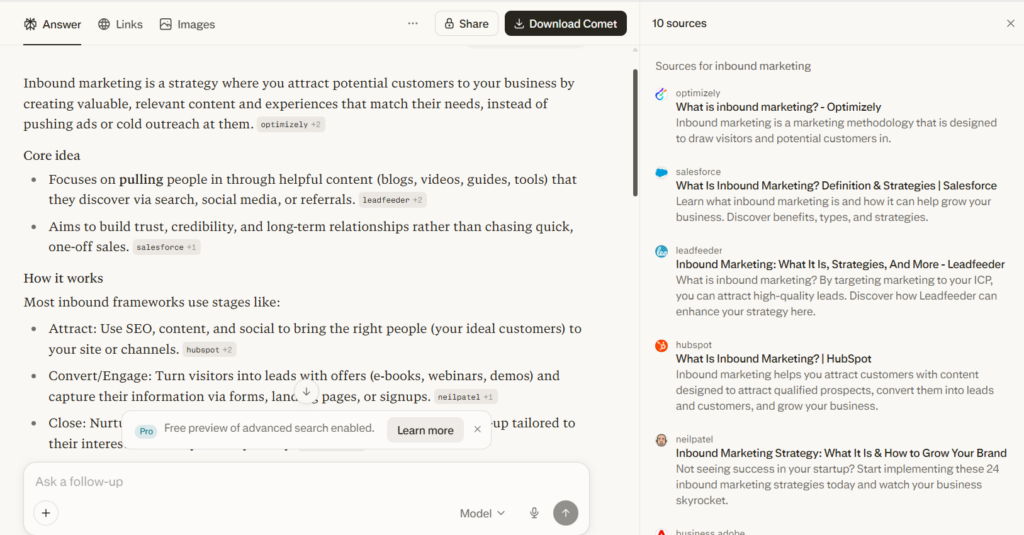
Inbound marketing is a strategy where you attract potential customers to your business by creating valuable, relevant content and experiences that match their needs, instead of pushing ads or cold outreach at them.optimizely+2
Core idea
- Focuses on pulling people in through helpful content (blogs, videos, guides, tools) that they discover via search, social media, or referrals.leadfeeder+2
- Aims to build trust, credibility, and long-term relationships rather than chasing quick, one-off sales.salesforce+1
How it works
Most inbound frameworks use stages like:
- Attract: Use SEO, content, and social to bring the right people (your ideal customers) to your site or channels.hubspot+2
- Convert/Engage: Turn visitors into leads with offers (e‑books, webinars, demos) and capture their information via forms, landing pages, or signups.neilpatel+1
- Close: Nurture leads with email, marketing automation, and sales follow-up tailored to their interests until they’re ready to buy.leadfeeder+1
- Delight: Continue to support and educate customers so they become repeat buyers and advocates.hubspot+2
Typical channels and tactics
- Content marketing: Articles, guides, e‑books, webinars, case studies that answer audience questions.optimizely+2
- SEO: Optimizing content so people find you when they search for solutions you provide.optimizely+1
- Social media: Sharing and promoting content, engaging in conversations where your audience spends time.advertising.amazon+2
- Email + automation: Lead nurturing sequences, newsletters, and personalized follow-ups.salesforce+1
- Analytics: Tracking traffic, leads, and conversions to refine what content and channels work.business.adobe+1
Inbound vs outbound
| Aspect | Inbound marketing | Outbound marketing |
|---|---|---|
| Direction | Customers come to you (“pull”) leadfeeder+1 | You push messages out (“push”) [forbes] |
| Main tools | Content, SEO, social, email, automation optimizely+1 | Cold calls, mass email, TV/radio, billboards [forbes] |
| User experience | Permission-based, helpful, non-disruptive salesforce+1 | Interruptive, often not requested [forbes] |
| Primary outcome | Trust, brand awareness, qualified leads salesforce+1 | Short-term reach and direct promotion forbes+1 |
Why businesses use it
- Generates more qualified leads because people come in already interested in solving a problem you address.neilpatel+2
- Builds brand authority and thought leadership in your niche over time.digitalmarketinginstitute+1
- Supports long, research-heavy buying journeys (like B2B or high-ticket services) where education and trust matter.business.adobe+1
If you tell me about your business or goals, I can outline a simple inbound plan tailored to you.
Perplexity cited HubSpot directly as the source for the Attract and Delight stages. But surrounding those citations was the full ecosystem in plain view: Optimizely, Salesforce, Leadfeeder, Neil Patel, Adobe, Amazon Ads, Forbes, and the Digital Marketing Institute — all teaching HubSpot’s stages in their own words across their own platforms.
When asked directly who coined the term, Perplexity confirmed without hesitation:
“The term inbound marketing was originally coined by Brian Halligan, co-founder and CEO of HubSpot, around 2005–2006. Multiple histories of the concept and HubSpot’s own materials credit Halligan with introducing the phrase and the core framework that later became widely known as the inbound marketing methodology.”
What Perplexity’s response shows is not just that HubSpot is credited as the origin — it is that the entire independent ecosystem has adopted and repeated HubSpot’s framework as their own explanation of the concept. Salesforce, Adobe, and Amazon Ads have no commercial reason to favor HubSpot. Yet all of them are teaching HubSpot’s structure.
That is what ecosystem-level narrative ownership looks like in practice.
What the Three Platforms Tell Us Together
Across Gemini, Claude, and Perplexity, the same pattern emerged consistently. HubSpot’s framework surfaces as the default definition of inbound marketing regardless of how the question is asked. When attribution is not requested, the framework appears as neutral industry knowledge. When attribution is pressed, it goes to HubSpot and Brian Halligan directly. And the independent ecosystem of sources teaching the concept — from Salesforce to Amazon Ads to Forbes — are all repeating HubSpot’s structure in their own words without being asked to.
This is the outcome Dharmesh Shah described when he said they wanted everyone to use the term. Not because HubSpot asked them to. Because the concept was useful enough that the ecosystem adopted it on its own terms.
Twenty years later, three AI platforms confirm the strategy worked exactly as intended.
HubSpot’s AEO Play — and Why the Jury Is Still Out
There is one more development worth noting for agencies that specialize in AEO and GEO.
In 2025, HubSpot launched an AEO Grader — a free tool that analyzes brand visibility across ChatGPT, Perplexity, and Gemini, scoring content readiness for answer engines and recommending optimization fixes. They also launched an AEO Strategy feature in private beta that generates optimized draft assets for AI search visibility.
The strategic intent is unmistakable. HubSpot coined “inbound marketing” in 2006 and spent 15 years building the category. They appear to be running the same playbook with AEO — publishing the guides, building the tools, and positioning themselves as the authority before the category fully matures.
For agencies operating in this space, that is worth paying attention to as a competitive signal.
However, the evidence that the tool actually works is thin.
Independent reviews of the AEO Grader are sparse and the analytics to support its effectiveness are largely absent. The figures that do exist — one agency blog citing a 36% improvement in rankings and a 27% AI-to-lead conversion rate — come from a single unverified source with no named client, no methodology, and no independent confirmation. That is not evidence. It is a claim.
There is also a structural limitation worth flagging. The GPT-4o component of the AEO Grader operates on a knowledge cutoff of September 2023, meaning it is not analyzing current AI visibility for that platform. And the tool provides point-in-time snapshots rather than continuous tracking, making it difficult to measure whether any changes it recommends actually moved the needle over time.
This is a meaningful weakness in HubSpot’s AEO strategy — and it illustrates an important distinction.
HubSpot’s narrative dominance in inbound marketing was earned through 15 years of independent repetition, original research, and genuine practitioner adoption. Their AEO Grader is a product launch with a content strategy attached. Those are not the same thing. The first approach built ecosystem-level authority. The second is attempting to shortcut it.
Whether HubSpot will successfully own the AEO category the way they owned inbound marketing remains to be seen. The playbook is familiar. The proof of execution is not yet there.
For agencies evaluating AEO tools, that distinction matters — and it is worth watching how this develops over the next 12 to 18 months.
The Contrast That Makes Both Cases Clear
Peloton and HubSpot were operating in the same information environment at roughly the same time. Both invested in content. Both had active PR and communications strategies. Both produced survey-based research. The outcomes could not be more different.
Peloton’s research lacked methodological transparency and wasn’t adopted externally. HubSpot’s annual State of Marketing report was cited independently across the industry every year. Peloton’s blog provided general wellness guidance that generated no external citations. HubSpot’s book, conference, and certification program created authority anchors that spread the framework into thousands of independent sources. Peloton’s messaging didn’t align with what users actually experienced. HubSpot’s framework was useful enough that practitioners adopted it as their own.
The AI narratives that formed around each brand reflect those differences precisely.
What PR Agencies Should Take From This
The HubSpot case is not a content marketing story. It is a narrative architecture story — and the distinction matters for every client conversation you have about AI visibility.
Three questions worth asking about any brand you represent:
Does the brand own a concept, or just a product? HubSpot didn’t win by marketing software. They won by defining a category. Brands that own a concept have something the ecosystem can repeat independently. Brands that only market products are dependent on controlled channels.
Is the brand’s research being cited externally, or just published? The difference between HubSpot’s State of Marketing report and Peloton’s commercial fitness survey is not quality — it is adoption. Research that earns independent citation becomes an authority anchor. Research that doesn’t is invisible to AI.
Does the brand’s messaging align with what users actually experience? HubSpot’s framework spread because it worked and practitioners said so publicly. No amount of ecosystem engineering overcomes a fundamental disconnect between what a brand claims and what users report. The ecosystem will always surface the lived experience over the official narrative.
The Longer View
HubSpot’s blog lost significant traffic in 2024. By most traditional marketing metrics, that would signal a weakening brand. But its AI narrative held — because the signals that matter to AI systems were never stored on the blog. They were distributed across 15 years of independent repetition, certification, research citation, and structural adoption by the entire industry.
That is what durable narrative infrastructure looks like. Not a content strategy. Not a PR campaign. An information ecosystem built deliberately over time, aligned with real user experience, and structured so that independent sources could adopt and repeat it on their own terms.
The brands that understand this now have a significant advantage. The ones still measuring success purely by traffic and media placements may find their AI narrative being written by someone else entirely.
Further Reading
How to Shape AI Narratives: A Rule-Based Approach for Modern PR — the strategic framework both case studies are built on.
Case Study: How Peloton Lost Control of Its AI Narrative — the contrasting case showing what happens when ecosystem signals work against a brand.
Sources
¹ Dharmesh Shah quote on deliberately not protecting the “inbound marketing” term — Sequoia Capital Crucible Moments podcast. sequoiacap.com/podcast/crucible-moments-hubspot/
² HubSpot founded 2006, early content and thought leadership strategy — SmartBug Media analysis. smartbugmedia.com
³ Inbound Marketing book published 2009 — Halligan and Shah, widely documented across marketing publications.
⁴ INBOUND conference attendance 26,000 attendees, 110 countries, 2019 — HubSpot public records and independent conference coverage.
⁵ HubSpot Academy certifications — over 305,000 professionals certified. SmartBug Media. smartbugmedia.com
⁶ HubSpot blog traffic decline — 13.5 million to 6.1 million visits, November 2024 to January 2025. Reported by Search Engine Land, Alphametic, and Surfer SEO citing Semrush and Ahrefs data.
⁷ HubSpot AI share of voice 35.3% — Athena HQ, “HubSpot Lost 70% of Its SEO Traffic — But That Doesn’t Mean It’s Losing.” athenahq.ai, 2025.
⁸ HubSpot AEO Grader knowledge cutoff limitation — documented in HubSpot Community forums. Point-in-time snapshot limitation noted in independent tool reviews.
⁹ AEO performance figures (36%/27%) — cited by Stackmatix. stackmatix.com. Not independently verified. Treat as unconfirmed.