
Many digital marketing agencies struggle when working with industrial, manufacturing, and technical service companies. Traditional marketing frameworks built around branding, funnels, and short landing pages often fail in industries where buyers are engineers, plant managers, and procurement teams.
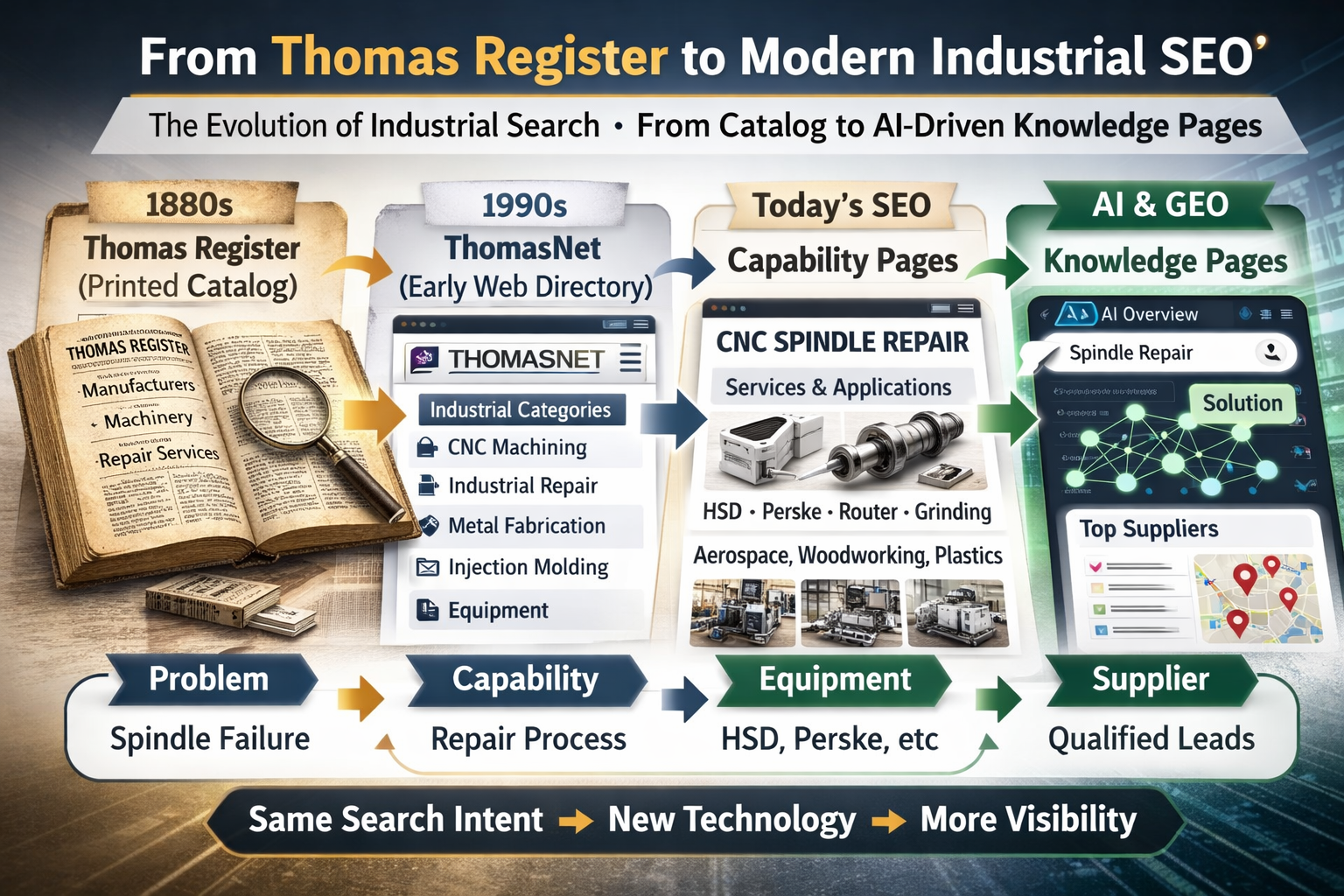
To understand why, it helps to look at a system that solved industrial search decades before modern SEO existed: the Thomas Register, now known as Thomas.
The structure that powered ThomasNet closely resembles the way modern search engines and AI systems organize information today.
What ThomasNet Did Before Google
For over a century, engineers and procurement teams used the Thomas Register to find industrial suppliers. Before the internet, it was a massive printed directory that organized manufacturers by capabilities instead of marketing language.
Instead of brand-first listings, the directory followed a structure like this:
Manufacturing
→ CNC Machining
→ 5-Axis Machining
→ Aerospace Machining
Industrial Repair
→ Electric Motor Repair
→ Spindle Repair
→ Hydraulic Repair
Material Processing
→ Injection Molding
→ Metal Fabrication
→ Composite Manufacturing
This capability-based taxonomy made it easy for engineers to find suppliers based on what they needed done, not who had the biggest advertising budget.
When ThomasNet moved online, it essentially became one of the first industrial search engines.
Why This Matters for Modern SEO
Modern search engines and AI systems do not only analyze keywords. They attempt to understand topics, relationships, and problem-solution patterns.
In industrial markets, search behavior often follows this pattern:
problem → capability → supplier
For example:
CNC spindle vibration
→ spindle repair
→ HSD spindle repair
→ repair service provider
Many agency-built websites skip the middle step. They jump directly to sales messaging, which leaves a gap in how search engines interpret the page.
A better approach is to build pages that clearly explain the capability itself, not just the company offering it.
The Industrial Capability Page Model
The Industrial Capability Page Model is a content structure designed for industries where buyers perform technical research before contacting suppliers.
Instead of creating dozens of thin pages or a large hub structure, the goal is to build one authoritative page that explains the entire capability.
A typical page includes the following sections:
Clear Definition
Start with a straightforward explanation of the capability.
Example:
What is spindle repair?
What is recycled concrete aggregate?
What is commercial HVAC maintenance?
This section often becomes the part cited by AI systems.
How the System Works
Explain the technical process in simple language.
For example:
- inspection and diagnostics
- component replacement
- balancing or testing
- restoration to manufacturer specifications
Industrial buyers often want to understand how something works before contacting a supplier.
Subcategories or Equipment Types
Break down the capability into related subtopics.
Example for spindle repair:
- HSD spindle repair
- Perske spindle repair
- router spindle rebuilds
- grinding spindle repair
Each of these sections expands the page’s topic coverage.
Industry Applications
Explain where the capability is used.
Examples:
- aerospace machining
- cabinet manufacturing
- plastics machining
- aluminum fabrication
This helps search engines connect the topic to multiple industries.
Common Problems
Industrial searches frequently start with problems rather than services.
Examples:
- spindle vibration
- overheating bearings
- tool runout
- machine accuracy issues
Including these problems helps capture real-world search intent.
Cost or Replacement Comparisons
Industrial buyers often research cost before contacting suppliers.
Example section:
Repair vs replacement cost comparisons.
These sections perform well in both traditional search and AI answers.
FAQ Section
Answer common technical questions in plain language.
These sections are particularly valuable for Answer Engine Optimization (AEO) because AI systems often quote them directly.
Why This Model Works for AI Search
AI-powered search tools such as ChatGPT, Gemini, and Perplexity attempt to build topic graphs rather than simply matching keywords.
Pages structured around a capability naturally include:
- definitions
- related equipment
- common problems
- use cases
- solutions
This creates a complete knowledge node, which AI systems are more likely to reference.
In other words, the page becomes a small knowledge base for a specific capability.
Why Agencies Often Miss This Opportunity
Many agencies design websites around traditional marketing pages such as:
Home
About
Services
Contact
While this structure works well for consumer businesses, it often fails in industrial markets where buyers are performing technical research.
A capability-based page structure aligns much more closely with how engineers and procurement teams search for solutions.
A Modern Example of Capability-Based SEO
Industries where this model works particularly well include:
- CNC spindle repair
- marine repair
- concrete recycling
- elevator maintenance
- commercial HVAC service
- industrial pump repair
These markets share several characteristics:
- high-value services
- technical buyers
- fragmented regional suppliers
- limited content marketing competition
Because of this, a single well-structured capability page can often outperform dozens of thin marketing pages.
What Agencies Can Learn from Industrial Search
The lesson from ThomasNet is simple:
Industrial buyers search for capabilities first, suppliers second.
When agencies build pages that fully explain the capability itself, they create content that works for:
- search engines
- AI-generated answers
- technical buyers
- procurement research
In many cases, the result is not just better rankings but better qualified leads, because the page attracts people who already understand the problem they are trying to solve.