
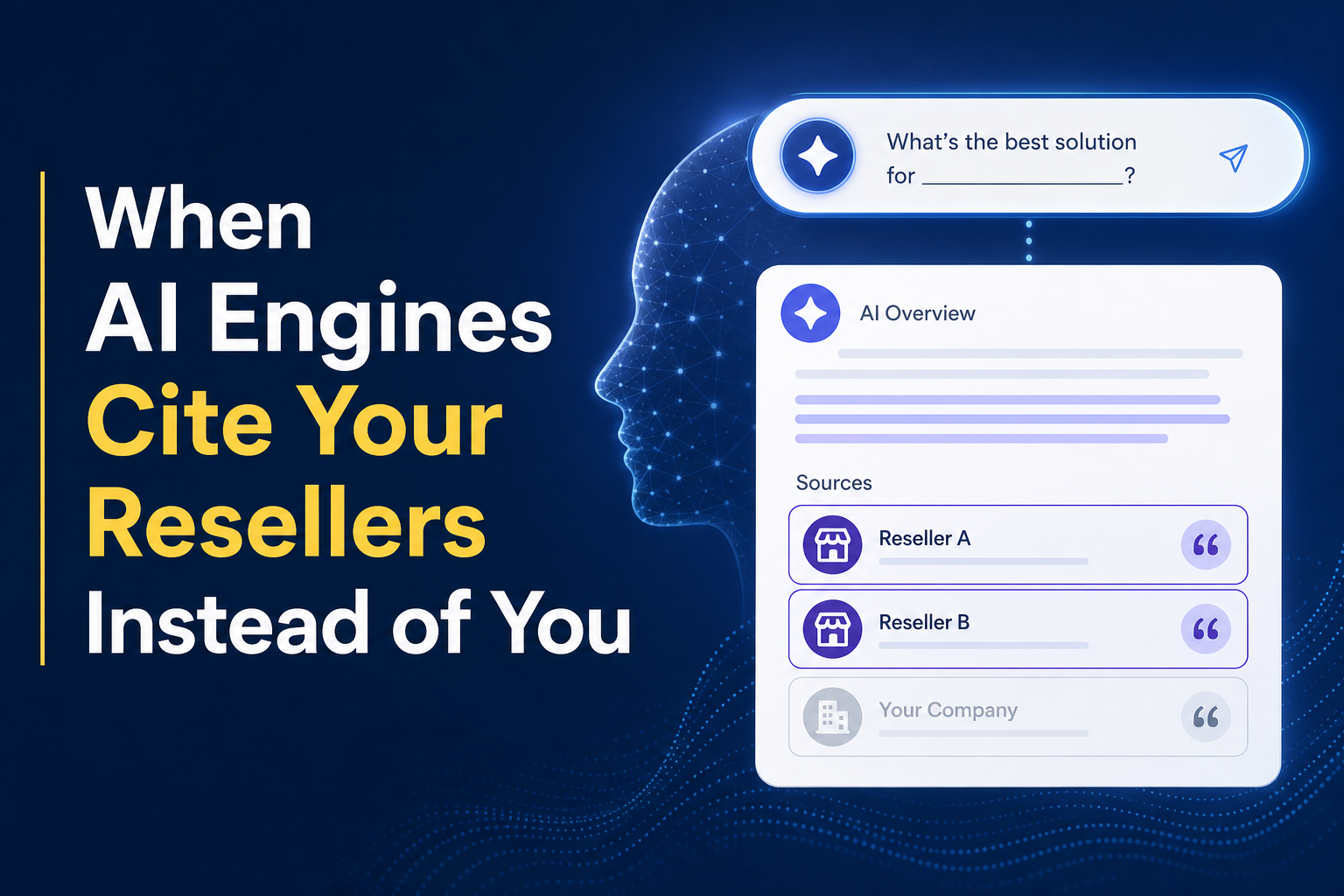
When AI Engines Cite Your Resellers Instead of You
Retailer page citations account for 10% of ChatGPT’s sources, 8% of Gemini’s, and 4% of Perplexity’s. For product brands, that is citation authority flowing to your resellers instead of your brand domain. The retailers are winning because their pages are more structured than yours.
What we mean by the retailer citation problem
Traditional SEO treats retailer placements as pure amplification. If Home Depot ranks for your product, that is usually fine — either way, a buyer finds their way to the purchase. AEO reframes the economics. When an AI engine generates an answer about your product and cites the Home Depot page rather than your brand page, three things happen: the retailer accumulates entity authority in AI engines over time, your brand loses the opportunity to anchor the narrative, and users see the retailer’s framing of your product rather than yours.
Our phase two dataset captured 38 retailer citations and 40 product-page citations across 546 total scored citations. About half of those product-page citations were on retailer domains rather than brand domains. The retailers are competing with the brands for AI citation authority, and in many cases winning.
Retailers earn more citations than brands in some verticals
In our work boots sample — the one vertical broad enough to support category-level conclusions — retailer pages outnumbered every individual brand domain. Safgard earned 7 citations. SR Max earned 7. Lehigh Safety Shoes earned 5. Only KEEN Footwear (at 8) outperformed the top retailer. Amazon at 5 citations tied with several brand domains.
At face value, these numbers suggest brand pages win on structural quality. They do, on average. But retailer citations still outnumber brand citations in work boots because retailers have more pages indexed per brand, more purchase-intent signals, and — critically — more consistent product data across the catalog.
The mean PSS of retailer pages hides variance. Structured retailer catalogs with consistent spec tables (Safgard, SR Max, Lehigh) score in the 60s and 70s. Retailer editorial content — blog-style “best of” listicles — scores in the 20s. When AI engines cite retailers, they cite the structured catalog pages, not the editorial content.
Why retailer catalog pages compete successfully with brand product pages
Three structural patterns give retailer catalog pages a competitive citation advantage that brands do not always match.
Consistent schema across the entire catalog
Retailers that take their SEO seriously apply Product schema with complete specification data to every SKU. The structure is identical across thousands of products. AI engines reward this consistency — extraction reliability matters as much as extraction depth. Brand product pages often have strong schema on hero products and weaker schema on long-tail SKUs.
Visible specification tables rendered in HTML
Retailer product pages typically render specs in a simple HTML table: dimensions, weight, material, certifications, SKU. Brand product pages often push these same specs into a “Specifications” tab that requires a JavaScript click to reveal, or bury them inside marketing copy that reads as prose. AI extraction favors the table.
Deep linking and cross-referencing
Retailer catalogs link related products aggressively — “customers also bought,” “compare with,” “also available in.” This creates a dense internal linking graph that AI engines use to establish topical authority. Brand sites often keep product pages semi-isolated, with fewer internal cross-references.
Where brands do win: named technology pages
When a brand invests in a technology-specific page — Red Wing’s SPR leather, KEEN’s ASTM rating documentation, Georgia Boot’s specific construction method — those pages consistently outscore retailer pages covering the same product. Retailers cannot compete on branded technology content. Brands that build out these pages win the citations retailers cannot take.
What brands can do to close the retailer citation gap
Apply the retailer schema playbook to your own site
Product schema, consistent specification tables, visible technical data, deep internal linking between related products and categories. These are solved problems on retailer sites. Brands that apply the same structural discipline to their own product pages close the extraction-quality gap.
Create named-technology hub pages
The single strongest brand citation lever is proprietary technology documentation. If your brand has a named material, process, certification, or capability, a dedicated hub page with full technical detail and schema markup is extremely difficult for retailers to compete with. Retailers can describe a product; they cannot author the canonical explanation of your technology.
Rewrite distributor and retailer agreements
Many retailer citation problems stem from retailers reproducing brand product copy verbatim without canonical link attribution. Requiring canonical links back to brand-owned pages in reseller agreements redirects some of the citation authority that would otherwise accumulate at the retailer.
Invest in YouTube and Google Business Profile for Gemini coverage
Gemini’s retailer citation rate is 7.9% — lower than ChatGPT’s 10.0% — specifically because Gemini reaches into YouTube and Google Business Profile for content retailers cannot provide. Brands that invest in those two lanes reclaim citation surface that retailers would otherwise take in ChatGPT.
What not to do about the retailer citation problem
Do not try to block retailers from ranking
Some brands attempt to suppress retailer rankings with price-MAP policies, duplicate-content complaints, or aggressive DMCA tactics. These strategies do not scale and do not address the underlying structural issue — AI engines will find authoritative product content somewhere, and pushing retailers out of the citation pool without providing a better brand alternative leaves a vacuum.
Do not treat retailer presence as a pure SEO question
The old framing was “retailers outrank me on Google, but they sell my product, so that is fine.” The new framing is “retailers win AI citations I could be winning, and those citations compound into entity authority they keep.” This is an AEO strategy question, not an SEO amplification question.
Do not over-invest in MAP enforcement at the expense of content
Brands that spend more on policing retailer pricing than on building their own technical documentation are optimizing for the wrong channel. The AI citation game rewards content depth, not pricing discipline.
Related analysis
The Gemini citation study
How Gemini differs from ChatGPT and Perplexity, and what that means for AI Overviews.
Read the analysis →Dominate ChatGPT
The authority engine. Brand primary domains, Wikipedia entity presence, and schema-rich page structure.
Read the guide →Dominate Perplexity
The platform engine. YouTube, LinkedIn, financial aggregators, Reddit, and Facebook as five surfaces.
Read the guide →Audit your retailer citation leakage
Tampa Web Technologies analyzes where retailers and resellers are earning AI citations that should belong to your brand — then rebuilds your product documentation to reclaim the citation surface.
Request a Retailer Citation Audit