
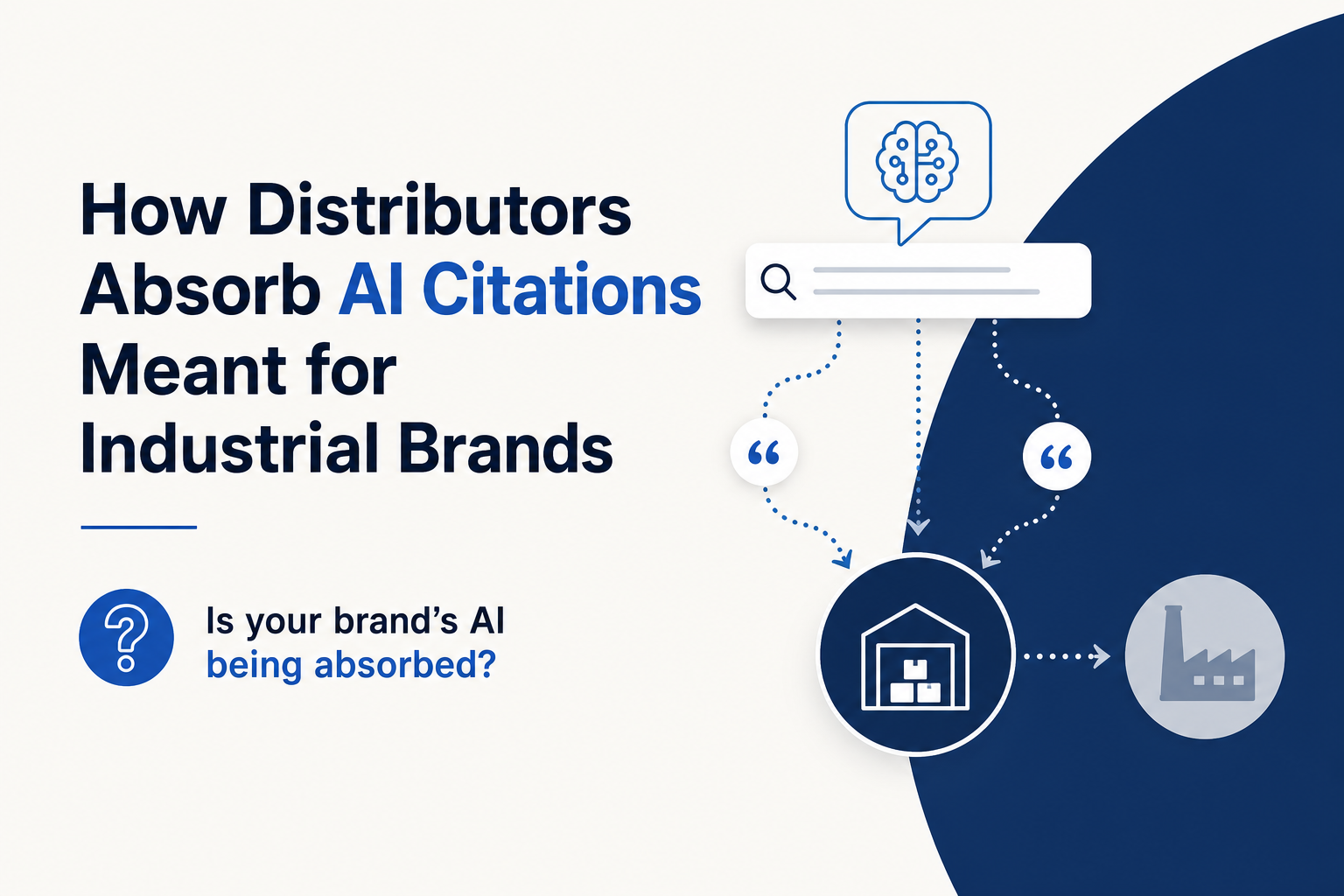
How Distributors Absorb AI Citations Meant for Industrial Brands
A study of 42 AI citations for a single ABB product — the Ability Smart Sensor — shows a pattern B2B industrial brands rarely recognize. Only 29% of citations go to ABB-owned domains. A third go to distributors mirroring ABB’s own content. The brand’s authority is leaking.
Why this case study matters for B2B industrial brands
ABB is one of the world’s largest industrial automation companies. The Ability Smart Sensor is a flagship condition-monitoring product for motors and pumps. For a query this specific, you would expect AI citations to concentrate on ABB’s own technical pages. Instead, they fragment across distributors, marketplaces, and secondary brands in the ABB portfolio.
The pattern is not unique to ABB. It appears in other industrial single-brand cases in our dataset — Schneider Electric, Trane, Carrier, FANUC — anywhere a brand with a deep distributor network competes with its own resellers for citation authority.
ABB owns 29% of citations for its own product. Distributors own 33%.
When we broke down the 42 citations by ownership, the distribution surfaced a structural problem. ABB-owned pages earned the largest single bucket, but distributors — Avonmore Electrical, Porter Electric, Doig Corp, Baldor (an ABB subsidiary), Motion.com, Applied Industrial Technologies, Flowtech, Automation Distribution, and KN Electric — collectively earned more.
ABB-owned pages that did get cited included the main product hub (new.abb.com/motors-generators/abb-ability-smart-sensor), the innovation page, the condition monitoring page, technical datasheets hosted on library.e.abb.com, and Baldor subsidiary pages. These pages scored strong PSS — the brand-owned content is well-built.
The problem is not quality. It is saturation. Distributor pages mirror ABB’s own content. When a distributor like Porter Electric or Automation Distribution hosts a page that says essentially what ABB’s own page says, AI engines see two roughly equivalent sources — and often cite the distributor first because distributor pages are sometimes better-indexed or linked.
The technical PDF pattern works — when the PDF lives on the brand domain
The single highest-scoring page in the ABB dataset was a brand-owned technical datasheet PDF hosted at library.e.abb.com. It scored in the mid-80s and was cited across all three engines. Gemini cited it with particular frequency — the datasheet appeared multiple times in the same response.
But a mirror of that same PDF hosted at safetycontrol.ind.br (a Brazilian distributor) also appeared in citations. And a version hosted at automationdistribution.com appeared in ChatGPT’s response. The content is identical. The authority is split.
When third parties mirror brand technical content, the citation goes to whoever has better page-level signals
Three factors seem to determine which mirror wins the citation: domain authority strength, page indexation freshness, and whether the PDF has a rendered HTML preview or requires download. Distributors with strong domain authority and HTML-rendered catalogs frequently outrank the brand’s own PDF library.
This pattern is worse than it looks
Each distributor citation represents a lost opportunity for ABB to build its own entity authority in AI engines. The brand invested in creating the technical content. The distributors gained the citation benefit. Over time, the distributor pages accumulate the entity signals — links, references, co-citations — that should have been consolidated on ABB’s own domain.
What ABB should do — and what other industrial brands should learn
Consolidate technical content under a single canonical URL
ABB has technical content scattered across new.abb.com, library.e.abb.com, search.abb.com, and Baldor subsidiary domains. From an AI citation perspective, this is a dilution problem. A single canonical URL per product, with all technical PDFs, FAQs, datasheets, and overview content either on that URL or canonically referencing it, would consolidate the entity signals.
Rewrite distributor content policies
Distributors mirror brand content because brands let them. A distributor agreement that permits catalog content reuse but prohibits technical documentation mirroring — or requires canonical link attribution back to the brand domain — shifts the citation economics. Not every distributor will comply, but the structural incentive matters.
Add author and organization schema to technical pages
Distributor mirrors typically lack the Organization schema, author attribution, and technical metadata that brand-owned pages can carry. Adding strong schema markup to ABB’s canonical pages — TechArticle, Product with full specification data, Organization with sameAs links to Wikidata, LinkedIn, and industry associations — creates structural differentiation AI engines can read.
Invest in canonical PDFs with HTML preview pages
A PDF hosted as a bare download is harder for AI engines to extract than a PDF accompanied by an HTML preview page with the same technical detail. The HTML-plus-PDF pattern consistently earned higher citation rates in our dataset than PDF-only pages.
What industrial brands in general keep getting wrong
Treating distributor sites as neutral third parties
From a traditional SEO standpoint, distributor links pass some authority to the brand. From an AEO standpoint, distributor pages compete with the brand for citation. Brands that think of their distributor network as a pure amplification channel are missing this.
Under-investing in canonical product documentation
Most industrial brands have deep technical content, but it lives inside PDFs, inside member portals, or inside customer-only technical libraries. If the content is not in the open HTML layer, AI engines cannot cite it, and distributor mirrors fill the gap.
Ignoring subsidiary brand fragmentation
ABB owns Baldor. Baldor owns Reliance. Each operates as a semi-independent web property. AI engines treat them as separate entities. For the user asking about “ABB Ability Smart Sensor,” a Baldor-hosted page is a third-party mirror even though the brand chain of ownership is clear. Subsidiary consolidation — or at least canonical URL strategy across subsidiaries — is an AEO issue most industrial conglomerates have not confronted.
Related analysis
The Gemini citation study
How Gemini differs from ChatGPT and Perplexity, and what that means for AI Overviews.
Read the analysis →Dominate ChatGPT
The authority engine. Brand primary domains, Wikipedia entity presence, and schema-rich page structure.
Read the guide →Dominate Perplexity
The platform engine. YouTube, LinkedIn, financial aggregators, Reddit, and Facebook as five surfaces.
Read the guide →Audit your distributor citation leakage
If you are an industrial brand with a deep distributor network, Tampa Web Technologies maps where AI engines are citing your resellers instead of your own domain — and rebuilds your canonical product documentation to reclaim citation authority.
Request a Distributor Citation Audit