
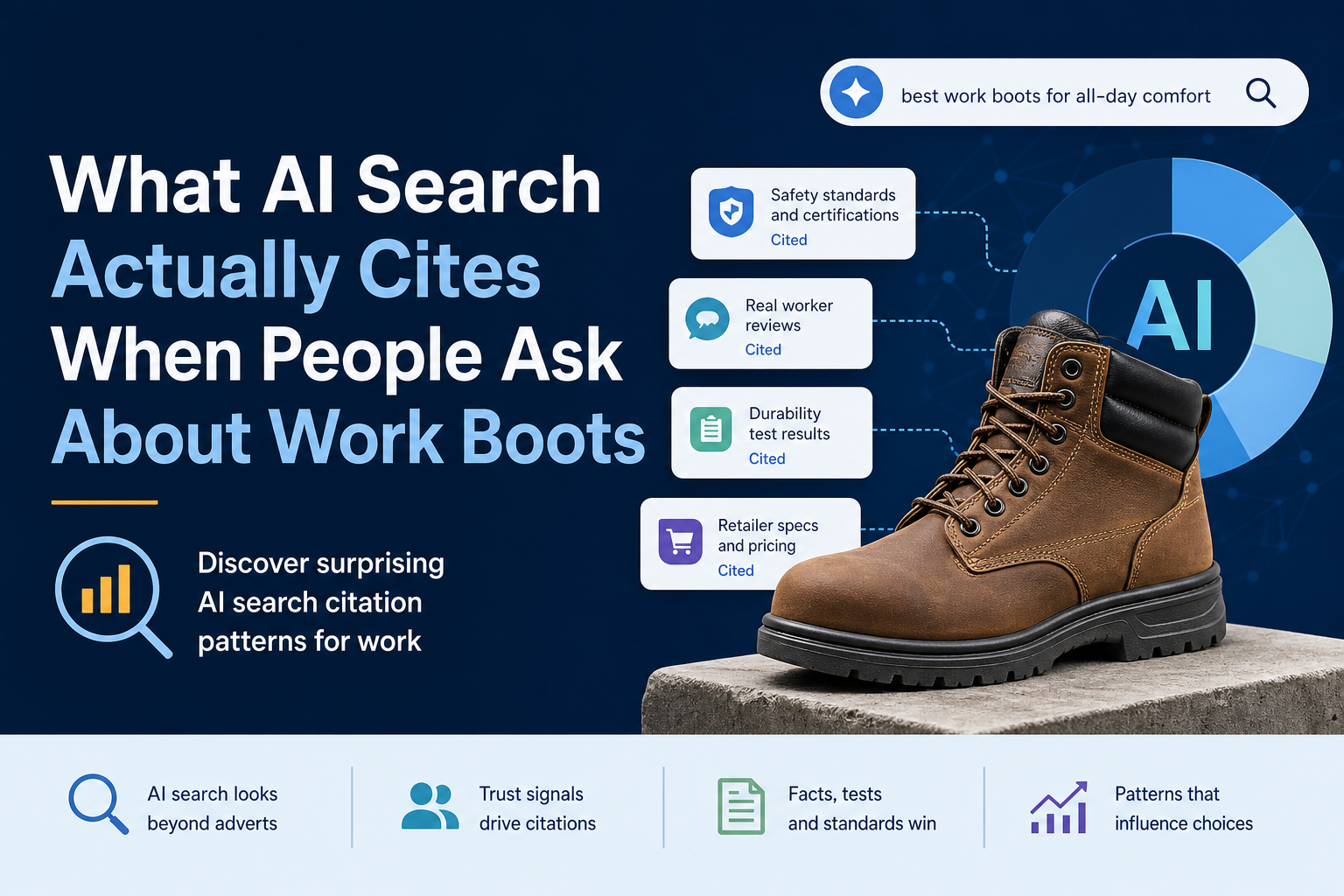
What AI Search Actually Cites When People Ask About Work Boots
Across 126 AI citations spanning nine brands and three engines — ChatGPT, Perplexity, and Gemini — the winners are not who you would expect. Retailer pages punch above brand pages. Amazon appears where it does not elsewhere. And the engines disagree about what counts as an authoritative source.
Why work boots are the cleanest vertical in our dataset
Most of the verticals we tested in phase two of our AI citation study were single-brand case studies. Work boots was the exception — nine brands, nine distinct query intents, and 126 citations across three AI engines. That breadth is what makes it worth writing about on its own.
The queries ranged from brand-comparison (“best work boots for restaurant workers”) to specific-product (“what safety ratings do Avenger Work Boots meet”) to historical (“J.R. Sweasy Red Wing”). This variation means the citation patterns are not an artifact of one query style — they represent how AI engines handle the category broadly.
The top-cited domains are retailer sites, not brand sites
If you assume AI engines answer brand questions by citing brand primary domains, the data pushes back. In our work boots sample, retailer citations outnumbered any individual brand domain, and half of the top 10 cited domains were retailers or aggregators rather than the brands themselves.
The top-cited single domain across all three engines was keenfootwear.com with 8 citations, closely followed by safgard.com (a retailer) and srmax.com (a brand/retailer hybrid) at 7 each. Wolverine, Shoes For Crews, and amazon.com tied at 5-6 each. YouTube pulled 5 citations — the same as Amazon. Reddit appeared 3 times.
For brand marketing teams used to optimizing the brand domain in isolation, this is a corrective. AI engines triangulate across retailers, brand pages, and third-party reviewers. A brand with strong primary-domain content but weak retailer partner pages leaves citation surface on the table.
Brand PSS scores cluster in a surprisingly narrow band
We scored every cited page on the Page Structure Score rubric — a 0 to 100 metric measuring structural readiness for AI extraction. The 100-point scale combines Structure, Answer Clarity, Relevance, Depth, Authority, and Extractability. Brands that clear 70 are preferred citation sources. Pages below 50 are typically low-value filler.
Across all nine work boot brands, mean PSS scores ranged from 57.7 (SR Max) to 69.0 (Georgia Boot). That is a narrow band. No brand dominated the structural quality dimension; most cluster between 60 and 67.
The top three structurally
Georgia Boot (69.0), Red Wing (66.8), and KEEN Utility (66.6) scored highest. The common thread: all three have clean product-technology pages with explicit technical vocabulary — SPR leather, waterproof construction, soft toe vs composite toe — rendered in extractable formats without requiring a JavaScript click to reveal the detail.
The bottom three
SR Max (57.7), Ariat Work (58.6), and Wolverine (59.4) trailed the pack. Wolverine in particular is interesting — strong brand recognition, high consumer trust, but the product pages themselves did not score as well as smaller competitors. Structural quality does not automatically follow brand authority.
Owned vs independent
Brand-owned pages averaged PSS 62.2 in our work boots sample. Independent pages (retailers, editorial) averaged PSS 64.7 — slightly higher than brand-owned. In most verticals, brand-owned content wins on structural quality. In work boots, third-party pages are doing it better. Retailers treat product data as a structured extraction surface. Brands too often bury specs inside marketing copy.
Amazon shows up in work boots — and only in work boots
Across the broader AI citation dataset, Amazon.com is cited almost nowhere. In our Gemini study covering 15 verticals, Amazon received just 4 citations total. Four of those were in the work boots set, accounting for 80% of all Amazon citations in the entire phase two dataset.
This is a practical signal for any brand with both B2B and consumer channels. If you sell work footwear to restaurants, warehouses, and construction crews and to individual buyers on Amazon, your Amazon listings feed into AI citation for consumer-framed queries. If you sell only to industrial distributors, Amazon is not a relevant AEO channel.
Brands in our dataset with Amazon citations: Wolverine, Ariat Work, and Timberland PRO. Shoes For Crews, SR Max, and Georgia Boot had Amazon pages but were not cited from them at the same rate.
What gets work boot brands cited
Technical specs rendered in structured, extractable formats
Safety ratings, toe material, waterproofing claims, slip resistance certifications — when these appear as bullet lists or tables on the product page rather than as sentences inside paragraphs, they become citable. Brands with high PSS scores consistently use the “spec sheet in visible HTML” pattern.
Named technologies and proprietary terms
Red Wing’s SPR leather, KEEN’s ASTM ratings, Georgia Boot’s specific construction methods — named proprietary technology earns brand-primary citation because there is no alternative authoritative source. If your brand has a proprietary technology, name it and put detail pages behind it.
Retailer partnerships with strong product-data feeds
Safgard, SR Max as a retailer, and Lehigh Safety Shoes all appeared at high citation volumes. What they share: clean product pages with visible specs, consistent product data across SKUs, and a focus on the industrial buyer rather than the marketing-driven consumer framing brands sometimes use.
YouTube videos with model-specific titles and captions
YouTube returned 5 citations for work boot queries — primarily walkthroughs, comparison reviews, and safety demonstrations. Uncaptioned or auto-captioned videos do not earn citations. Manually captioned procedural content does.
Audit your work boot brand for AI citation readiness
Tampa Web Technologies analyzes your brand’s presence across AI engines, identifies where retailers and third parties are taking citations you should be earning, and rebuilds product content to score PSS 70+ for AI extraction.
Request an AI Citation Audit