
In industrial markets, visibility used to be straightforward.
If your paid ad appeared at the top of the page for:
- “automated blast system”
- “industrial dust collector”
- “bridge fabrication equipment”
You controlled the introduction.
If you ranked organically #1, you owned first impression.
That hierarchy has changed.
Today, AI-generated summaries often appear at the top of the search results — above paid ads, above organic listings, sometimes filling the entire first screen on mobile.
Before a plant manager scrolls.
Before an engineer evaluates specs.
Before a purchasing team compares vendors.
The narrative has already been framed.
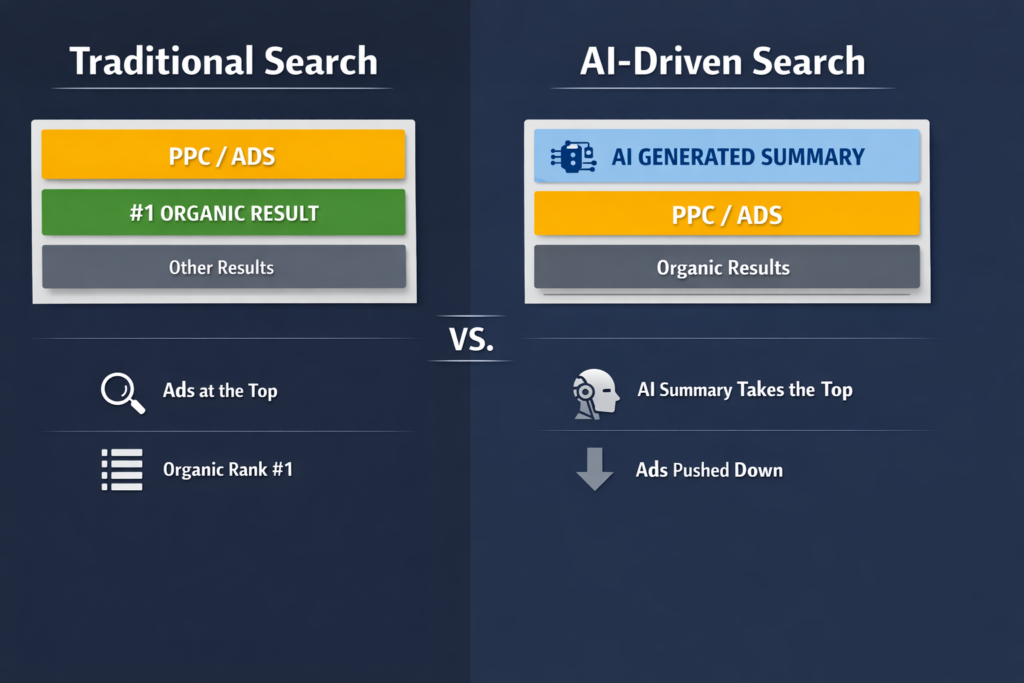
In Industrial Markets, Narrative Is Everything
Industrial buying cycles are not impulse-driven.
They are:
- Spec-driven
- Risk-aware
- Budget-controlled
- Multi-stakeholder
When AI appears first, it does more than summarize.
It:
- Defines what “modern” solutions look like
- Suggests performance criteria
- Highlights certain manufacturers
- Frames ROI expectations
- Establishes terminology
By the time someone scrolls to your ad, they may already have:
- A preferred system type
- A perceived “leader”
- A defined evaluation framework
Your ad is no longer introducing you.
It is competing with a pre-framed market.
The Paid Search Reality Few Industrial Advertisers Are Considering
Let’s look at the mechanics.
If AI summaries push paid ads below the fold:
- Fewer users see the ad immediately.
- Scroll depth becomes a variable.
- Click-through rates may decline.
- Engagement signals may weaken.
Over time, lower click-through rates can affect Quality Score.
Lower Quality Score can require higher bids to maintain visibility.
Higher bids increase cost per click.
In industrial PPC — where clicks are expensive and volume is low — that math matters.
You may be paying for impressions that technically rank “top,” but in practice receive reduced visual exposure because AI controls the first screen.
This isn’t a bidding problem.
It’s a layout hierarchy problem.
Industrial Buyers Are Quietly Changing Behavior
Engineers are increasingly using AI tools to:
- Compare equipment categories
- Understand system differences
- Evaluate surface prep standards
- Review throughput claims
- Clarify compliance requirements
Executives are using AI to:
- Understand CapEx tradeoffs
- Evaluate labor reduction claims
- Estimate ROI ranges
- Identify “leading” manufacturers
If AI frames your competitors first — and omits you — then your paid ad is fighting an uphill battle.
Even if your campaign is optimized.
Even if your budget is strong.
This Is Not an Argument Against PPC
Paid search still plays a role in industrial marketing.
But its role is shifting.
PPC is becoming reinforcement and amplification.
AI inclusion is becoming introduction.
If AI does not clearly understand:
- Your category authority
- Your system differentiation
- Your application depth
- Your industrial positioning
Then your ads are working harder than they should.
Leadership Question for Industrial Teams
If a plant manager searches your core equipment category today and sees an AI summary first:
Does it mention your company?
Or does it define the market without you?
Because if AI now sets the narrative before your industrial ads even appear, the first visibility battle is no longer paid.
It’s structural.
And structure is not solved with higher bids.
Industrial teams that ignore this shift will spend more to maintain visibility while controlling less of the narrative.