
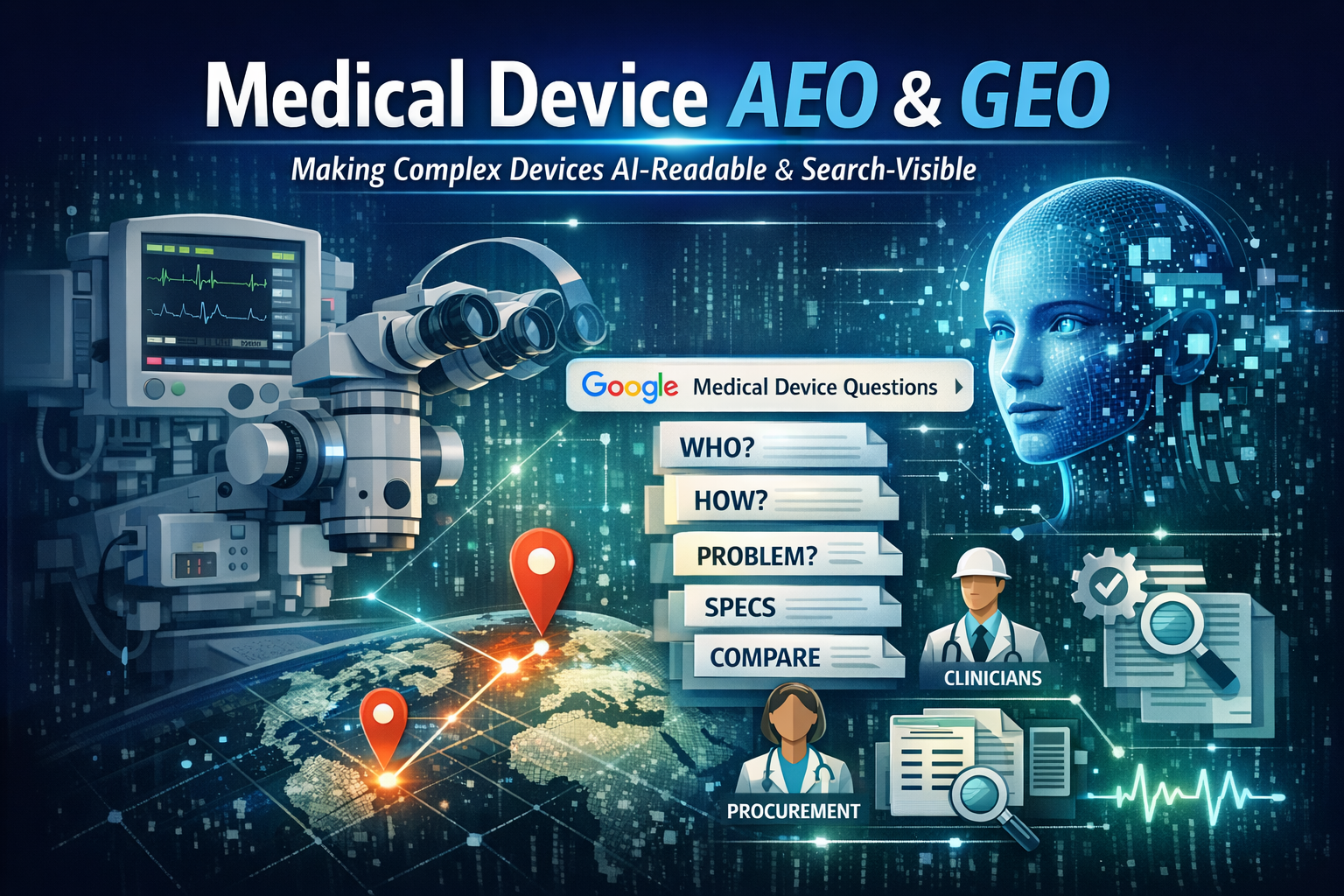
Medical Device AEO and GEO: How Complex Device Information Becomes Search-Visible and AI-Readable
Most medical device companies don’t have a content problem. They have a presentation architecture problem. The clinical expertise exists. The product data exists. The differentiation exists. What’s missing is the structural layer that allows search engines and AI retrieval systems to find it, interpret it, and surface it when buyers are actively evaluating.
Why Medical Device Websites Underperform in AI-Driven Search
AI systems — including Google’s AI Overviews, Perplexity, ChatGPT, and Gemini — don’t retrieve pages. They retrieve structured, interpretable answers to specific questions. Medical device websites are frequently built in ways that make this difficult.
| Structural Problem | Why It Hurts AEO/GEO Performance |
|---|---|
| Product pages with thin explanatory context | AI systems have nothing to summarize or cite |
| Key specs buried in PDFs | PDFs are poorly indexed and rarely cited by AI retrieval systems |
| Investor-oriented language | Doesn’t map to the language clinicians or procurement teams use when searching |
| Catalog-style pages without use-case framing | Lists products but doesn’t explain fit, application, or decision criteria |
| No comparison, FAQ, or intent-layered content | Misses the query types AI Overviews preferentially surface |
| Technical detail present but structurally disconnected | Data exists — AI can’t connect it to a question or user intent |
Comparative Analysis
- Ease of use: Which device is faster for staff to learn and use consistently?
- Compatibility: Which option fits current workflows, systems, or facility requirements more cleanly?
- Documentation quality: Which manufacturer explains specs, use cases, and setup more clearly?
- Maintenance demands: Which device creates less operational friction over time?
- Support and training: Which vendor makes adoption easier after purchase?
The Five Questions Medical Device Content Must Answer
AI retrieval systems are optimized to answer specific questions. Medical device content that answers these five questions clearly — on the page, in HTML, with proper structure — becomes significantly more citable and surfaceable.
Who is this device for?
Don’t just name a product category. Name the actual audience.
A vague “for use in surgical settings” helps no one. Strong AEO content specifies: Is this for the attending surgeon? The scrub tech? The biomedical team? The procurement director? Each audience searches differently and trusts different language. AI systems can only surface your content to the right audience if your content identifies that audience explicitly.
How is it used?
Features describe what a device has. Use cases describe what a device does in practice.
AI systems respond to workflow-oriented content — preparation, setup, intraoperative use, post-use handling. A page that explains the device in procedural context gives AI retrieval systems something to synthesize. A page that only lists features gives them nothing to work with.
What problem does it solve?
This is where device content moves from catalog to decision asset.
Connect the device to a real problem: inconsistent performance, reprocessing complexity, compatibility gaps, staff training burden, procurement friction. Buyers searching with problem-oriented queries will find content that names those problems. They won’t find content that only names product SKUs.
Which specifications actually matter?
Not every spec deserves equal prominence. Emphasize the ones that drive purchase decisions.
For most device categories, the specs that matter are compatibility, reprocessing requirements, material durability, performance tolerances, and service life. Strong AEO content separates signal specs from catalog filler. AI systems weight content that clearly explains why a specification matters, not just what it is.
What do buyers compare before purchase?
This is the layer most medical device content is missing entirely.
Experienced buyers compare fit for intended use, documentation quality, reprocessing compatibility, vendor support structure, and operational practicality — in addition to price. Content that addresses these comparison criteria directly is far more likely to be surfaced in AI-generated comparison responses. If your product pages don’t address this, a competitor’s page will fill that space instead.
Why This Is Specifically an AEO and GEO Problem
When a clinician, procurement director, or biomedical engineer asks an AI system a question about a device category, the AI does not browse your catalog. It retrieves structured content that directly answers the query, synthesizes it, and cites the sources it used.
Pages that get cited share common structural characteristics. Pages that don’t get cited contain the right information in the wrong format.
Pages That Get Cited
- Answer a specific question in plain language
- Use headers that map to actual search queries
- Contain comparison-oriented content
- Include FAQ structures for follow-up questions
- Present technical information in HTML
Pages That Don’t Get Cited
- Right information buried in PDFs
- Disconnected product pages without context
- Investor or regulatory language that buyers don’t search
- Feature lists with no workflow or decision framing
- Catalog pages with no comparison layer
The information problem in medical device marketing isn’t usually knowledge depth. It’s information architecture.
What a Stronger Medical Device Content Architecture Looks Like
Rebuilding for AEO/GEO doesn’t require replacing clinical depth with simplified language. It requires adding a presentation layer that makes existing expertise retrievable.
Category-Level Pages
Plain-language summaries with use case framing, audience identification, and comparison context. These target broad evaluative queries and feed AI overview synthesis.
Product Pages With Intended-Use Context
Beyond specs: who uses it, how it fits the workflow, what problem it addresses, what it’s compared against. Each product page should stand alone as a decision document.
Comparison Pages
Structured comparisons between product lines, use cases, or clinical applications. These are the pages AI systems preferentially cite for “what’s the difference between X and Y” queries.
Buyer-Question Pages
Pages built around the specific questions procurement teams, clinical evaluators, and biomedical engineers actually ask. These map directly to query formats AI Overviews surface.
Glossary and Explainer Pages
Define device categories, regulatory classifications, reprocessing standards, and clinical terminology. These build topical authority and strengthen internal linking across the domain.
HTML Versions of Key Technical Content
IFUs, spec sheets, and compatibility guides that exist only as PDFs are invisible to AI retrieval. Converting key technical content to structured HTML directly improves citability.
The Architecture Problem vs. The Expertise Problem
Most medical device companies are not asking AI and search to do something beyond their product’s capability. They are asking AI and search to surface expertise that their website actively makes difficult to find.
The information already exists — in clinical whitepapers, in sales training decks, in IFUs, in the institutional knowledge of clinical affairs and commercial teams. The website hasn’t been built to surface it.
AEO and GEO work for medical device companies is largely a translation and architecture project: taking existing expertise and restructuring it so that AI retrieval systems can parse it, cite it, and deliver it to buyers at the moment of evaluation.
Frequently Asked Questions
Questions procurement teams, marketing directors, and digital strategy leads ask before starting an AEO/GEO project for medical device content.
Answer Engine Optimization (AEO) is the practice of structuring content so that AI-powered search systems — including Google AI Overviews, Perplexity, and ChatGPT — can retrieve, synthesize, and cite it in response to user queries. For medical device companies, this means building pages that directly answer the questions clinicians, procurement teams, and biomedical evaluators actually ask, rather than presenting content as static catalogs or PDF-dependent product listings.
Generative Engine Optimization (GEO) focuses specifically on making content citable and usable by large language model-based systems when they generate responses. Where traditional SEO targets keyword ranking, GEO targets structural citability — ensuring that when an AI generates a response about your device category, your content is among the sources it draws from. AEO and GEO are closely related and are typically addressed together in a content architecture project.
AI retrieval systems primarily index and cite HTML content. PDFs are indexed inconsistently, rarely cited in AI-generated responses, and don’t support the structured markup — headers, FAQ schema, semantic HTML — that improves AI interpretability. Clinical data, spec sheets, and compatibility guides that exist only as PDFs are effectively invisible to AI Overview synthesis, even if the information is technically public.
Structured content improvements — FAQ schema, HTML conversion of key technical pages, and category-level use-case framing — can begin influencing AI citation patterns within 60–90 days for established domains. New domain builds take longer to accumulate topical authority signals. The highest-leverage starting point for most medical device sites is converting existing expertise into structured, question-answering HTML pages rather than building net-new content.
No. Effective AEO does not mean replacing technical depth with simplified language. It means adding structural clarity so that technical content is retrievable. A page can contain precise clinical and regulatory language and still be well-optimized for AI retrieval — provided it uses proper header structure, answers specific questions directly, and presents information in HTML rather than PDF format.
Companies with complex products, long sales cycles, and multi-stakeholder buying committees benefit most — including surgical instrument manufacturers, medical imaging companies, infusion safety vendors, patient monitoring system providers, and any device company selling into hospital procurement or IDN contract processes. The more questions a buyer needs answered before purchase, the more value a well-structured AEO content architecture delivers.
Summary: By shifting from a feature-list to an intent-answer model, medical device brands provide the structured data AI systems require for citation.