
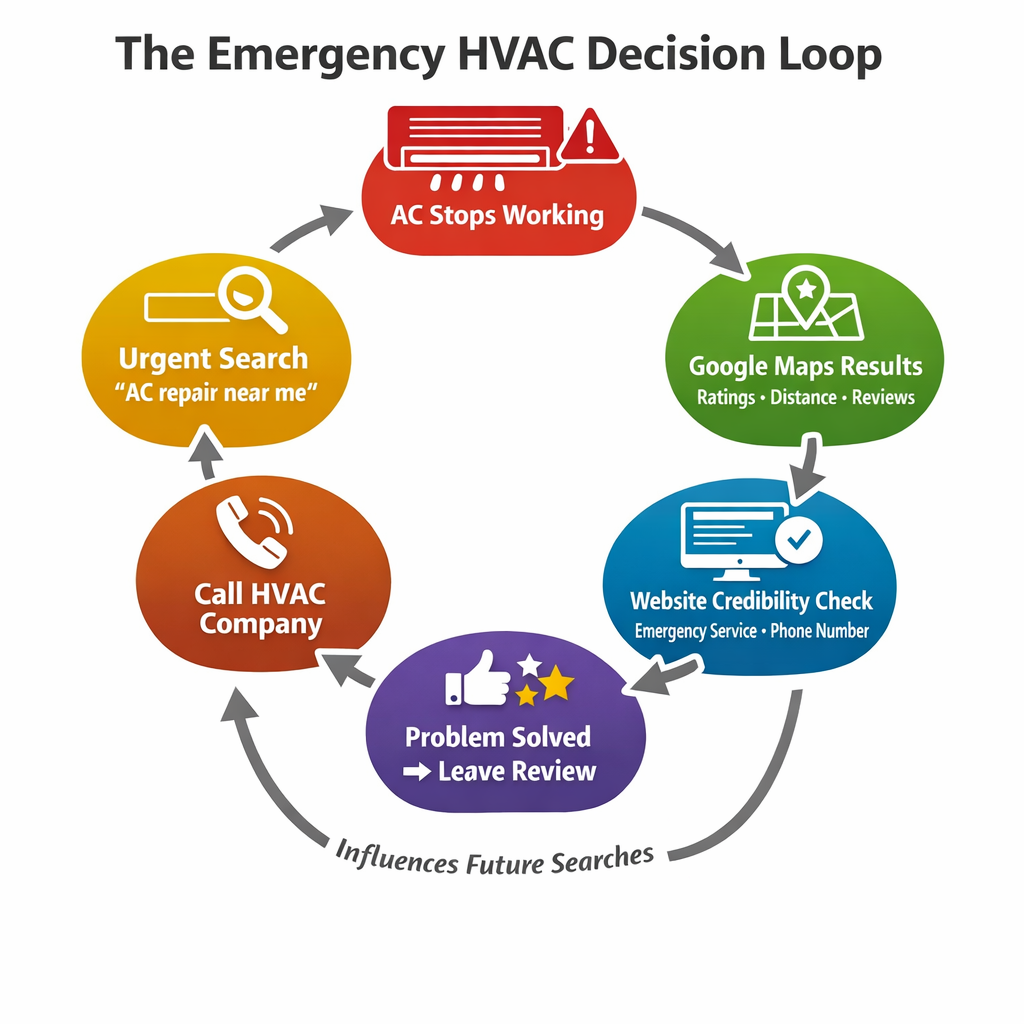
When an air conditioner stops working in the middle of a Florida summer, homeowners don’t research HVAC companies the way marketers imagine. They don’t spend hours reading reviews or comparing service packages. Instead, they follow a fast, predictable search pattern driven entirely by urgency — and it plays out in under ten minutes.
Understanding this pattern is one of the most practical things an HVAC company can do. It tells you exactly what a panicked homeowner needs to see on your website, your Google listing, and your search result — and how quickly they need to see it.
The 5-Step Emergency HVAC Search Pattern
This sequence plays out the same way whether the AC dies on a Tuesday afternoon or at 9pm on a Saturday. The steps are predictable. The timeline is compressed. The tolerance for friction is zero.
Problem recognition — immediate
Warm air comes out of the vents. The system won’t turn on. The house is 82° and rising. In Florida, this transitions from “annoying” to “urgent health concern” within an hour — especially for households with elderly residents, young children, or pets. At this stage the homeowner is thinking one thing: I need this fixed today.
Quick Google search — typically from a phone
The search happens fast. No one types a paragraph into Google when their AC is out. Common emergency searches:
- AC repair near me
- Emergency AC repair
- 24 hour HVAC service Tampa
- Air conditioner not cooling fix today
- Same day AC repair
These searches are entirely intent-driven. There is no research phase. The homeowner already knows they need help — they’re looking for who can provide it right now. This differs fundamentally from the multi-step search process described in the HVAC search strategy hub.
Google Maps scan — 60 seconds
After the search, most users go straight to the Local Pack. They’re scanning fast for four things: star rating, number of reviews, distance, and whether the listing says “24-hour” or “emergency service.” Companies without a complete, active Google Business Profile don’t appear here. How Google Maps rankings work for HVAC companies →
30-second website credibility check
Before calling, most homeowners tap through to the website for a fast gut check. They are not reading your About page. They are scanning for four signals in roughly this order:
- Phone number visible immediately
- Emergency / same-day service mentioned
- Service area confirmation
- Signs the company is real and established
If any of these takes more than a second to find, many homeowners tap back and try the next listing. This is where most HVAC companies lose emergency customers — not because they couldn’t do the job, but because the website didn’t communicate fast enough.
Call the first company that feels trustworthy and available
In an emergency, homeowners don’t contact five companies and wait for quotes. They call the first one that passes the credibility check. If no one answers or the hold time is long, they call the second. Speed of response — both in how fast your listing appears in search and how fast a human answers — is the single biggest conversion variable in emergency HVAC scenarios.
Why Florida Emergency Searches Are a Different Animal
In most states, a broken AC is an inconvenience. In Florida from May through October, it’s a legitimate health event. Temperatures above 90°F with high humidity can make an un-air-conditioned home dangerous within hours for vulnerable residents. This changes the search behavior in measurable ways.
“In Florida, an HVAC emergency in July is not a home maintenance problem. It’s a safety problem. The homeowner isn’t price-shopping. They’re calling the first number they trust.”
Peak season (May–Oct)
Emergency search volume spikes. Response time expectations are compressed. Homeowners expect same-day or next-morning service as the baseline. Companies that can’t communicate availability clearly lose calls to those that do.
Off-season (Nov–Apr)
Heating emergencies are rarer but the search pattern is identical — urgency-driven, Maps-first, 30-second website scan. Off-season is also when homeowners schedule maintenance and replacement consultations, where the full research loop applies.
This seasonal pattern is one reason HVAC SEO operates differently from other local service categories — the demand curve is steeper, the search intent more urgent, and the consequences of not showing up in the right moment are higher.
What Emergency Customers Need to See — and What Loses Them
The homeowner who lands on your website during an emergency is not reading. They are scanning. Your site has approximately 30 seconds to communicate four things before they tap back and try the next listing.
✓ What keeps them on the page
Phone number above the fold
Visible without scrolling on mobile. Tappable. No hunting required.
Emergency / same-day service stated clearly
“Same-day AC repair” or “24-hour service” in the headline — not buried in body copy.
Service area confirmation
Cities named explicitly. If a homeowner can’t confirm you serve their area in 5 seconds, they move on. Service area pages →
Trust signals visible fast
Review count, years in business, or a credibility badge. How reviews shape trust and rankings →
✗ What sends them to a competitor
Phone number in the footer only
If they have to scroll to find your number, many won’t. They’ll tap back instead.
Slow load time on mobile
A 4-second load feels like an eternity when the house is 85°. Speed is a conversion variable.
No emergency or same-day service mention
If your site reads like a general HVAC page, emergency searchers don’t know if you’re even available today.
No service area information
Ambiguity about coverage is a reason to leave. Specificity is a reason to call.
How AI Search Changes the Emergency HVAC Equation
Most emergency searches still happen on Google — but a growing number of homeowners ask AI tools like ChatGPT, Siri, or Google’s AI Overviews for help first. “Who does emergency AC repair near me?” is the kind of query that increasingly routes through AI before a traditional search.
This matters because AI systems answer these questions based on what they know about your business — and what they know comes from your website content, your Google Business Profile, your schema markup, and how consistently your entity is described across the web. A company with strong AEO foundations can get recommended by AI before the homeowner ever opens a search results page.
The same content that makes you visible in emergency Google searches — clear service descriptions, explicit location coverage, specific emergency service language — also makes you citable by AI systems. How HVAC companies get recommended by AI search engines →
For HVAC companies, AEO isn’t a replacement for local SEO — it’s the layer on top that makes you visible in the channels where emergency search behavior is shifting. The full framework is covered in HVAC SEO vs AEO: What Companies Need to Know About Modern Search.
Emergency Searches Are Part of a Larger Pattern
Emergency repair searches represent the highest-intent traffic in the HVAC category. But they are only one part of how homeowners find HVAC companies. Most customers go through a multi-step research journey that starts with problem searches, moves through service searches, and arrives at local contractor searches before any emergency triggers.
Companies visible throughout that entire journey — not just at the final “near me” moment — build stronger local search positions and stronger AI recommendation profiles. See the full HVAC search strategy hub →
And ranking in Google doesn’t automatically mean the phone rings. Why HVAC companies lose leads even when they rank →
Want to know if your HVAC website is set up to capture emergency searches?
Request a Free Assessment →Florida HVAC
Energy Savings Calculator
Estimate how system efficiency, duct condition, insulation, and usage patterns may affect your cooling costs — and how much an upgrade could save.
- Low-efficiency equipment running more hours to maintain setpoint
- Duct leakage losing conditioned air to unconditioned spaces
- Poor attic insulation allowing heat gain through the ceiling
- Aggressive thermostat settings requiring longer run cycles
- Long daytime occupancy increasing internal heat load
- Aging equipment losing efficiency relative to nameplate SEER
- Oversized or undersized systems cycling inefficiently
- High Florida humidity adding latent cooling demand
Want a Real Number?
Request a professional HVAC evaluation. A qualified contractor can assess your actual system performance, duct efficiency, and insulation — and give you a real project cost and savings estimate.
Frequently Asked Questions
Common questions about emergency HVAC search visibility from HVAC company owners and marketers.
How is an emergency HVAC search different from a regular HVAC search?
In a regular HVAC search, homeowners go through a multi-step process — they research symptoms, compare service types, then look for local contractors. In an emergency search, those first two steps are skipped entirely. The homeowner goes straight to "AC repair near me" or "24 hour HVAC service." The timeline compresses from days to minutes, and price is rarely the primary concern.
This means your website, GBP listing, and search result need to communicate availability and urgency instantly — not after the homeowner has read three paragraphs.
What's the most important thing an HVAC website needs for emergency searches?
A visible, tappable phone number above the fold on mobile — followed immediately by a clear statement that you offer same-day or emergency service. If a homeowner has to scroll to find your number or can't tell from the first screen whether you're available today, a significant percentage will leave without calling.
Secondary to that: explicit service area coverage, a fast load time on mobile, and trust signals (reviews, years in business) that are visible quickly. Urgency first, credibility second.
Does a Google Business Profile matter for emergency HVAC searches?
It's arguably the most important asset for emergency searches. Most emergency searchers go to the Google Maps Local Pack — the three businesses shown with a map above organic results — before they visit any website. If you don't appear there, you don't get considered.
For emergency searches specifically, your GBP needs to clearly show service hours (including 24-hour or weekend service availability), have a strong review count, and include emergency service language in your services and description. How Google Maps rankings work for HVAC companies →
Do homeowners use AI assistants for emergency HVAC searches?
Increasingly, yes — though voice and AI queries are still secondary to direct Google searches for most emergency scenarios. When someone asks ChatGPT "Who does 24-hour AC repair in Tampa?" the response draws from your website content, GBP listing, and online entity signals.
The practical implication: the same on-page content and structured data that helps you rank in Google also improves your visibility in AI-driven responses. There's no separate strategy required — it's the same foundation. How HVAC companies get recommended by AI search engines →
What keywords should an HVAC company target for emergency searches?
Emergency HVAC keywords cluster around urgency and availability modifiers combined with service type and location. The highest-value patterns: "emergency AC repair [city]," "same day AC repair [city]," "24 hour HVAC service [city]," "AC not working [city]," and "air conditioner repair today [city]."
These should appear in page titles, H1 headings, first paragraphs, and your GBP services list — not just buried in body copy. A dedicated emergency service page is more effective than trying to optimize a general homepage for both routine and emergency searches. Complete guide to HVAC keywords for local SEO →
Why do HVAC companies lose emergency customers even when they rank in Google?
Ranking is only the first step. The moment a homeowner lands on your site during an emergency, every second of friction is a reason to leave. The most common failure points: phone number not visible without scrolling, no emergency service statement, slow page load on mobile, and no service area confirmation. Some companies also lose calls at the phone stage — if the call goes to voicemail during an emergency, the homeowner simply calls the next listing.
Ranking gets you considered. Your website and phone answer converts the consideration into a call. Why HVAC companies lose leads even when they rank →
HVAC SEO & AEO — Full Article Cluster
View Strategy Hub →