
Commercial HVAC systems are essential for keeping offices, hospitals, retail spaces, and industrial buildings operational. When these systems fail, the responsibility for diagnosing the issue and finding a repair contractor often falls to facility managers, building engineers, or property managers.
Because these professionals oversee complex equipment and large facilities, the way they search for HVAC repair services is very different from how homeowners search for residential HVAC companies.
Understanding how facility managers research HVAC problems can help contractors position their websites to appear earlier in the decision process.
The Role of Facility Managers in HVAC Decisions
Facility managers are responsible for maintaining building systems, managing vendor relationships, and minimizing downtime when equipment fails.
When a commercial HVAC issue occurs, their first goal is usually to understand the problem before contacting outside contractors.
This often means researching:
• the equipment brand
• the system type
• possible causes of failure
• repair options
Only after gathering information do they begin contacting service providers.
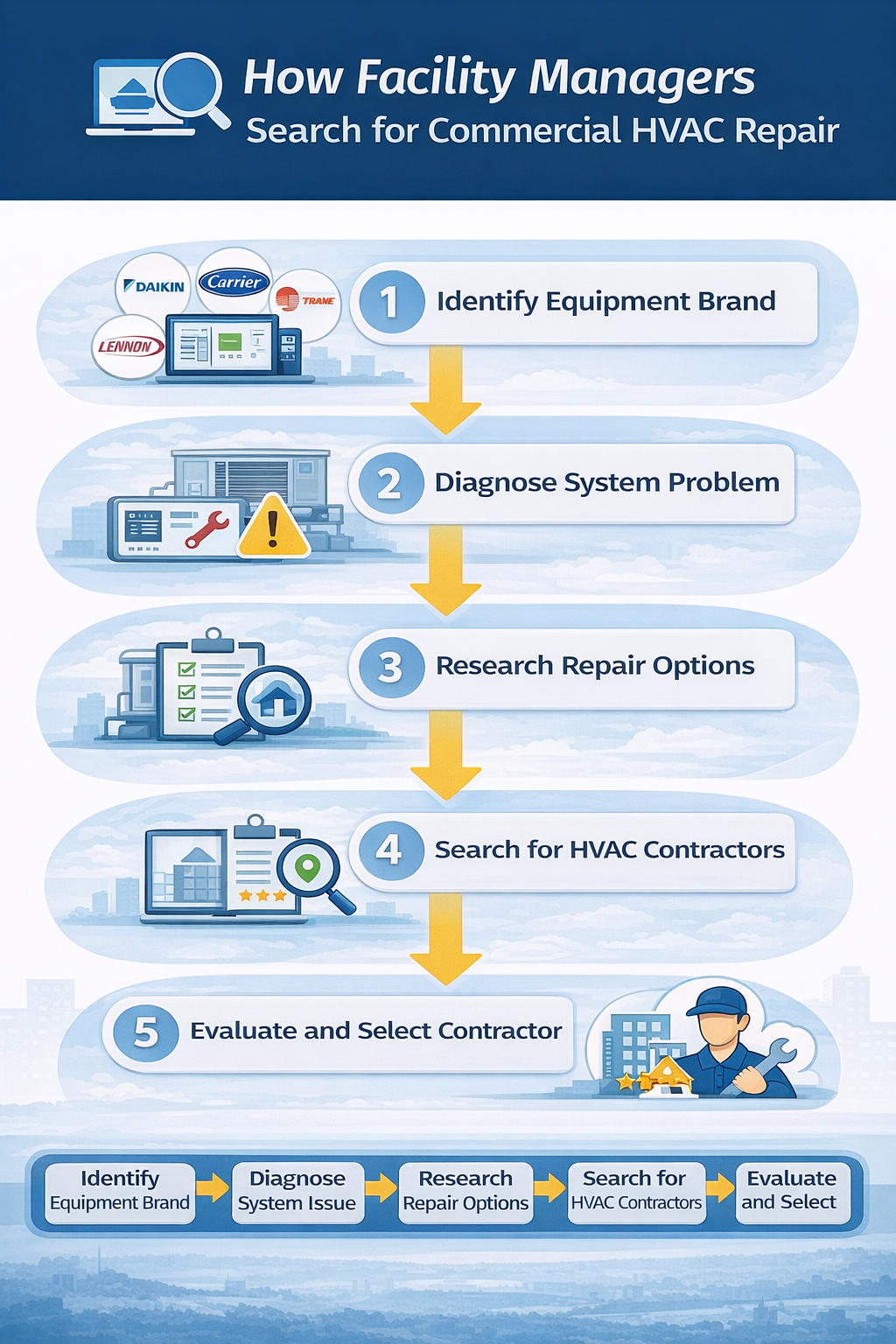
Stage 1: Identifying the Equipment
Most commercial HVAC systems are associated with specific manufacturers. Because of this, the first search often includes the brand installed in the building.
Common commercial HVAC manufacturers include:
Daikin
Carrier
Trane
Lennox
York
Example searches may look like:
Trane rooftop unit troubleshooting
Carrier chiller repair
Daikin VRF system problems
These searches help facility managers determine whether the issue is common and what repair options may be available.
Stage 2: Diagnosing the Problem
Once the equipment brand is identified, the next step is usually diagnosing the mechanical problem.
Typical searches may include:
rooftop unit not cooling building
commercial HVAC compressor failure
chiller not starting
These searches are often focused on troubleshooting rather than hiring a contractor.
Facility managers may review guides, diagrams, and technical explanations before deciding whether the issue requires outside service.
Stage 3: Researching Repair Options
After identifying the likely problem, facility managers begin researching repair approaches and potential solutions.
Examples include:
RTU compressor replacement
commercial HVAC motor repair
chiller maintenance procedures
At this stage, they are evaluating the seriousness of the issue and whether it requires specialized repair services.
Websites that provide clear explanations of system failures and repair options can establish credibility during this stage.
Stage 4: Searching for Commercial HVAC Contractors
Once the problem is understood, the facility manager begins looking for qualified contractors.
Typical searches include:
commercial HVAC contractor near me
rooftop unit repair service
commercial chiller repair company
Because commercial HVAC projects can involve significant costs and operational risk, facility managers often review multiple companies before making contact.
Stage 5: Evaluating Contractors
Before scheduling service, commercial HVAC buyers typically evaluate contractors based on several trust signals.
Common evaluation factors include:
manufacturer certifications
experience with similar systems
commercial project experience
safety compliance and insurance
customer reviews or referrals
Contractors that clearly communicate these signals online are more likely to receive calls from commercial clients.
How This Search Process Impacts SEO and AEO
The commercial HVAC research process highlights why many traditional marketing strategies fail.
If a website only targets contractor-related keywords such as:
commercial HVAC contractor
commercial HVAC repair
it appears only at the final stage of the research process.
However, websites that also provide content related to:
equipment brands
system troubleshooting
repair explanations
can appear earlier during the research phase.
This approach improves both Search Engine Optimization (SEO) and Answer Engine Optimization (AEO).
AI systems and search engines increasingly reference websites that provide clear explanations of technical problems.
By publishing structured troubleshooting content, HVAC companies increase the chances that their websites will appear in search results and AI-generated answers.
The Commercial HVAC Research Loop
Commercial HVAC searches typically follow a predictable pattern.
The process often looks like this:
HVAC problem discovered
↓
Search equipment brand
↓
Research system troubleshooting
↓
Evaluate repair options
↓
Contact HVAC contractor
Contractors who appear early in this research loop often gain an advantage because they become a trusted source of information before competitors are contacted.
Why Educational Content Builds Commercial Trust
Facility managers often prefer working with contractors who demonstrate expertise and technical knowledge.
Websites that include content such as:
system troubleshooting guides
equipment repair explanations
storm damage inspections
preventive maintenance resources
signal that the contractor understands complex commercial systems.
This content not only improves search visibility but also reassures potential clients that the contractor has experience working with large HVAC equipment.
The Advantage of Understanding Commercial HVAC Search Behavior
Commercial HVAC projects are often high-value service contracts. Because of this, contractors that understand how facility managers research problems online have a significant advantage.
Instead of competing only for contractor keywords, they position their websites to appear throughout the entire research process.
This approach allows HVAC companies to:
build trust earlier in the decision cycle
capture technical search queries
reduce reliance on paid advertising
generate higher-quality commercial leads
The Bottom Line
Facility managers rarely search for commercial HVAC contractors immediately when equipment fails. Instead, they begin by researching equipment brands, troubleshooting system problems, and evaluating repair options.
Contractors that align their websites with this research process are far more likely to appear in search results during the early stages of decision-making.
By structuring their websites around equipment brands, system troubleshooting, and repair expertise, commercial HVAC companies can attract more qualified commercial clients and build stronger long-term service relationships.
To understand how commercial HVAC search actually works, see our guide on Commercial HVAC Search Architecture.