
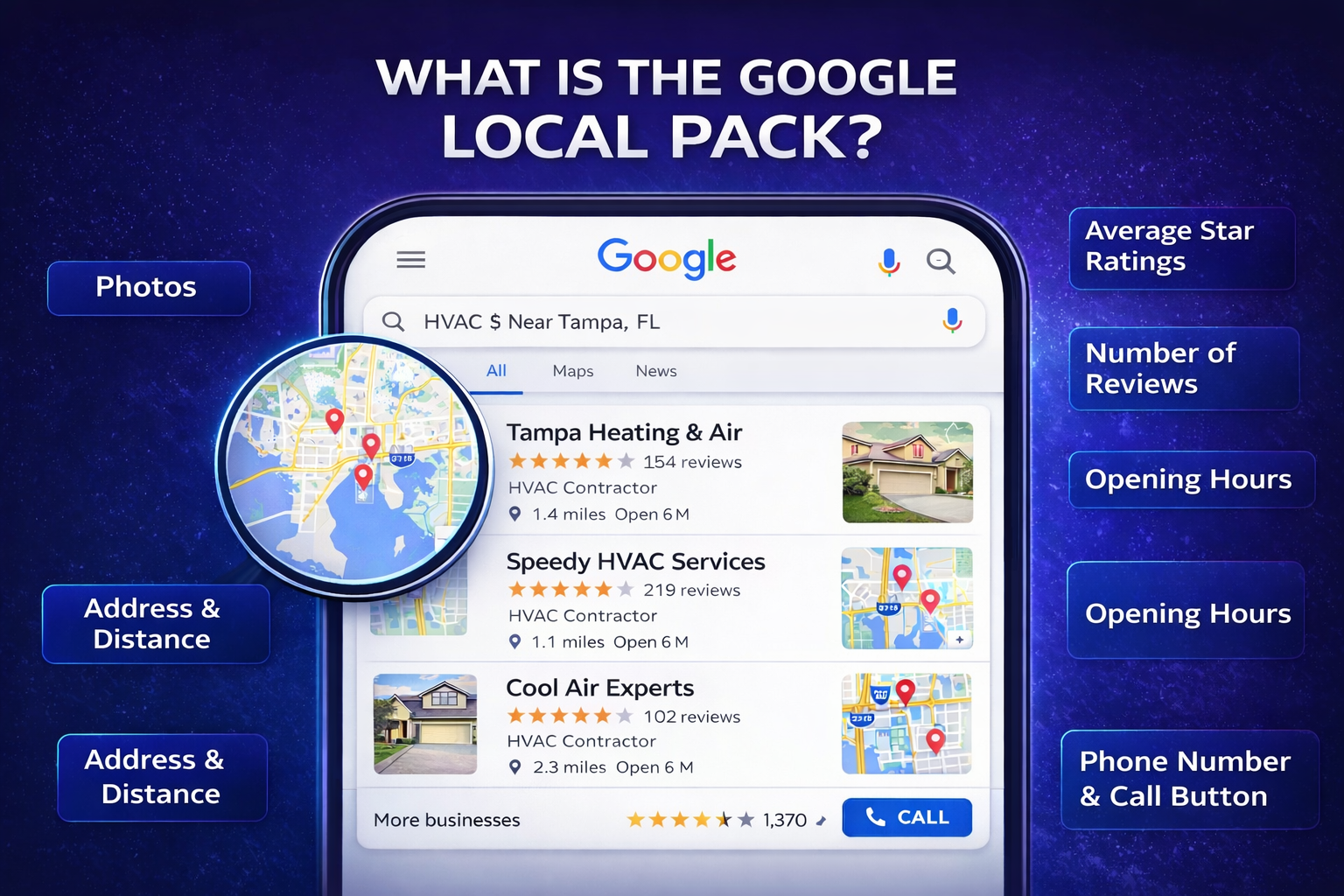
When a homeowner searches “AC repair near me,” they’re rarely thinking about algorithms. They see a map, three businesses, star ratings, and a call button. Within seconds they’ve made a decision. For the HVAC company that appears in those three spots, that search produces a phone call. For the hundreds of other HVAC companies in the area, it produces nothing.
Understanding how Google decides which three businesses appear — and why — is the foundation of every effective HVAC local SEO strategy. Google has publicly documented its Local Pack ranking system around three primary factors: relevance, distance, and prominence. Each factor contains multiple signals, and the interplay between them determines who appears and who doesn’t.
Relevance
How closely a business profile and website match what the homeowner is searching for. Services listed, categories selected, and content depth all contribute.
Distance
How far the business location is from the searcher’s actual location at the time of the search. The one factor HVAC companies cannot directly control.
Prominence
How well-established and trusted the business appears across the web. Reviews, citations, website authority, and engagement signals all feed into this factor.
What the Local Pack Is and Why It Dominates HVAC Search
The Local Pack — Google’s map-based results block — appears at or near the top of the search results page for local service queries. For HVAC searches, it triggers reliably on service + location queries (“HVAC contractor Tampa”), proximity queries (“AC repair near me”), and urgency queries (“emergency AC repair”). These are the three highest-converting search types in HVAC local search, and the Local Pack intercepts all of them before organic results appear.
Each Local Pack listing shows the business name, star rating and review count, address and proximity indicator, hours, and direct call button. A homeowner can evaluate and call an HVAC company without ever visiting the website. This means GBP optimization and review strength have a direct, measurable impact on phone call volume — independent of whatever’s happening with organic website rankings.
What triggers the Local Pack
Service + city queries (“HVAC repair Tampa”), “near me” searches, and emergency service searches. The Local Pack appears above organic results for these, making it the first thing homeowners see.
What the Local Pack shows
Business name, overall star rating and review count, distance from searcher, hours of operation, and a direct call button. Most homeowners make their decision from this information alone.
Why three spots matter
The Local Pack displays three businesses by default. Studies consistently show click-through heavily favors the top position, with the third position receiving substantially less engagement than first. Visibility drops sharply outside the top three.
Local Pack vs organic
Local Pack and organic website rankings are different systems with different optimization requirements. A company can rank #1 in organic results and still be invisible in the Local Pack if GBP signals are weak. Both require distinct strategies.
Factor 1: Relevance — Helping Google Understand What You Do
Relevance is Google’s measure of how well a business profile matches the specific search query. For HVAC companies, this means Google needs to understand clearly which services you offer, in which geographic areas, for which system types. The more precisely your GBP and website communicate this, the more confidently Google will show your listing for relevant searches.
Primary GBP category
The most significant relevance signal in your GBP. “HVAC Contractor” is the correct primary category for most full-service HVAC companies — not just “Air Conditioning Contractor” which limits relevance for heating and general HVAC searches. Secondary categories should cover every service type you offer.
Services list in GBP
Google’s services feature allows you to list every individual service by name with descriptions. “AC Repair,” “Emergency AC Repair,” “HVAC Installation,” “Furnace Repair,” “Heat Pump Service,” “Duct Cleaning” — each service listed is an additional relevance signal for its specific search query. Most HVAC companies leave this section incomplete.
Business description
The GBP business description (750 characters) should name specific services, mention key service cities, and include emergency availability if you offer it. This text is indexed and contributes to relevance matching. Generic descriptions that say “we provide quality HVAC services” contribute almost nothing compared to descriptions that name specific services and areas.
Website content depth
Google’s local algorithm analyzes your website to understand and confirm the services your GBP claims to offer. A GBP that lists “furnace repair” but links to a website with no furnace-specific content creates a relevance gap. Service pages on your website that clearly describe each service reinforce the GBP signals and improve overall relevance. HVAC keyword strategy →
Q&A section management
The GBP Q&A section allows anyone to post questions — and anyone to answer them. Pre-populating it with accurate answers to common questions (service area, emergency availability, licensing, payment methods) ensures homeowners get correct information and adds another layer of indexed content that contributes to relevance.
Factor 2: Distance — The Factor You Can’t Control (But Can Work Around)
Distance is calculated dynamically, based on the physical location of the searcher at the moment they perform the search. An HVAC company headquartered in Riverview will struggle to appear in Local Pack results for searches performed in New Tampa — not because of anything wrong with their optimization, but purely because of geography. This is the factor HVAC companies cannot directly change.
The Local Pack results that appear for “AC repair near me” literally change block by block across a city. A search in South Tampa produces different results than the same search in Carrollwood, even though both are within what most HVAC companies would call their service area.
For the company whose GBP address is in the searcher’s general vicinity: distance advantage reinforces all other signals. For companies whose GBP address is 10+ miles away: distance disadvantage is difficult to overcome even with strong reviews and a perfect GBP.
For areas where your GBP address creates a distance disadvantage, the primary compensation tools are:
- Service area pages targeting “[service] [city]” for each secondary market — these support organic rankings that appear below the Local Pack and capture homeowners who scroll past it
- Location-specific content that signals your coverage of secondary areas to both Google and searchers
- GBP service area settings — listing your true service area helps Google understand which searches to consider you for, even when distance is a partial disadvantage
Factor 3: Prominence — The Most Differentiated and Most Durable Signal
Prominence is Google’s measure of how well-established and trusted a business is — both online and in the real world. It’s the factor with the widest variance between competitors and the longest time horizon to build. Companies with strong prominence maintain Local Pack visibility more stably, more predictably, and more defensibly than companies that rely on recency of optimization alone.
Review volume and velocity
Total review count and the rate at which new reviews arrive are both prominence signals. A company with 280 reviews receiving 5–8 new reviews per week has far stronger prominence than a company with 40 reviews receiving one review per month — even if the per-review quality is similar. Review velocity signals to Google that the business is active, serving customers consistently, and maintaining relevance over time. Full review strategy guide →
Citation consistency (NAP)
Business name, address, and phone number (NAP) appearing consistently across Google, Yelp, BBB, Angi, HomeAdvisor, local chambers, and industry directories reinforces the business entity in Google’s local knowledge graph. Inconsistencies — a different suite number on Yelp, an old phone number on a directory listing — create entity ambiguity that dilutes prominence signals. Auditing and cleaning citations is a foundational prominence-building task.
Website authority
The strength and topical authority of the associated website directly influences Local Pack prominence. Google treats the linked website as evidence of the business’s expertise and legitimacy. An HVAC company with a thin 5-page website has significantly weaker website authority signals than one with 30+ pages covering services, service areas, symptoms, and industry education. The two ranking systems — organic and Local Pack — share authority signals.
Engagement signals
When homeowners repeatedly click on a Local Pack listing, read its reviews, request directions, or tap the call button, Google interprets that engagement as evidence that the listing is relevant and useful for that type of search. Higher visibility generates more engagement, which signals more relevance, which maintains or improves visibility. This feedback loop is one reason dominant Local Pack positions are difficult to displace once established.
Third-party mentions and links
Manufacturer dealer designations (Carrier, Trane, Lennox, Goodman authorized dealer pages), NATE certification listings, ACCA membership directories, BBB accreditation, and local news features all create authoritative third-party mentions that contribute to prominence. These aren’t just trust signals for homeowners — they’re citation sources that signal to Google’s local algorithm that the business is recognized within its industry and community.
GBP Optimization: What “Fully Optimized” Actually Means
Most HVAC companies have a Google Business Profile. Most of them are incomplete. “Fully optimized” means every available field is filled in correctly and maintained actively — not set once and forgotten. Here’s what that looks like in practice:
Primary category: HVAC Contractor
Not just “Air Conditioning Contractor.” Correct primary category selection is the most impactful single GBP optimization decision for most companies.
Secondary categories
Add all relevant: Air Conditioning Contractor, Heating Contractor, Furnace Repair Service, HVAC Repair Contractor, Heat Pump Contractor.
Every individual service listed
AC Repair, Emergency AC Repair, HVAC Installation, Furnace Repair, Heat Pump Service, Duct Cleaning, HVAC Maintenance, Air Quality Testing. Each is an individual relevance signal.
Business description (all 750 characters)
Names specific services, covers primary service cities, mentions emergency availability if applicable. Not generic — specific.
10+ current photos
Service vehicles, technicians on jobs, completed work, the office. Updated regularly — photos with recent timestamps signal an active business. No stock photos.
Hours accurate including holidays
Hours inconsistencies are a trust signal to Google. Update holiday hours every year. If you offer 24/7 emergency service, mark those hours correctly.
GBP posts 2–3x/month
Seasonal tips, completed job highlights, emergency availability reminders, maintenance reminders before summer/winter. Active posting signals a live, engaged business.
Respond to every review within 48 hours
Both positive and negative. Response rate and recency are management signals that influence both customer perception and GBP completeness signals.
Q&A pre-populated
Answer your own most common questions before customers ask them: service area, emergency hours, licensing, financing, payment methods. Prevents wrong answers from appearing.
Service area cities listed
List every city you actively serve, not just your home city. This influences which proximity-adjacent searches Google considers you for.
Completing this checklist takes 2–3 hours once and ongoing maintenance of 30–60 minutes per month. Most HVAC companies that aren’t appearing in the Local Pack have 3–4 of these items missing or incomplete. The GBP audit is always the first step in any local SEO engagement because it produces the most immediate impact for the least effort. Why some companies dominate Maps →
Frequently Asked Questions
Common questions about how Google Maps rankings work for HVAC companies.
How long does it take for GBP changes to affect Local Pack rankings?
GBP changes typically take 1–4 weeks to be fully processed and reflected in rankings, though some changes (like completing missing sections) can have faster effects. Category changes are among the most impactful and generally process within 1–2 weeks. Review accumulation effects are more gradual — a single new review won’t move rankings, but a consistent increase in review velocity over 60–90 days typically produces measurable ranking changes.
The honest answer is that Local Pack rankings shift continuously based on many signals simultaneously. Isolated changes are difficult to attribute with precision. The better frame is: consistent optimization activity over 90–180 days produces measurable, durable improvement. Single changes produce minimal effect on their own.
Can an HVAC company appear in the Local Pack for a city where it doesn’t have a physical office?
It’s significantly harder, but not impossible, depending on the competitive landscape and how close the secondary city is. Google weights physical proximity heavily for Local Pack positioning. A company whose GBP address is 15 miles from a secondary city will face a built-in disadvantage that strong reviews and GBP optimization can partially — but rarely fully — compensate for in direct Local Pack competition.
The more reliable strategy for secondary cities is organic search: service area pages targeting “[service] [city]” rank in the organic results below the Local Pack and capture homeowners who scroll. In less competitive secondary markets, these pages can also influence Local Pack appearance with enough accumulated relevance. Service area page strategy →
Does having more Google reviews than a competitor guarantee a higher Local Pack ranking?
No, but review volume is one of the most consistently reliable prominence signals. All three factors — relevance, distance, and prominence — combine to determine rankings. A company with 300 reviews but an incomplete GBP and weak website might still rank below a company with 180 reviews that has a fully optimized GBP and strong local website authority, because relevance signals are also insufficient.
What review volume reliably does: it produces a clear prominence advantage when relevance and distance are roughly equal between competitors. In Tampa Bay’s most competitive HVAC markets, the top three Local Pack positions almost always belong to companies with 150+ reviews. Review volume isn’t sufficient on its own, but below roughly 100–150 reviews in a competitive market, it’s often the primary constraint.
What’s the relationship between Google Maps rankings and Google Ads for HVAC companies?
Google has stated that paid advertising does not directly influence organic or Local Pack rankings. Running Google Ads will not improve your GBP’s position in the Local Pack. They operate as separate systems. However, Google also offers Local Services Ads (LSAs) — a separate paid product that places verified businesses above the regular Local Pack with a “Google Guaranteed” badge. LSAs and the organic Local Pack are different products that appear in different positions on the results page.
The strategic interaction worth understanding: LSAs require the Google Guarantee verification, which involves background checks and licensing verification. The verification process forces GBP completeness. Companies that go through LSA setup often see Local Pack improvement as a side effect, simply because they’ve been required to complete their GBP correctly.
How does AI search (ChatGPT, Perplexity, Google AI Overview) affect HVAC Local Pack visibility?
For HVAC service searches, AI tools and Google’s Local Pack serve different search intents and don’t directly compete. When a homeowner asks “find me an AC repair company near me,” most AI tools currently either draw on Google Maps data or acknowledge they can’t locate real-time local businesses with phone numbers. The Local Pack remains the dominant surface for local service discovery.
Where AI search is relevant for HVAC companies is in informational and reputation queries: “who are the best HVAC companies in Tampa?” or “which HVAC companies have the best reviews?” These queries increasingly get AI-generated responses that synthesize review data, website content, and third-party mentions. Companies with strong review volume, a well-documented online presence, and consistent entity signals across the web are better positioned to be cited positively in these AI responses. HVAC AEO strategy →
HVAC SEO & AEO — Full Article Cluster
View Strategy Hub →