
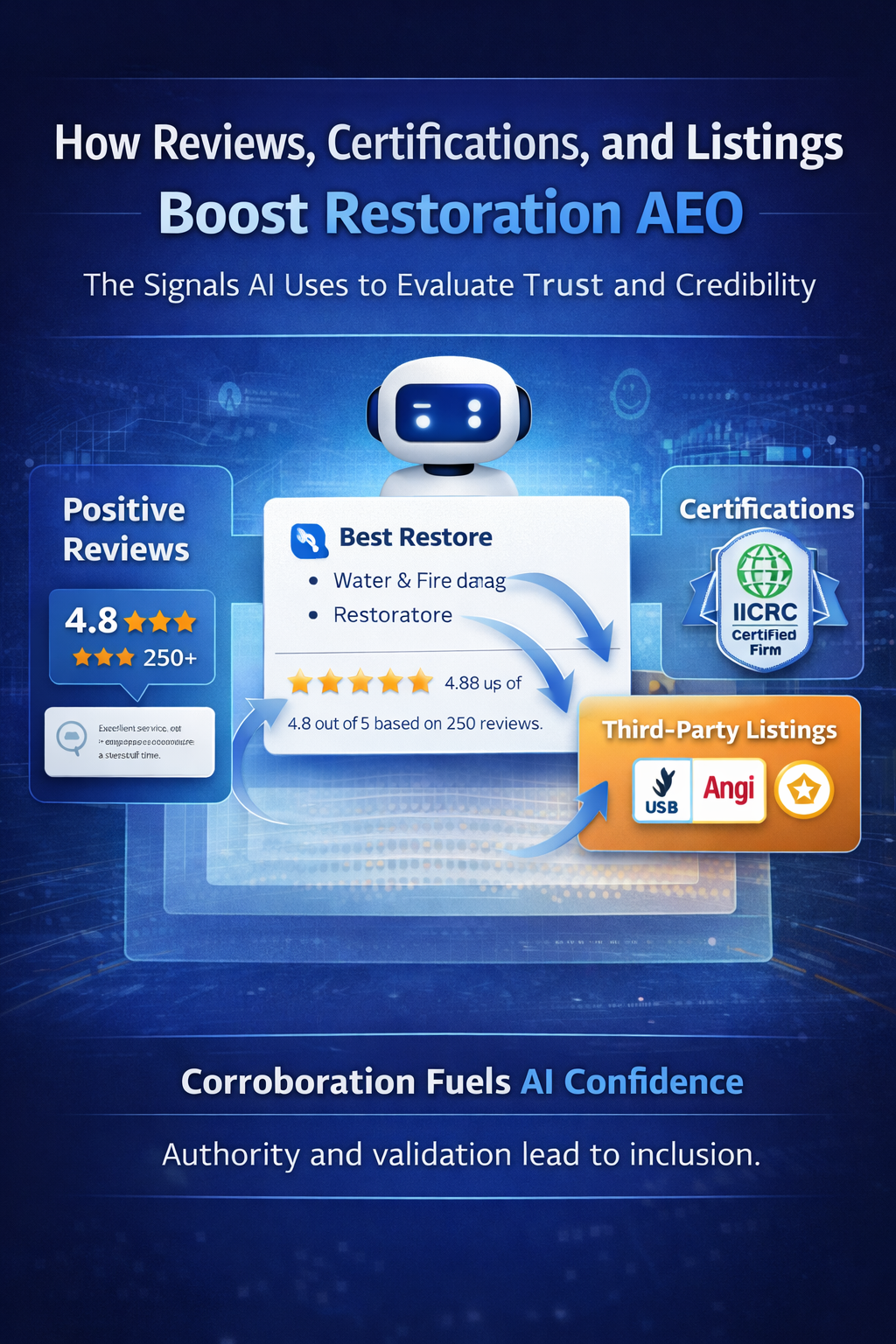
How Reviews, Certifications, and Third-Party Listings Make AI Recommend Your Restoration Company
AI engines do not just count your stars. They read your reviews, verify your certifications, and check whether trusted third-party sources are naming your company as a recommended restoration provider. Each of these signals contributes to whether you appear in AI recommendations — and most restoration companies are leaving all three on the table.
Why AI Reads Your Reviews — and What It Is Looking For
When an AI engine evaluates whether to recommend your restoration company, it does not stop at your star rating. Modern AI recommendation systems perform sentiment analysis on review content — reading the actual text of your reviews to identify which services you performed, how the experience went, and whether customers used the specific service terminology that matches the homeowner’s query.
A review that says “Great service, highly recommend!” is a positive sentiment signal but nothing more. A review that says “They responded within 45 minutes to our water damage emergency in South Tampa, extracted all the standing water, and had industrial dryers running the same day. IICRC certified crew, worked directly with our insurance adjuster” — that review is a citation goldmine. It contains service keywords, location signals, process confirmation, certification verification, and insurance workflow confirmation. Every specific detail increases the probability that this review contributes to an AI recommendation for a relevant query.
The review content gap: Most restoration companies have dozens of five-star reviews that say essentially nothing AI can use. The fix is not fake reviews — it is coaching customers on what to mention. A brief, genuine prompt at the end of a job produces significantly more useful review content without violating any platform policies.
Weak Review vs Strong Review: What the Difference Looks Like
Keywords Your Customers Should Mention in Reviews
These are the service terms and phrases that carry the most weight when AI engines analyze restoration review content. When you follow up with customers after a job, a simple prompt — “If you mention the specific service we performed and your general location in your review, it really helps other homeowners find us” — naturally produces more useful content.
Certifications and Third-Party Listings: The Trust Signals AI Uses to Decide Who Is Qualified
Beyond your own website and your reviews, AI engines pull from third-party sources to assess whether your restoration company meets the trust threshold for a recommendation in a safety-sensitive, expert-dependent service category. Two types of third-party signals carry the most weight: professional certifications from recognized industry bodies, and inclusion in authoritative “best of” or “top companies” lists that AI engines treat as curated recommendations.
IICRC Certifications
The Institute of Inspection Cleaning and Restoration Certification is the primary credentialing body AI engines recognize for restoration. Specific certifications that carry citation weight include IICRC Certified Firm, Water Damage Restoration Technician (WRT), Applied Structural Drying Technician (ASD), Applied Microbial Remediation Technician (AMRT), and Fire and Smoke Restoration Technician (FSRT).
How to activate it: Name every certification by full title in your website copy, in your About page, and in your LocalBusiness schema hasCredential field.RIA Membership
The Restoration Industry Association is a second credentialing signal AI engines recognize, particularly for commercial restoration and larger residential projects. RIA membership signals professional standing within the industry and is cross-referenced by AI systems evaluating restoration company legitimacy.
How to activate it: State RIA membership explicitly in your website copy. “Member of the Restoration Industry Association” in text carries weight that an RIA logo image does not.State Licensing (Florida)
Florida requires mold assessors and remediators to hold a state license from the Department of Business and Professional Regulation. Naming your license number and license type in your website copy creates a verifiable credential signal that AI engines can cross-reference against public records.
How to activate it: Include your Florida mold remediation license number in your website footer and on your mold service pages.E-E-A-T Signals for Restoration
Google’s E-E-A-T framework — Experience, Expertise, Authoritativeness, Trustworthiness — directly influences AI recommendation quality. For restoration companies, E-E-A-T is demonstrated through named technician credentials, years in operation, documented project experience, and certification history — not through generic claims of being “the best.”
How to activate it: List your team’s certifications with individual names. “John Smith, WRT, ASD” on an About page is a stronger E-E-A-T signal than “our certified team.”Third-Party Listicles: Why “Top 5 Restoration Companies in Tampa” Rankings Matter
AI engines frequently pull from curated list articles when generating local service recommendations. A restoration company that appears in multiple “best of Tampa” or “top rated restoration” articles across reputable sites earns a citation authority signal that no amount of on-page content can fully replicate. Getting onto these lists requires active outreach and consistent service quality — but the AEO payoff is significant.
- Angi’s “Top Restoration Companies in Tampa” category pages
- HomeAdvisor Pro listings with verified reviews
- Expertise.com’s “Best Water Damage Restoration in Tampa”
- Thumbtack’s local restoration pro rankings
- Local Tampa Bay news outlets’ “Best Of” annual lists
- Nextdoor recommendations in Tampa Bay neighborhoods
Frequently Asked Questions
AI recommendation engines analyze review text for specific service keywords, location signals, process descriptions, and sentiment indicators that go beyond star ratings. For a restoration company, a review mentioning “emergency water extraction,” “structural drying,” “mold testing,” or “IICRC certified” contributes directly to the probability of being cited in response to queries containing those terms. Reviews that contain only generic positive language contribute to overall sentiment score but add no keyword or service-specific citation value. The practical implication is that 20 detailed, service-specific reviews outperform 100 generic five-star reviews for AI recommendation purposes.
IICRC certifications carry the most weight because the IICRC is the most recognized credentialing body in the restoration industry and its directory is publicly accessible for AI cross-referencing. The highest-impact individual certifications are IICRC Certified Firm status, Water Damage Restoration Technician (WRT), Applied Microbial Remediation Technician (AMRT) for mold work, and Applied Structural Drying Technician (ASD). For Florida-specific queries, your state mold remediation license from the DBPR also functions as a verifiable credential. All of these must be named in HTML text on your website — not displayed only as logo images — to generate AI citation value.
Very important, and increasingly so. AI engines frequently pull from curated “best of” and “top companies” category pages on high-authority platforms when generating local recommendations. A restoration company that appears in Angi’s Tampa restoration category, HomeAdvisor’s local pro listings, and Expertise.com’s Tampa water damage rankings has built a citation network that AI treats as corroborating evidence of quality and relevance. Being absent from these platforms — particularly for a service category where homeowners are actively seeking trusted recommendations — creates a gap that on-page content alone cannot fully fill.
The most effective approach is a simple, genuine follow-up at the end of the job. You can tell customers: “If you have a moment to leave a review, it really helps other Tampa homeowners find us when they need help. Mentioning what service we did and your general area helps people understand what we can do for them.” This is entirely compliant with Google, Yelp, and other platform policies — you are not scripting the review or offering incentives, you are simply giving customers useful context for writing a helpful review. Most satisfied customers are happy to include specific details when they understand it is helpful rather than being pressured into generic praise.
E-E-A-T stands for Experience, Expertise, Authoritativeness, and Trustworthiness — a framework Google uses to evaluate content quality that increasingly influences AI recommendation systems as well. For a restoration company, Experience is demonstrated through documented project history, years in operation, and before-and-after case studies. Expertise comes from named technician certifications and technically accurate service content. Authoritativeness is built through third-party citations, media mentions, and industry directory presence. Trustworthiness comes from consistent reviews, transparent business information, and verifiable credentials. Companies that invest in all four signals consistently outperform competitors who only focus on keyword rankings.
Are Your Reviews and Certifications Working as Hard as Your Crew?
Tampa Web Technologies builds trust signal strategy for restoration companies — review coaching, certification markup, and third-party citation development. Request a free assessment.
Request a Free Assessment