
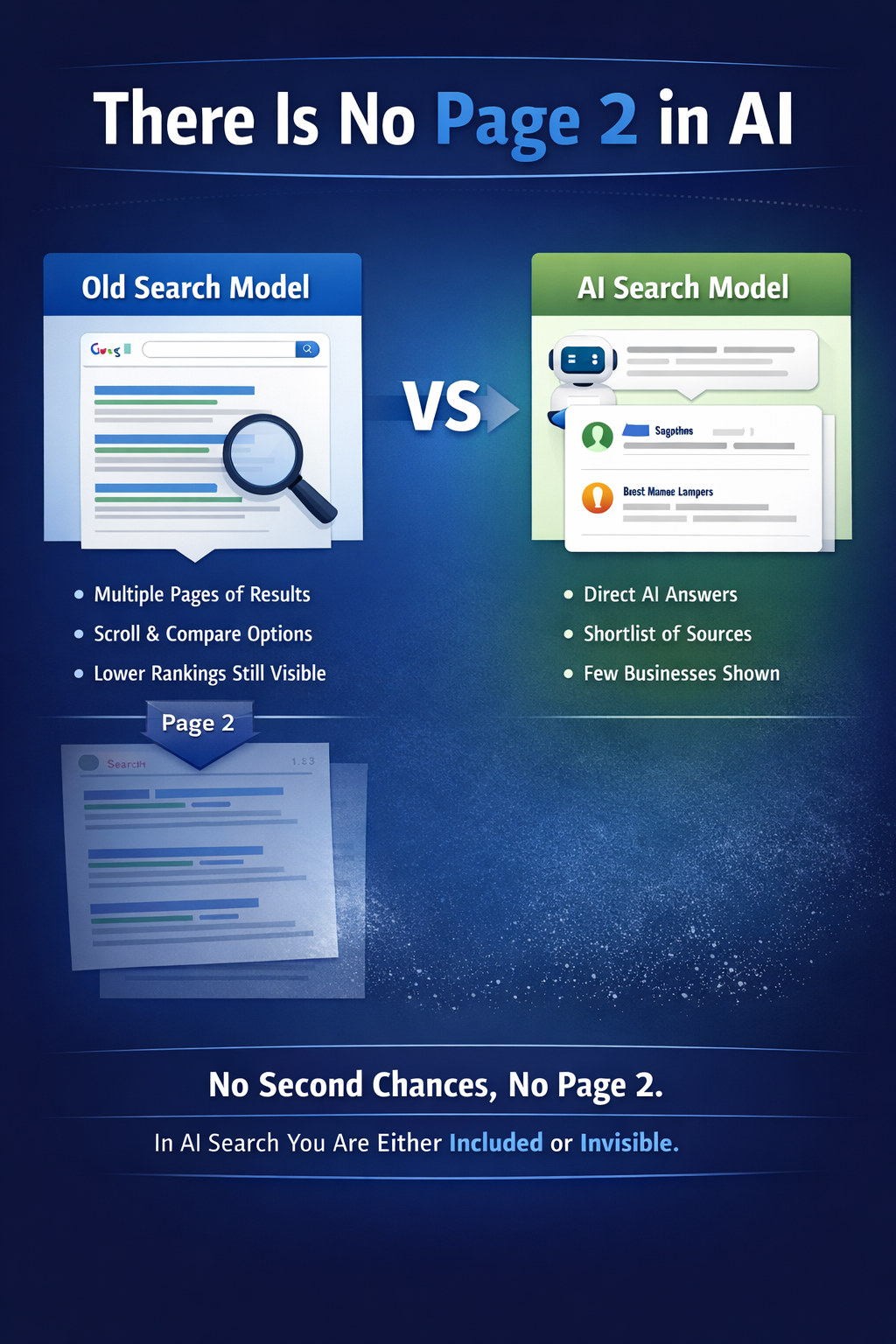
For years, businesses understood digital visibility through a familiar model. Page one mattered, the top three spots mattered more, and page two was where momentum usually died. Even so, the old search environment still gave companies multiple ways to be discovered. A buyer could scroll, refine a query, compare several websites, and continue researching until they found a provider that fit. Visibility was imperfect, but it was still layered.
- Page one captured most attention.
- Lower rankings could still produce some traffic.
- Long-tail searches created more opportunities to appear.
- Users often explored multiple results before deciding.
AI search changes that structure. Instead of presenting a long list of links, platforms like ChatGPT, Perplexity, Gemini, and Google AI-generated results often compress the market into a direct answer, a shortlist, or a few cited sources. That means the old idea of “we may not rank first, but we still show up” starts to break down. In many AI-driven experiences, there is no meaningful second page for a business to fall back on.
- AI often summarizes instead of listing.
- Fewer companies are surfaced to the user.
- The platform narrows the field before the click.
- Being absent matters more than being slightly lower.
In AI search, you are not just competing for rank. You are competing for inclusion.
This creates a harder environment for companies that still think in traditional SEO terms. In the past, a business could survive with broad keyword coverage, a decent position for service terms, and a website that was “good enough.” Now the question is different. AI systems are trying to decide which businesses are worth including in the answer itself. If your company is not part of that answer layer, you are not simply ranking lower. You are functionally invisible in that interaction.
- Ranking is no longer the only goal.
- Inclusion becomes the real threshold.
- “Good enough” content is easier to ignore.
- Visibility is increasingly tied to machine confidence.
Why Most Websites Get Left Out
That is why structure matters so much now. Many websites still hide their best information inside PDFs, image-heavy pages, vague service copy, or disconnected site architecture. A company may have real experience, strong technical knowledge, and a solid reputation, but if that expertise is difficult for AI systems to extract and verify, it may never become part of the response. In that sense, AI visibility is not just about having knowledge. It is about making knowledge retrievable.
- PDFs are harder to surface cleanly.
- Images without supporting text lose context.
- Thin service pages weaken extractability.
- Poor architecture breaks topical relationships.
Old Search Model
- Blue links
- Multiple pages of results
- Users compare many options
- Ranking lower still had value
AI Search Model
- Compressed answers
- Shortlisted sources
- Machine-filtered visibility
- Omission often means invisibility
What AI Is Actually Looking For
This is where Answer Engine Optimization becomes more important than many business owners realize. AI systems are not just matching keywords. They are trying to understand who you are, what you do, what specific problems you solve, and whether your claims can be trusted. Clear service pages, strong factual language, structured data, supporting content, and consistent third-party signals all improve the odds that your company will be recognized as a credible source.
- AI looks for clarity, not just keywords.
- Entity consistency increases trust.
- Structured content improves extraction.
- Supporting signals help validate expertise.
The encouraging part is that this shift does not automatically reward only the biggest brands. It often rewards the clearest brand, the most organized brand, and the one with the easiest information to cite. That gives smaller specialized companies a real opening. A focused firm with excellent content architecture and strong entity signals can outperform larger competitors whose websites are still built for yesterday’s search habits.
- Smaller specialists can still win.
- Clarity can beat size.
- Good architecture creates leverage.
- Strong entity signals support inclusion.
The Real Shift
There is no page two in AI. There is only the answer layer and everyone left out of it. Businesses that understand this early will stop optimizing only for traffic and start optimizing for inclusion, retrievability, and trust.
What Businesses Should Do Now
The companies that adapt fastest will not be the ones publishing the most content for the sake of volume. They will be the ones building pages that are easier to understand, easier to verify, and easier to cite. That means treating website structure, entity consistency, service clarity, and supporting proof as part of the same system. AI visibility is becoming less about being present somewhere on the web and more about being confidently selected.
- Build service pages around real buyer questions.
- Turn hidden expertise into readable HTML content.
- Support claims with specifics, not vague language.
- Strengthen entity validation across third-party sources.
- Organize content so AI can connect topics and services clearly.
Final Thoughts
There is no page two in AI. The old fallback visibility that many businesses relied on is shrinking, and the cost of being unclear is getting higher. Companies that still treat their website like a digital brochure may find that they are not being outranked so much as excluded. The future belongs to businesses that make their expertise easy to extract, easy to trust, and easy to include in the answer itself.
Need a website built for AI visibility, not just old-school rankings?
Tampa Web Technologies helps businesses structure their content for retrievability, authority, and modern search behavior.
Frequently Asked Questions
What does “There is no page 2 in AI” mean?
It means AI platforms often do not present users with long lists of results. Instead, they summarize the market into a direct answer, shortlist, or cited set of sources. If your business is not included, you may not be seen at all.
How is AI visibility different from traditional SEO?
Traditional SEO focused heavily on ranking position across search results. AI visibility depends more on whether your content is structured clearly enough to be extracted, understood, and trusted as part of an answer.
Can smaller companies still compete in AI search?
Yes. AI often rewards clarity, structure, and credibility over sheer size. Smaller specialized firms can gain visibility when their expertise is easier to cite and verify than larger competitors with poorly organized websites.
What should a business fix first?
Start with service-page clarity, crawlable HTML content, strong internal structure, and better entity consistency across your website and third-party profiles. Those are foundational for both SEO and AI retrievability.