Reading on Google?
Add Tampa Web Technologies as a preferred source to see more of our AEO and SEO research in your Top Stories.

The UK’s Competition and Markets Authority (CMA) is taking a massive victory lap. In what it loudly proclaims as a “world-first” antitrust triumph, the watchdog has officially ordered Google to allow news publishers and media websites to opt out of having their content scraped for AI Overviews and AI Mode—all without being penalized in traditional search rankings.
Pop the champagne, right? The free press is saved.
According to The Guardian, the watchdog swooped in after legacy publishers spent months “complaining about a drop in click-through traffic and revenue” caused by Google’s Gemini-powered summaries. The narrative is neat: big bad tech steals data, heroic regulator forces a “No-Retaliation” toggle in Google Search Console, and balance is restored to the digital force.
Except, it’s a total illusion. The CMA hasn’t leveled the playing field; they’ve legally protected a publisher’s right to be completely invisible. By focusing entirely on rescuing the traditional “blue link,” both the regulators and the publishers have proven they are fundamentally out of touch with how the internet works in 2026.
Here is why this historic ruling is actually a masterclass in bureaucratic irrelevance.
1. Protecting a Bankrupt Currency
The CMA’s grand prize is ensuring that if a publisher opts out of AI search, Google cannot downrank their traditional organic blue links. But here’s the reality check: the blue link economy is dead anyway.
When an AI Overview or AI Mode interface dominates the top of a smartphone or desktop screen, user behavior fundamentally changes. It triggers a massive wave of “zero-click searches”—the user gets their summary, gets their answer, and leaves. Recent data shows that when an AI Overview is present, click-through rates to source websites plummet by up to 60%.
The CMA has successfully fought for the right of premium publishers to hold the #1 organic spot on a part of the page users no longer scroll to. It is the legal equivalent of fighting for prime horse-and-buggy parking spaces at Heathrow Airport.
2. The Death of the Clickbait Tax
There is a poetic justice to this traffic drop that publishers refuse to admit: AI search has effectively broken the clickbait business model. For over a decade, digital media has forced users to play a exhausting game of hide-and-seek. Headlines like “You’ll Never Guess What This New Policy Means For Your Taxes” or “This Common Habit Is Ruining Your Sleep, Study Finds” were engineered precisely to conceal the actual answer behind a wall of introductory fluff, intrusive ads, and cookie banners.
AI Overviews simply extract the hidden fact, present it upfront, and let the user move on with their day. By throwing a tantrum over lost click-throughs, publishers are essentially mourning their ability to hold basic information hostage for ad impressions. The user doesn’t want to read a 1,200-word article to find out if it’s going to rain tomorrow or what time a kickoff is; they want the answer. AI gives it to them instantly, bypassing the clickbait tax entirely.
3. The “Infinite Substitute” Loophole
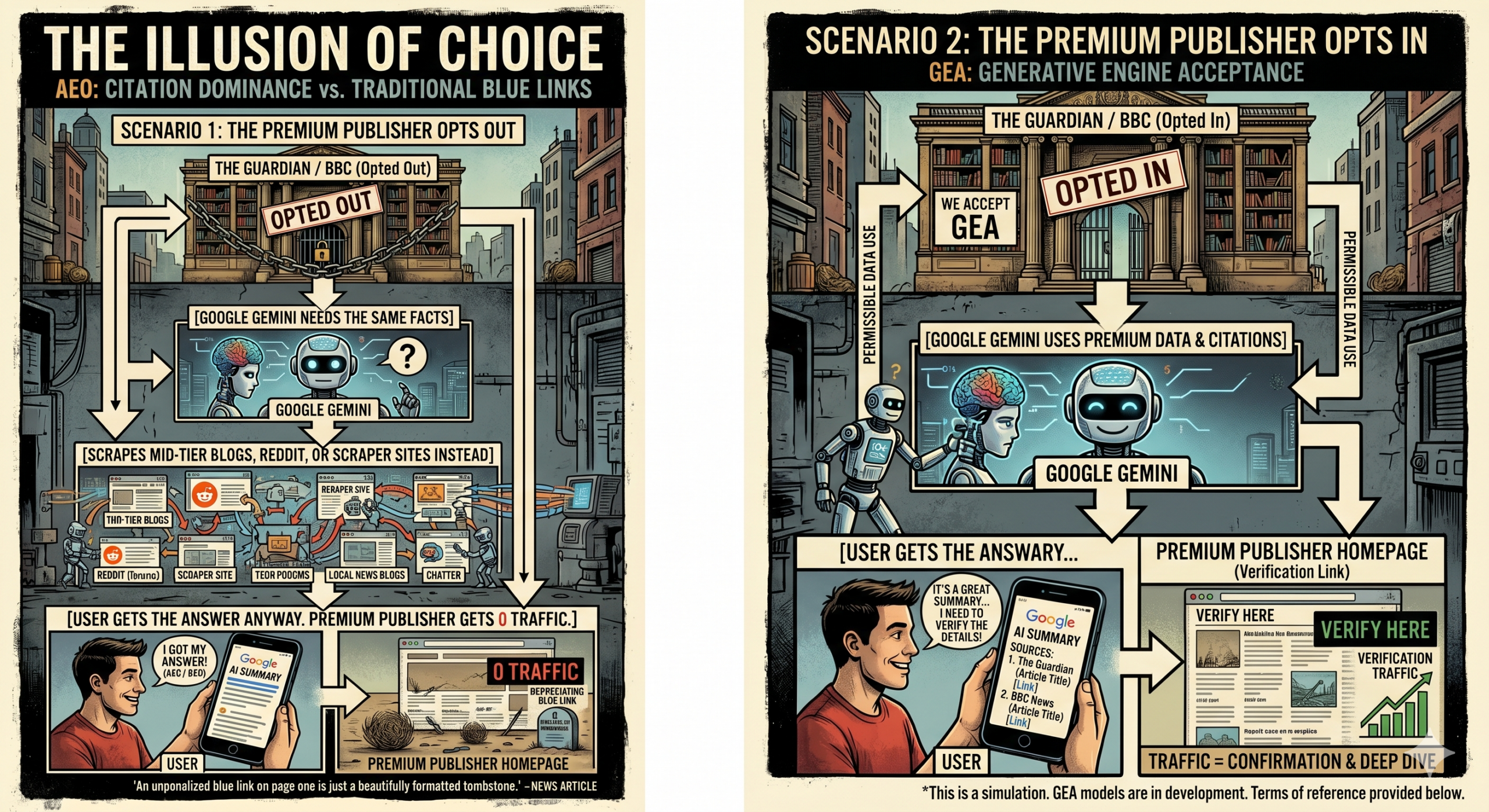
The regulatory framework assumes that if a major outlet like The BBC or The Telegraph flips the “opt-out” switch, Google’s AI will suddenly find itself starved of facts, forcing the tech giant to crawl back with a fat licensing check.
It completely misunderstands how modern Large Language Models (LLMs) operate. News and information on the open web are commodities. If the premium tier opts out, Gemini’s algorithms don’t just stop answering questions about UK politics or global events. The system will simply route around the digital blockade.
Google’s AI doesn’t need Pulitzer-prize-winning prose to summarize a factual event; it just needs the data points. If a premium site opts out, Google will simply scrape a mid-tier blog, a Reddit thread, or a scraper site that hasn’t toggled the switch. The user gets their answer anyway, Google keeps the user on their platform, and the premium publisher gets zero traffic. By opting out, a publisher doesn’t hurt Google—they merely isolate themselves.
4. The Real Failure: Publishers are Playing the Wrong Game
If publishers are genuinely throwing tantrums over missing referral traffic, they are fundamentally working the algorithm wrong. Legacy media is treating AI like an intruder to be blocked rather than an ecosystem to be optimized. In the age of Answer Engine Optimization (AEO), the goal is no longer to horde users behind a traditional URL storefront. The goal is citation dominance.
The smart publishers aren’t opting out; they are opting in and engineering their content to pull in high-weight AI citations. When an AI summary provides an answer, users still look for a premium, trusted brand name attached as a footnote to verify the details or deep-dive into the nuance. If a brand’s name and authoritative entities are constantly cited as the underlying trust-anchors inside Gemini, they build entity authority and capture high-intent “verification traffic.” Opting out doesn’t claw back the traffic of 2018; it just ensures your brand name is never spoken by the primary interface of tomorrow.
The Bottom Line The CMA’s ruling did not save digital journalism; it gave it a beautifully formatted tombstone. By giving publishers a technical escape hatch from AI while completely deferring binding rules on actual financial licensing compensation, the regulator has handed Google a massive victory wrapped in an antitrust bow. Publishers who use this toggle out of spite aren’t hurting Big Tech—they are just committing digital suicide in the name of a blue link that nobody is clicking anyway.

David Chamberlain is a search strategist and founder of Tampa Web Technologies, where he focuses on the intersection of AI and search visibility. His work centers on Answer Engine Optimization (AEO), Generative Engine Optimization (GEO), and the structural changes reshaping how businesses appear in AI-driven results. David has 17 Years of Tech Experience.
He writes regularly on AI search updates, industry shifts, and the evolving dynamics of zero-click discovery, providing analysis designed for business leaders and technical teams.