
Traditional gated PDFs and form-first lead capture are structurally incompatible with AI search. Here is what is happening, why it matters, and what a modern content architecture looks like.
The Model That Used to Work
For most of the 2010s, the inbound playbook was clear: produce high-quality content, gate it behind a form, capture an email, nurture the lead, hand off to sales.
It worked because search engines rewarded domain authority and backlinks. Buyers used Google, clicked through to landing pages, and filled out forms in exchange for expertise they couldn’t find elsewhere. HubSpot built an industry around this logic. Agencies built entire revenue models on it.
The mechanism was sound — at the time.
What AI Search Changes
AI assistants — ChatGPT, Perplexity, Gemini, Claude — do not return a ranked list of links. They extract answers from content they can read, parse, and verify.
The underlying behavior resembles retrieval-augmented generation (RAG): the system identifies relevant sources, extracts structured information, and synthesizes a response. The user never sees your landing page. They receive a distilled answer, sometimes with a citation, sometimes without one.
This is a structural shift, not a trend.
“If AI can’t read it, it can’t recommend it.”
The implication for gated content is severe and largely unacknowledged.
Two Problems Compounding Each Other
The Gating Problem
AI does not fill out forms. It cannot accept cookies, navigate a consent wall, or submit an email address in exchange for a PDF download.
When your most authoritative content sits behind a form, it is functionally invisible to every AI retrieval system operating today. Your competitors who published the same information as open HTML are being cited. You are not.
This is not a hypothetical future risk. It is happening now, in every industry where AI-assisted search is replacing the first two pages of a Google query.
The PDF Problem
PDFs are binary containers. They are designed for print fidelity, not machine readability. Compared to structured HTML, PDFs present multiple extraction problems:
- Pages fragment continuous arguments into discrete units
- Many require OCR to extract text at all
- Heading hierarchy is visual, not semantic
- There is no native support for structured schema (Article, FAQ, CreativeWork)
- Paragraph boundaries are ambiguous to parsers
Note: PDFs are not bad. They are a poor primary surface for discovery. None of these limitations matter for a document intended for print or archival. They matter enormously when a PDF is your primary discovery asset.
The Fake Lead Economy
There is a downstream consequence of friction-first lead capture that rarely gets discussed directly.
When a buyer is genuinely interested in your methodology or results, and you put a form in front of them before delivering any value, a significant percentage will submit a burner email address. They want the content. They do not want the follow-up sequence.
The result is a CRM pipeline full of leads that were never real. Sales teams spend cycles chasing addresses that route to Mailinator. Marketing reports MQL counts that overstate actual intent by a substantial margin.
“Agencies think they are generating leads. They are often generating friction.”
The gated PDF did not fail because the content was weak. It failed because the gate destroyed the trust relationship before it could form.
The Visibility Gap
AI systems select sources based on signals that favor open, structured content:
- Clean HTML with semantic heading hierarchy
- Short, extractable paragraphs with clear topic sentences
- Schema markup — FAQ, Article, HowTo
- Consistent entity coverage (named technologies, methodologies, industries)
- Pages that resolve without authentication or consent flows
Content that lacks these properties — regardless of its quality — loses citation share to content that has them. The visibility gap between a well-structured HTML page and a gated PDF is not minor. It is nearly total.
A competitor publishing mediocre analysis in clean, open HTML will be cited by AI more frequently than your rigorous case study locked behind a form.
The Modern Framework: AEO-First Lead Capture Architecture
The solution is not to eliminate lead capture. It is to restructure the sequence. Value delivery comes first. Trust is built on the page. Conversion is offered after the reader has already received something useful.
The full case study, methodology, or analysis lives as an open, structured HTML page — no gate, no form. Semantic heading hierarchy, short extractable paragraphs, FAQ and Article schema, and a concise summary at the top. This is the surface AI retrieves from. It earns citations and drives organic discovery.
After substantive value has been delivered — typically 60–70% through the page — a lightweight capture mechanism appears. Not a wall. An offer. Simple email input, framed as access to a deeper asset or related analysis. The reader has already received value. The ask is proportionate. Conversion rates on this model consistently outperform top-of-page gates.
The downloadable asset — an ROI calculator, strategy template, or scored checklist — lives here. This is what used to be the gate. It is now the reward. It can still require an email. At this point, the reader has consumed a full authority page, understands your methodology, and is making a deliberate choice to go further. That is a real lead.
The sequence: Value first → Trust second → Conversion third.
The AI Mirror Page Concept
For organizations with existing PDF libraries, the path forward does not require discarding existing assets.
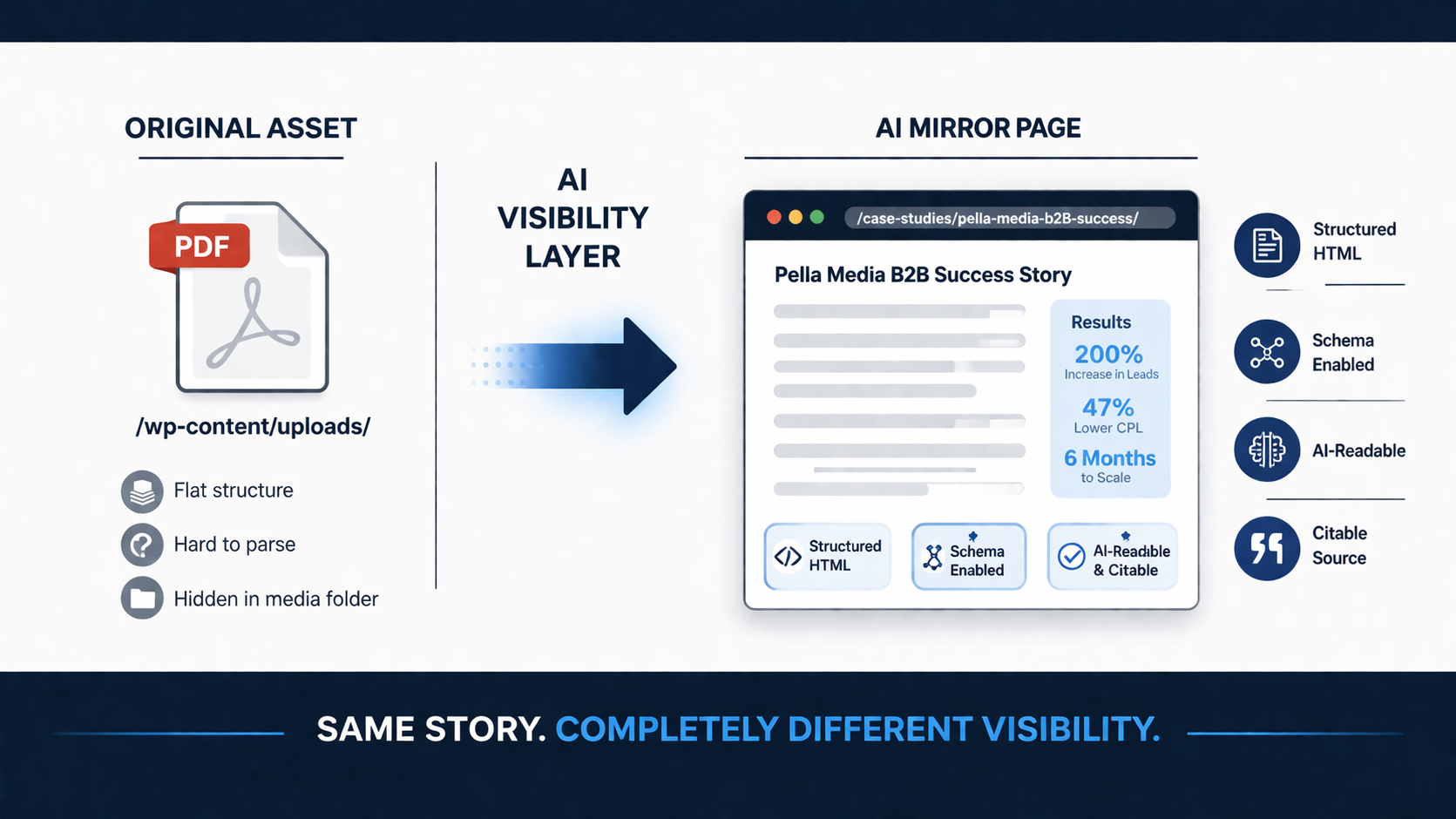
Every significant PDF should have an HTML mirror: a structured web page that presents the same analysis, findings, and conclusions in machine-readable form. The PDF becomes a secondary artifact — appropriate for download, printing, or formal distribution. The HTML page becomes the primary discovery surface.
“Same story. Completely different visibility.”
This applies to case studies, white papers, research reports, methodology documents, and any other asset currently living only inside a binary container.
Old Model vs. AEO-First Model
| Dimension | Old Model | AEO-First Model |
|---|---|---|
| Content format | Gated PDF | Open HTML page |
| Primary audience | Human, post-form submission | Human + AI retrieval systems |
| AI visibility | None | Full |
| Lead quality | Mixed; high burner email rate | Higher intent; trust established first |
| Conversion timing | Before value delivery | After value delivery |
| Schema support | None | Article, FAQ, CreativeWork |
| Trust sequence | Form → content → trust | Content → trust → form |
| Citation potential | Zero | High |
- If your best work lives in a PDF, it is not participating in AI search
- AI favors structure over format — clean HTML wins regardless of content quality
- Visibility now happens before the click; AI answers replace the consideration stage for many buyers
- Trust is built before the form in any model that converts at scale
- The fake lead problem is a structural consequence of friction-first architecture, not a data quality issue
- Every major PDF in your library should have an HTML mirror with schema markup
- The sequence has permanently shifted: open surface, then soft capture, then asset delivery
The agencies and B2B firms that adapt to this shift will not necessarily produce more content. They will produce content that AI can trust, parse, and recommend — before a buyer ever types a query into a search bar.
The gated PDF was a product of a specific information environment. That environment no longer exists.
“The firms that win the next five years of B2B discovery will be the ones who understood that visibility is not something you earn after someone finds you. It is what determines whether they find you at all.”
Questions about AI search and gated content
AI retrieval systems cannot submit forms, accept cookies, or authenticate through lead capture walls. When your content sits behind a gate, the AI crawler simply cannot access it — regardless of its quality.
Beyond the gate itself, PDFs present additional parsing problems: fragmented page structure, visual-only heading hierarchy, no native schema support, and frequent reliance on OCR. Open HTML is structurally far easier for AI to extract from.
No. The goal is to restructure the sequence, not eliminate lead capture. The AEO-First model delivers the full analysis as open HTML first, then offers a lightweight email capture mid-page after value has been delivered, and places a downloadable asset at the bottom for buyers ready to take action.
Value first, trust second, conversion third. Lead capture still exists — it just comes after the reader has a reason to trust you.
An AI mirror page is an open HTML page that presents the same content as an existing PDF — the same analysis, findings, and conclusions — in a structured, machine-readable format. The PDF becomes a secondary artifact for download or printing. The HTML page becomes the primary discovery surface.
To create one: publish the content as a standard WordPress page with proper H2/H3 heading hierarchy, short paragraphs, and FAQ or Article schema. Add a download link to the original PDF at the bottom. Same story, completely different visibility.
AI retrieval systems favor content that is open and accessible, structured with semantic HTML headings, written in short extractable paragraphs, marked up with schema (Article, FAQ, HowTo), and free of authentication or consent barriers.
Content quality matters, but structure and accessibility are prerequisites. A mediocre competitor with clean, open HTML will be cited more frequently than a rigorous analysis locked in a gated PDF.
It generates higher-quality leads with a lower volume of junk. When a buyer reaches the mid-page soft gate, they have already read your methodology, seen your results, and formed a view on your expertise. The email they submit is a deliberate act, not a toll paid to see the content.
The traditional gated model inflates CRM pipelines with burner addresses from buyers who wanted the PDF but not the follow-up sequence. The AEO-first model eliminates most of that friction-generated noise.
No. This applies to any B2B or industrial company whose buyers use AI assistants to research vendors, compare options, or diagnose problems before making contact. That now includes procurement across manufacturing, professional services, co-packing, marine, HVAC, and most other specialized industries.
If a potential customer asks an AI tool about a problem you solve, and your content is gated or PDF-only, you do not exist in that answer. A competitor with open, structured content does.