
AEO Strategy — Visual Search
Most industrial companies optimize for keyword searches. A growing segment of their customers never types a keyword at all — they point a phone at a machine tag and ask Google what it is. Here is how that behavior works, and how to be the result that comes back.
The behavior most SEO strategies miss
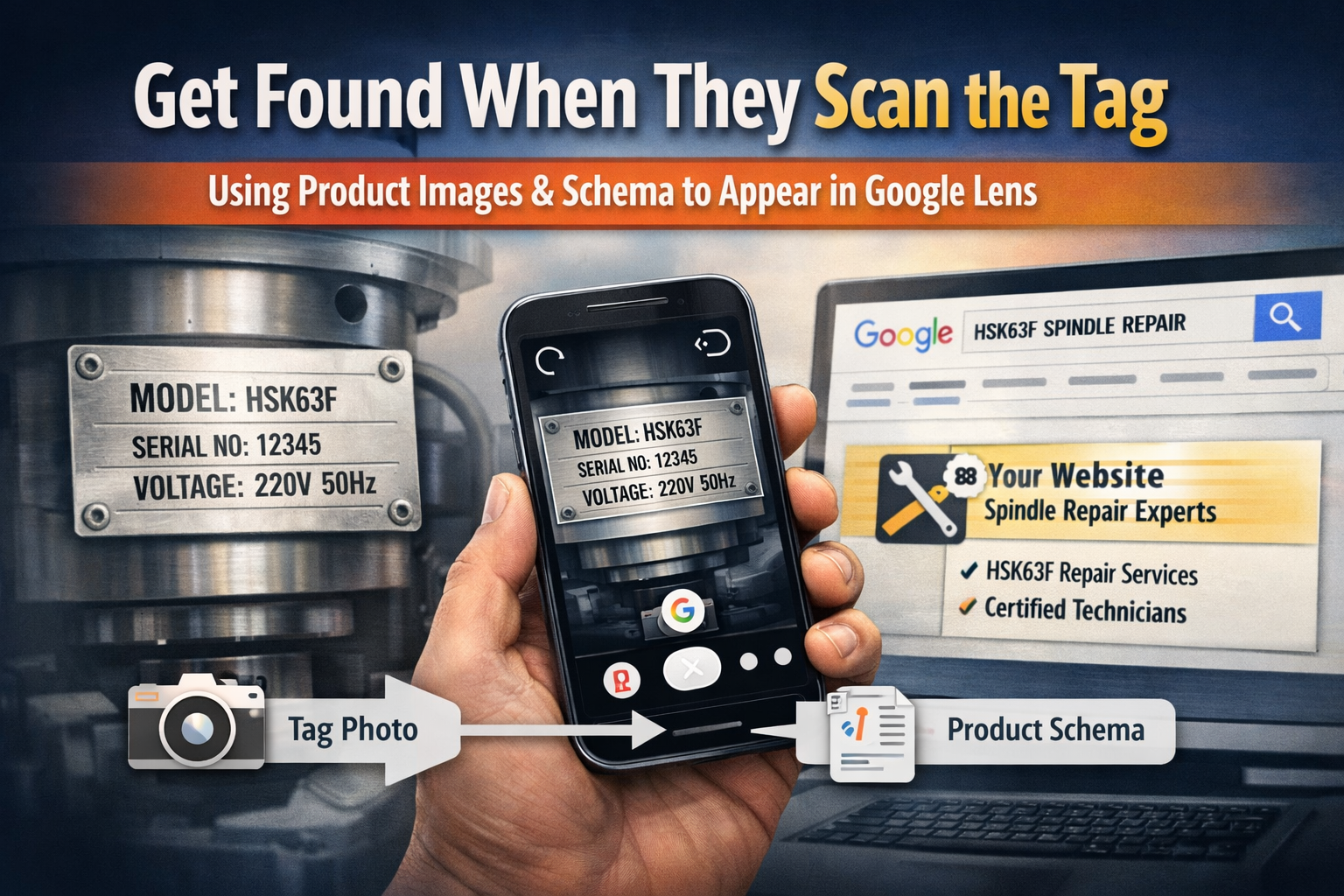
In industrial environments, the search doesn’t always start at a keyboard. A maintenance tech finds an unfamiliar spindle, a shop manager inherits equipment without documentation, a buyer needs to verify a part number before ordering. They pull out their phone, open Google Lens, and scan the nameplate.
Google reads the tag, identifies the brand and model, and returns results — product listings, manuals, support content, and service providers. If your business covers that model and your site has the right content and images, you can be one of those results. Most of your competitors are not thinking about this at all.
How Google Lens processes an equipment tag
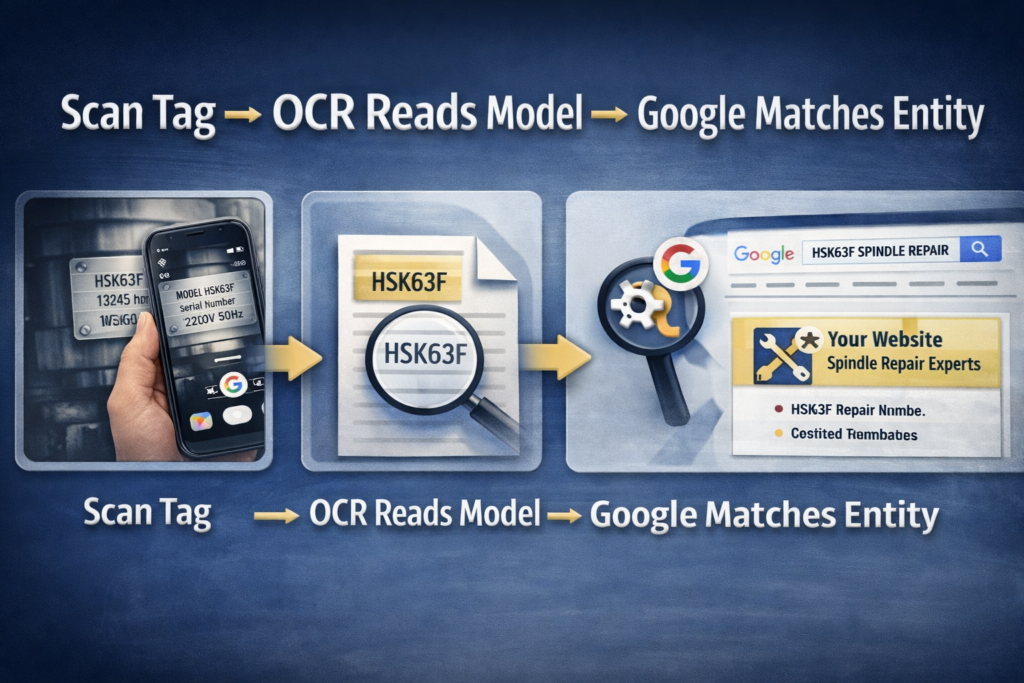
When someone scans a machine nameplate, Google runs the image through OCR to extract visible text, identifies the brand and model from that text, and matches it against indexed pages that contain that model. The search is effectively triggered by the physical world rather than by deliberate query construction.
| Step | What Google does | What this means for your site |
|---|---|---|
| 1. Image captured | OCR extracts text from the tag | Model numbers on your pages must match exactly |
| 2. Entity identified | Brand and model matched to known entities | Your page needs to name the model clearly |
| 3. Results ranked | Indexed pages with matching content surfaced | You need a dedicated page for that model |
| 4. Service providers shown | Repair, support, and parts pages included | Your service content must be present and indexed |
Why equipment tags are high-value visual assets
A machine nameplate is one of the most information-dense images you can publish. It typically contains the manufacturer name, model number, voltage or speed specifications, and a serial number — exactly the data Google uses to match a scan to indexed content.
Most industrial companies have access to these tags and never photograph them. The ones that do, name the files correctly, write proper alt text, and build matching pages around that content are positioned to capture searches that competitors cannot even see coming.
Real images vs. stock photos — why it matters
Stock photos and AI-generated images do not help here. Google Lens recognition improves significantly with full, clear images of actual equipment — particularly tags and nameplates. Abstract or partial images return poor results. The asset you need is a photograph of the real thing, taken well enough that the text is readable.
| Image type | Recognition strength | Notes |
|---|---|---|
| Full equipment tag / nameplate | Strong | Model number and brand both visible — highest match rate |
| Full equipment, tag visible | Good | Object recognition and text extraction both work |
| Equipment without tag visible | Moderate | Shape recognition only, no model matching |
| Stock photo or AI image | Poor | Generic — no entity matching, no model signal |
| Cropped or blurry tag | Poor | OCR fails on unreadable text |
What schema actually does in this context
Schema markup does not make Google “see” an image better. What it does is help Google understand what a page is about, what the image represents, and how the content connects to a specific entity — in this case, a piece of equipment by a known manufacturer and model number.
When combined with a real image, exact model naming, and service-relevant content, schema reinforces the connection between your page and the entity Google identified from the scan. It is a supporting layer, not the primary signal — but it adds specificity that unstructured content cannot.
Real image + readable model number + matching page content + schema = the strongest combination for visual search visibility.
Practical implementation — what to do right now
1. Photograph the equipment tag
- Shoot the full nameplate — do not crop tight to just the model number
- Text must be fully readable — use good lighting, avoid glare
- Capture the tag in context on the equipment where possible
2. Name the file correctly
Use the exact model number in the filename. Example: omlat-hsk63f-spindle-nameplate.jpg — not IMG_4821.jpg. The filename is read by search engines and contributes to entity matching.
3. Write specific alt text
Alt text should describe exactly what is in the image, including the model number. Example: Omlat HSK63F spindle nameplate showing model 06398050 and serial number specifications.
4. Build a matching page
The page must contain the exact model name, common name variations, a clear explanation of what the equipment is, and relevant service or repair content. The image and the page content need to tell the same story.
5. Add schema as the support layer
Use TechArticle or Article schema. Include the image URL, the model name, and the service context. This reinforces the entity connection Google already made from the image and page content.
Why this matters more for industrial businesses
Industrial equipment has nameplates. Every machine your customers work on carries a manufacturer name, a model number, and specifications in a standardized format. That is a structural advantage that consumer-facing businesses do not have.
A maintenance tech scanning a spindle tag is not browsing. They have a specific piece of equipment in front of them and a specific problem. The business that shows up at that moment — with a real image of that tag, a page about that model, and service content that addresses that situation — is in the conversation before a single keyword is typed.
Frequently asked questions
Does Google Lens actually return service provider results?
Yes. When Google identifies a piece of equipment from a scan, the results can include repair services, parts suppliers, and technical documentation — not just product listings. The condition is that your page exists, covers that specific model, and is indexed. Most service providers do not meet these conditions because they have never published model-specific content with real images.
Does schema markup improve image recognition?
No. Schema does not affect how Google processes the image itself. What it does is help Google connect your page to the entity it already identified through OCR and image recognition. The image and page content do the recognition work; schema does the attribution work.
Do I need one page per model, or can I list multiple models on one page?
Dedicated pages per model perform better for this use case. When Google matches a scan to a specific model number, it is looking for a page that clearly and specifically addresses that model — not a page that mentions it in a list of fifty others. A dedicated page allows you to include the real tag image, exact model naming, relevant failure scenarios, and service content all in one place.
What makes a tag photograph usable for this purpose?
The text on the nameplate needs to be readable — not necessarily perfect, but clear enough for OCR to extract the model number and manufacturer name. Full frame, no glare obscuring text, sufficient resolution that characters are distinguishable. A basic smartphone camera in decent light is sufficient. The failure mode is almost always glare or motion blur, not camera quality.
How does this relate to traditional SEO?
Visual search is a trigger mechanism, not a ranking system. The page that surfaces in a Google Lens result still has to be indexed and relevant — the same fundamentals apply. What changes is how the search is initiated. A page that is well-optimized for a specific model will benefit from both traditional keyword searches and visual scans of that model’s nameplate. The strategies are complementary.
Which industries are best positioned to benefit from this?
Any industry where the equipment or product carries a visible manufacturer tag. Spindle repair, CNC machine service, HVAC equipment, commercial appliance repair, and industrial motor service are strong candidates. The common thread is that the customer is physically present with a labeled piece of equipment and has an immediate need.