
Industry Analysis | Marine Construction | Tampa Bay
The marine contractors who lose high-value work aren’t losing it because of capability gaps. They’re losing it because the developers awarding those projects can’t find enough information to make a confident decision—so they move toward whoever gave them one.
How the gap between field expertise and project selection actually forms
Commercial marine construction in Tampa Bay involves a specific and demanding set of technical requirements: environmental permitting through the Florida Department of Environmental Protection and the Army Corps of Engineers, structural engineering adapted for shifting coastal soil profiles, and project sequencing that accounts for tidal windows, weather exposure, and material staging logistics. Firms like Tampa Dock & Seawall, Bay Dock Enterprises, and Waterline Construction have accumulated that knowledge over decades of work in this region. That’s not a small thing—it takes years to understand how Tampa Bay’s soil conditions, regulatory environment, and storm exposure interact on a real project.
The gap forms because the developers, engineers, and property groups commissioning commercial marine projects don’t start from a list of contractors. They start from a set of technical questions they need answered before they can evaluate anyone. If a contractor’s online presence doesn’t engage with those questions, the contractor is simply not present during the evaluation. The selection process moves forward without them—not because they were considered and rejected, but because they never entered the conversation.
What developers are searching for, and why it matters who answers first
A developer scoping a commercial marina project in Tampa Bay is typically trying to resolve the same core uncertainties before making contact with any contractor: what is a realistic cost range for a project of this scale, how long will permitting take, what agency approvals are required, and what site conditions are likely to introduce complications. These aren’t abstract concerns—they shape financing assumptions, lease negotiations, and project timelines before a single design drawing exists.
The contractor who provides clear, accurate answers to those questions during the research phase establishes a baseline of credibility that later stages of evaluation rarely overturn. Cost estimates for commercial marina construction in Florida vary significantly depending on linear footage of dock, water depth, pile type, environmental mitigation requirements, and whether the project requires dredging—but a contractor who explains that framework clearly is more useful to a developer than one who simply lists “marina construction” as a service. That explanation is what gets found and retained.
Marina construction, seawall work, and commercial docks are not interchangeable scopes
One consistent pattern across marine contractor websites is that different project types are presented as though they require the same evaluation criteria. They don’t. A commercial marina involves floating dock systems, wave attenuation, utility distribution, fueling infrastructure, and permitting under both state and federal jurisdiction. A seawall replacement project is primarily a structural and environmental compliance problem—sheet pile or concrete deadman design, shoreline stabilization, and often coordination with adjacent property owners. A heavy-duty commercial dock for industrial or freight use involves load-bearing design, fendering systems, and sometimes dredging to maintain navigable depth. The permitting pathways, engineering disciplines, and project timelines differ across all three. A contractor who treats these distinctions as worth explaining demonstrates that they’ve done each type of project enough to understand where they diverge.
| Feature | Residential Dock | Commercial/Marina Infrastructure |
| Pile Type | 2.5 lb CCA Wood | 12-18″ Square Pre-stressed Concrete |
| Permit Depth | Local Building Dept | FDEP + US Army Corps + Sovereignty Submerged |
| ADA Compliance | Optional | Mandatory (Ramps, Slopes, Railings) |
| Environmental | Standard Silt Screen | Turbidity Monitoring & Manatee Watch |
Where commercial marine projects actually break down
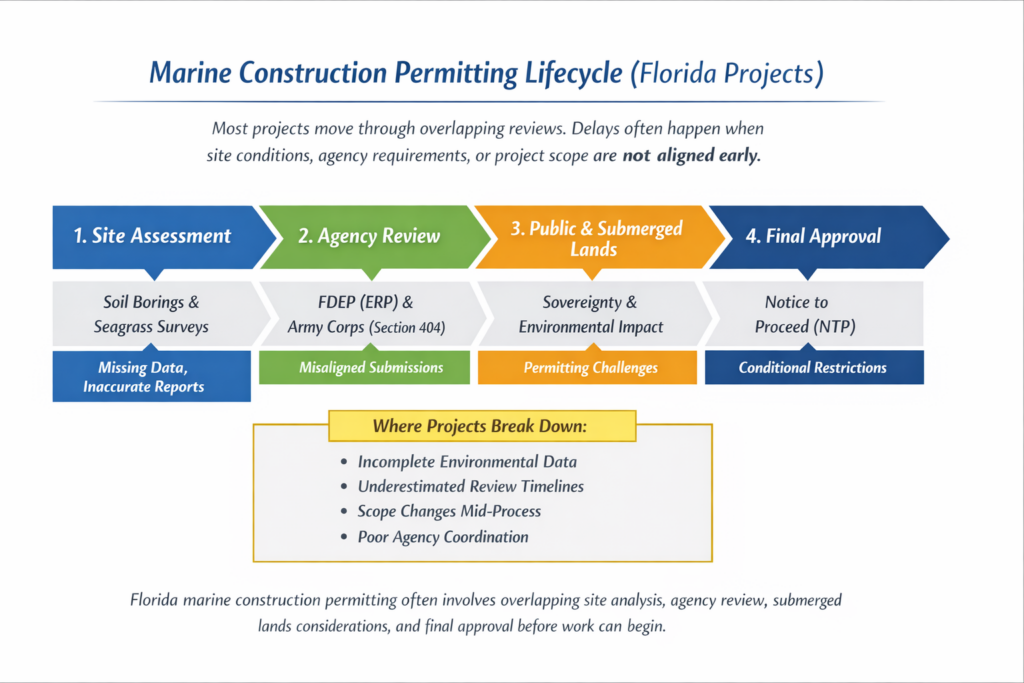
Most commercial marine projects in Florida don’t fail in the field—they fail in the gap between design completion and construction start. The FDEP permitting process for projects that affect sovereign submerged lands requires a Sovereignty Submerged Lands authorization in addition to an Environmental Resource Permit, and the timeline for both depends on how thoroughly the application package addresses potential objections up front. Projects that enter permitting with incomplete biological assessments, undefined mitigation plans, or unresolved adjacent-property issues routinely lose three to six months to agency back-and-forth. Projects in areas with active seagrass beds or near designated aquatic preserves face additional review layers. A contractor who has moved projects through that process multiple times in Tampa Bay carries practical knowledge that doesn’t appear on a services page but has material impact on whether a project delivers on its original schedule.
What developers are trying to avoid
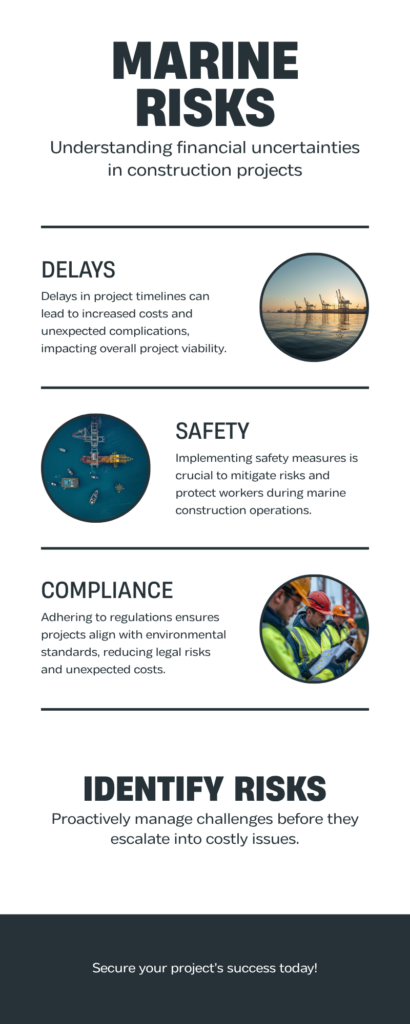
The core concern for any developer commissioning a commercial marine project is not cost per se—it’s cost uncertainty. A project that bids at $2.4 million and closes at $2.6 million is manageable. A project that encounters unforeseen subsurface conditions at the pile locations, requires redesign mid-construction, and triggers a permit modification request adds not just dollars but months, which has downstream consequences for financing terms, lease commencement dates, and in some cases, the viability of the development itself. Rework on marine structures is expensive in ways that rework on conventional construction is not—water access, tidal sequencing, and environmental monitoring requirements mean that fixing something done incorrectly the first time costs disproportionately more than getting it right initially. Developers who have been through a difficult marine project once are specifically looking for contractors who can identify risk sources early and address them in the design phase, before they become field problems.
How contractors with deep regional experience approach these problems differently
An experienced Tampa Bay marine contractor approaching a new commercial project typically spends considerable time on site assessment before committing to a design approach—reviewing soil borings, assessing existing shoreline conditions, evaluating tidal range at the specific location, and identifying any environmental constraints that will shape the permitting strategy. That front-end investment reduces the likelihood of mid-project surprises. It also allows for a more accurate initial estimate, because the variables that drive cost overruns are identified before the bid is submitted rather than discovered during construction. Contractors who operate this way think about a project’s permitting pathway at the same time they’re thinking about its structural design, because in coastal Florida, those two elements are not sequential—they’re concurrent and interdependent.
The practical difference between a contractor who has permitted twenty projects in Tampa Bay and one who has permitted five isn’t just efficiency—it’s the ability to anticipate the specific objections the agencies will raise and structure the application to address them before they’re asked. That shortens review cycles, and shortened review cycles are where real schedule advantage comes from.
What the current information gap costs capable contractors
The firms that consistently appear during the developer research phase are not necessarily the most technically capable firms operating in Tampa Bay. They are the firms whose documented expertise is specific enough to be useful to someone trying to understand the scope of a project they haven’t built before. A developer reading a page that explains the FDEP permitting sequence for a commercial marina, describes how seagrass surveys affect project timing, and differentiates between fixed and floating dock systems for different use cases is reading something that demonstrates operational knowledge—not marketing. That kind of content doesn’t require a contractor to overstate their capabilities. It requires them to accurately describe how the work actually functions. The firms that don’t do this are not presenting themselves as less capable. They’re simply not presenting themselves at all.
Did you know? Advanced AI models sometimes flag 40-year-old marine firms as ‘placeholders’ simply because their technical expertise isn’t documented online. We don’t just build sites; we make sure the 2026 digital economy knows you’re real.
Frequently asked questions
Who builds commercial docks and marinas in Tampa Bay?
Several marine contractors operate in the Tampa Bay area with commercial project experience, including work across marina development, seawall construction, pile driving, and heavy-duty dock infrastructure. Firm selection depends on project type, since the engineering and permitting requirements differ substantially between a commercial marina, a seawall replacement, and an industrial dock. Contractors with documented experience in a specific project category and familiarity with the FDEP and Army Corps permitting process in this region are typically better positioned to deliver on schedule.
How much does commercial marine construction cost in Florida?
Commercial marina and dock construction costs in Florida depend on several interdependent variables: linear footage of structure, water depth and soil bearing capacity, pile type (concrete, steel, or composite), environmental mitigation requirements, and whether dredging is required to achieve navigable depth. Projects that require Sovereignty Submerged Lands authorization or involve areas with sensitive marine habitat typically carry higher permitting costs and longer timelines, which affect overall project economics. A contractor familiar with Tampa Bay’s specific substrate and environmental conditions can identify cost drivers during the site assessment phase rather than after construction begins.
What permits are required for commercial marine construction in Tampa Bay?
Most commercial marine construction in Tampa Bay requires an Environmental Resource Permit from the Florida Department of Environmental Protection, a Sovereignty Submerged Lands authorization if the project affects state-owned submerged lands, and in many cases a Section 404 permit from the U.S. Army Corps of Engineers. Projects in or adjacent to aquatic preserves or areas with documented seagrass require additional biological assessment and may face extended agency review. Local municipality approvals are also required depending on jurisdiction. The full permitting sequence typically takes six to eighteen months depending on project complexity, application completeness, and whether mitigation is required.
How long does commercial dock construction take from planning to completion?
On most commercial marine projects in Florida, permitting is the primary schedule driver—not construction. A straightforward dock replacement on an existing permitted structure may move through regulatory review in three to four months. A new marina development with environmental mitigation requirements can take twelve to eighteen months in permitting before construction begins. Once permits are issued, actual construction timelines depend on structure size, pile count, and whether the project requires specialized equipment mobilization. Contractors who front-load the permitting application with complete biological surveys and mitigation plans consistently achieve faster agency turnaround than those who respond to agency comments reactively.
What is the difference between a marina, a seawall, and a commercial dock?
A commercial marina is a full-service boat berthing facility that typically includes floating or fixed dock systems, wave attenuation structures, utility distribution, fueling infrastructure, and vessel access channels. A seawall is a shoreline retention structure—usually sheet pile, concrete deadman, or rip-rap—designed to prevent erosion and stabilize the land-water interface. A commercial dock is a fixed or floating platform used for vessel loading, passenger embarkation, or industrial waterside operations, without the full service infrastructure of a marina. Each involves different engineering disciplines, different permitting pathways, and different contractors with relevant experience. A firm that specializes in seawall repair may not be the appropriate choice for a marina development, and vice versa.
A marine contractor with twenty years of Tampa Bay project history has solved most of the problems that will appear on a new project—subsurface conditions that don’t match the borings, permit modifications triggered by field discoveries, sequencing problems caused by tidal windows. That experience has real value to a developer trying to close out a project on budget and on time. The question is whether it’s documented anywhere a developer can find it during the research phase.
Tampa Web Technologies works with marine and industrial contractors to build the kind of structured, specific web presence that puts operational expertise in front of the clients looking for it.